Designing Commercial Interiors Beyond the Photo Moment
What Interior Designers Can Take From Theater
- Start with the experience a space should create, not only how it should look.
- Use story, sequence, and emotional beats to guide the user journey.
- Treat lighting, sound, motion, and reveal as atmosphere-building tools.
- Let camera-ready moments emerge from a strong physical experience.
If your commercial space isn’t telling a story, it’s just scenery. In an age where nearly every surface is engineered to be photographed, that distinction has never mattered more.
We all know examples of the phenomenon. The restaurant everyone wants a picture of, yet no one returns to twice. The boutique that goes viral for a weekend, only to feel oddly lifeless in person. Meanwhile, we cross oceans for a drink in Ibiza, climb narrow staircases for a single pastry in Paris, or return again and again to a favorite coffee shop where the sounds of the rush of steam and clink of cups feel inexplicably magnetic. The difference isn’t aesthetic. It’s emotional. It’s atmospheric. It’s narrative.
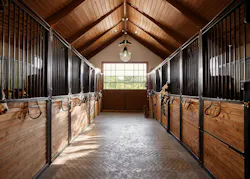
Today’s interior designers are under unprecedented pressure to craft highly recognizable, “Instagrammable” moments—the neon quip on the wall, statement color-blocking, obsessive symmetry. While these visual markers perform brilliantly online, they often flatten the depth and dimensionality of the physical environment.
A bar can be breathtaking in photographs, displaying a monolithic, backlit wall of bottles gleaming like a jewel box. But what happens when guests avoid it because it feels unapproachable? Or when it becomes so crowded that its beauty (and its function) collapses under its own ambition?
By designing “for the picture” rather than the purpose, we risk creating spaces that are stunning but sterile. More importantly, we work against one of commercial interior design’s core responsibilities: shaping environments that support how people move, gather, work, linger, and remember.
The need to fulfill the client’s goals can be the epicenter of the problem. When clients describe what they “want,” it often sits at the intersection of instinct and influence. The last beautiful rendering, AI-generated bar, lobby, or pop-up they saw online can influence their preferences more than they realize.
That doesn’t diminish the value of what they bring. Their true insight comes from lived experience, from knowing the way their environment flows. When a project tries too hard to reproduce an inspiration image, the actual purpose of the space can get lost. A beautiful concept still has to support circulation, staffing, maintenance, accessibility, safety, and the everyday behaviors of the people who use it.
This creates a real tension: How do we design spaces that inherently support the people who run them while crafting an atmosphere guests crave to return to? Too often, aesthetic ambition and functional heartbeat drift apart, leaving designers chasing clean visuals while operators absorb the inefficiencies that follow. The challenge isn’t choosing between beauty and usability; it’s in creating a world based on the needs of the people who inhabit it.
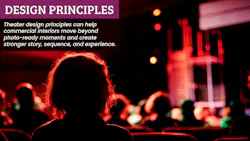
This is where a theater designer’s perspective becomes useful. Theater is not built around isolated visual moments; it relies on sequence, expectation, emotion, and payoff. Every element has a role in the audience’s journey. Applied to commercial interiors, that mindset can help designers move beyond image-making and toward spaces that unfold with purpose.
Theater designers have long understood that atmosphere is constructed through more than scenery. Light, sound, movement, timing, and reveal all work in tandem to guide how an audience feels.
Imagine:
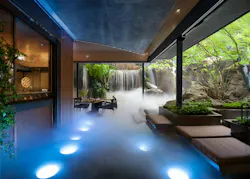
- A spa where projected light creates the sensation of water and reflection without relying on literal water features.
- A botanical conservatory where directional audio, such as birdsong, adds depth and orientation to the guest experience.
- A hospitality or wellness space where low-lying fog, motion, or subtle reveal creates ambiance without overwhelming operations. Carefully curated kinetic architectural elements, such as ceilings that softly open or sculptures that subtly move, to enhance wonder and delight.
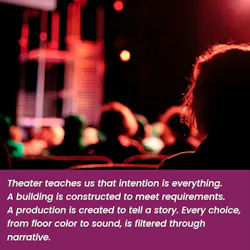
These tools were built to manipulate perception, trigger memory, and heighten emotion. When integrated into architectural practice, they offer designers an expanded palette—one that extends beyond material and form to include the atmospheric.
Still, even the most advanced technologies can fall flat when used as features instead of narrative threads. A lighting effect is not inherently meaningful. A kinetic sculpture is not inherently moving. When done without narrative intention, these techniques can feel decorative rather than immersive.
Theater teaches us that intention is everything. A building is constructed to meet requirements. A production is created to tell a story. Every choice, from floor color to sound, is filtered through narrative. Stage designers do not ask, “What looks good?” but rather “What deepens the world?” That discipline of storytelling is often what separates a photogenic space from one people experience and remember.
When commercial interiors adopt this ethos, experiential design becomes more intentional. From major theme parks to Las Vegas casinos, designers are increasingly using storytelling as a design strategy. Here’s where to start.
Step One: Begin with Story—Not Aesthetic
First, imagine the experience of your space. Picture yourself entering the space as a first-time guest. Where do you park? How are you ushered in? When do doors open, and what is the emotional beat of that moment?
Step Two: Identify Moments—Develop the Plot of Your Story
A design story follows the traditional story arc:
- Exposition—wherever your guests were before
- Inciting incident—they start to interact with your space
- Rising action—things get progressively more interesting
- Climax—the main reason they came is presented to them in a fantastic way
- Falling action—the return to normal, ideally with something changed
Identify these moments and look for opportunities to reinforce them throughout the journey.
Step Three: Start Early—This Story Cannot Truly Begin in the Middle
Theater productions begin with a concept meeting where all designers align on world, tone, and emotional arc. Share the design story with your team and invite interpretation. This clarifies what’s most important in a design, allowing the whole team to build upward from the same foundation instead of creating well-intentioned elements that pull against it.
Step Four: Collaborate—Don’t Dictate
Theater depends on generative collaboration: direction, design, performance, music, movement, and technical execution all inform one another. That same openness can strengthen commercial design teams. Many designers bring experience from theater or adjacent creative disciplines. Listen to their instincts; they are trained to feel the space before they draw it.
Step Five: Rehearsal—Walk the Space Again
Some of the best moments in a production are developed by reworking scenes over and over. Repeat step one from the perspective of different “main characters”: a first-time guest, a returning customer, a staff member, a facilities team member, or someone navigating the environment with accessibility needs. Ensure the space guides them the way the narrative intends.
Step Six: Encore—Capture the Moments for Social Media
Once the story and atmosphere are established, the camera moments will naturally emerge. Social media is not the enemy of good design; it becomes a problem only when it leads the process. When the physical experience is strong, the most shareable moments tend to feel discovered rather than staged.
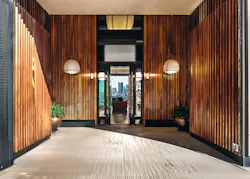
Of course, even the most immersive environments no longer live solely within their walls. The way a space is photographed, and by whom, can accelerate its cultural footprint, drawing in audiences who might never have discovered it otherwise. But the camera-ready moments that truly resonate aren’t manufactured; they emerge from spaces built around a clear emotional arc. When a design is anchored in narrative, the images practically compose themselves.
The difference between a striking image and a memorable project is the experience that surrounds it. Theater design reminds us that atmosphere is built through sequence, timing, emotion, and intention—not through spectacle alone. When commercial interiors are approached as stories people move through, every choice has a clearer role to play. The result is a space that can still photograph beautifully, but more importantly, one that gives people a reason to enter, stay, return, and remember.
About the Author
Paul R. Taylor
Paul R. Taylor works in Theatrical + Lighting at McClure Engineering, a mechanical and electrical consulting engineering firm dedicated to the development of innovative solutions to unique engineering problems. Paul helps create innovative technical solutions for performance venues, cultural institutions, and immersive environments. He has worked internationally with one of the world’s leading hospitality and entertainment companies, supporting the design, operation, and production of world-class shows and guest experiences. His background spans theatrical systems, architectural lighting, entertainment technology, and venue operations, giving him a unique perspective that blends creative vision with practical engineering. Passionate about the intersection of technology, storytelling, and design, Paul and the McClure Engineering team work to transform spaces into memorable experiences while delivering reliable, high-performing solutions for clients and communities.