The Business Case for Immersive Experiences in Commercial Interiors
What Designers Should Know
- Why immersive design is moving from novelty to strategic business tool
- How brands use experience to build identity, culture, and engagement
- What makes immersive spaces feel authentic—not overstimulating
- Where longevity, maintenance, and budget realities shape success
When we consider an interactive or immersive experience, the feelings and locations are often associated with entertainment. Meant to engage the senses and bring out curiosity and wonderment, popular unforgettable opportunities include the Sphere in Las Vegas, Disney’s Star Wars: Galaxy’s Edge, and the Van Gogh Exhibit.
Immersive entertainment is expected to hit $412.69 billion by 2030—up from an estimated $144.17 billion in 2025, at a CAGR of 23.41% during that time—according to market researcher Mordor Intelligence. It attributed the following among drivers for the boom:
- Engagement: Post-COVID consumer mindset shift to “experience over things”
- Technology:
-
- Availability of fast-maturing, location-based VR business models
- Growth of 5G/edge networks enabling real-time, multi-user AR overlays
- Finances: Experiential real estate investment trusts (REITS) began unlocking capital
Interior designers will increasingly be expected to architect these experiences, blending the physical and digital into one. As they become more commonplace, immersive experiences are tasked with creating a sense of place (the engagement) through the presentation (the technology), which in turn can drive business, brand loyalty, and growth (the finances).
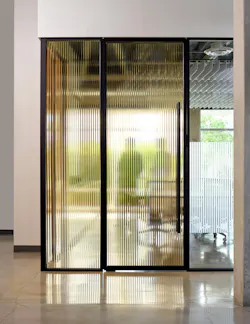
Forward-thinking designers are moving beyond flat, static spaces that blend into a background, enveloping a person with their surroundings to tell a story that creates authentic connection. And it’s happening across markets beyond entertainment, bringing new value to high-profile corporate environments.
Establishing Corporate Intent and Identity
In practice, this shift is already making an impact on corporate interiors. As those digital-physical lines blur, a company lobby adorned with posters featuring historical advertisements can seem dated, and corridors that display a brand’s values in large type may lack appeal. Static engagements are making way for a feast of the senses, telling a story in ways that words or pictures alone cannot.
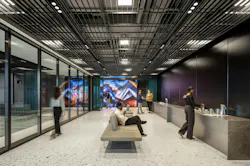
Take global investment firm AllianceBernstein, who moved into its new location in The Spiral at Hudson Yards from its 1960s-era office. The leadership team sought to create a compelling, collaborative, and engaging work environment as part of a return-to-office plan—one that democratized the office through an open floor concept for all, regardless of seniority.
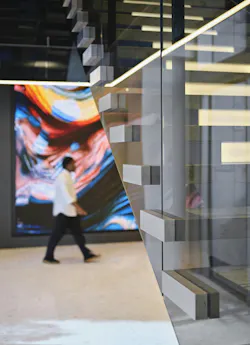
The centerpiece of this experience is the Dreamwall, a large-scale dynamic digital art installation designed by Gensler that went live in late 2024. The piece was developed to inspire, explained Karl Sprules, chief operating officer at AllianceBernstein. “Part of it was a ‘wow’ factor. You come out of the elevator … right to this incredibly dynamic piece of art.”
This generative, motion-activated, and button-controlled installation features a high-definition display that measures 33 x 9 ft in the reception hub and continues for around 250 ft into the hallway and office area. It employs laser radar for discreet motion detection and adjusts accordingly.
“A key consideration in its creation was placemaking, positioning the Dreamwall as the centerpiece of the firm’s welcome area. By engaging with AllianceBerstein teammates, it strengthens the sense of place and community already established within the space,” noted Gensler creative technology director Eran Sharon.
Starting with 12,000 images curated by the teams at AllianceBernstein and Gensler, the responsive artwork leverages artificial intelligence (AI) to produce and animate unique visuals inspired by different artistic styles, themes, and other precedents, he explained.
While Sharon described the Dreamwall as showcasing the company’s commitment to “embracing artificial intelligence as an integral part of business and everyday life,” Sprules credited the project with a more practical outcome. He said it has significantly boosted the acceptance of generative AI within the organization, with more than 70% of employees estimated to utilize such technology in their daily work.
Large-scale digital installations offer one approach. Still, authenticity can come through many forms of immersion.
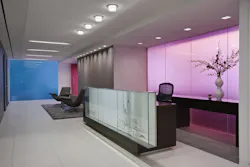
Anchoring Experiences in Authenticity
Jeffrey Teuton, director of interior design at Ideation Design Group, reinforced the notion that the digital evolution leads us to expect more out of places, spaces, and experiences. Beyond implementing technology, he advised that immersive experiences should create a sense of connection and authenticity in ways that more subtly bond users with a brand and an experience.
Teuton challenges clients to consider how visitors and employees alike can experience a company’s core values and storyline every day, then set expectations through a design that establishes a sense of place.
“It’s not [enough that] ‘there’s a screen,’” he observed. “Now you really have to create an environment—go above and beyond to show something new and make someone feel wowed, pushing the engagement.”
Those expectations should be fulfilled through a seamless experience, Teuton added. “We look at spaces and ask ourselves how we can […] give people a moment of quiet or engagement, being transported or immersed that they don’t have to actively seek out, they can fall into naturally,” he said. If users have to push a button to initiate something, they are less likely to engage, he cautioned.
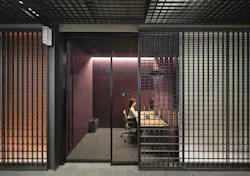
Chris Pales, 3form marketing director, expressed the view that successful immersive designs don’t need to be digitally dense. Instead, he disclosed how materials properties can transform the ordinary into something special.
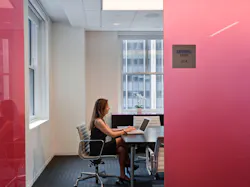
Citing a commercial project, Pales described how encompassing a conference room with translucent, rose-hued walls not only established a level of privacy within the office, it created “a jewel box of sorts.”
“We are not just solving a practical problem with a translucent wall system,” he said. “We are giving it a strong brand, color presence, and a warm glow.”
Pales suggested that physical spaces like this could balance the overstimulation people can feel in a digital environment and promote the in-person connection people crave. “The hope with most designs is that we collectively can raise the quality and beautify physical surroundings, so that you feel better, are more productive, can heal better, and the experience of day-to-day life becomes that much more enjoyable,” he said.
Maximizing Design Longevity
Completing and engaging with an interactive experience is just the surface. Maintaining it over time is another level of service and skill that design firms can promote to clients. Rob Bischoff, global leader of Gensler’s Digital Experience Design (DXD) practice, has found clients such as AllianceBerstein seeking training and support in AI post-occupancy for environments where dynamic content and personalization are central.
“Many of the spaces we design now incorporate digital platforms—generative content engines, personalized media walls, or adaptive lighting and signage—that are powered in part by AI,” he said. “In these cases, we’re building these systems, then helping clients understand how to maintain and evolve.”
Specialists at Gensler’s Experience Labs in New York and Los Angeles continue to build on this technology-driven capability by analyzing the key characteristics of experiences, what makes them successful, why people seek them out, monetary value, commonalities, and so forth.
Gensler clients are invited to visit the lab and explore the potential of their own experiential story. Bischoff works with them to understand their brand, location logistics, and the space and context for presenting an experience to users. From there, the lab team interprets that information and applies “out-of-the-box technology in out-of-this-world ways,” in Bischoff’s words.
Merging Dreams with Reality
Otherworldly spaces still need to be approached through the lens of reality. Pales warns that the economics of design can be a factor—perhaps even the final say for spaces and experiences.
Gensler’s Bischoff advises designers and clients to be open-minded, willing to engage in fun brainstorming, and honest about budget—considering both upfront costs and what it might take to maintain an experience.
“We want to be realistic. Don’t show me a $2 million idea when I know I’m not going to go ask for more than a half a million,” he said. “That’s when you go dream really big, then the things that we create feel less impactful because you’ve shown [the client] something that isn’t in the realm of possibility.”
There are plenty of ideas and options along a spectrum of cost and complexity, but according to Bischoff, user and brand identities are the most important determinants for a successful immersive design experience.
“No matter who we’re designing for, there’s a brand behind it,” he concluded. “There’s a bunch of different ways the story will come to life.”
Considerations Before Concepting an Immersive Experience
Before you begin, align with your client on expectations with the following questions.
1. What is your tolerance level for brand immersion?
Reason: Innovation requires a safe space for ideas that might seem wild at first glance (like a honky-tonk piano that controls the room lights in Nashville, as Gensler’s Bischoff created for a client). Establish whether the client is willing to prototype.
2. What is the Day 2 plan?
Reason: Determine whether the client has the internal resources to manage content, or they need a generative system that runs itself (like AllianceBernstein’s AI wall). “We need to keep a budget in mind for keeping content fresh, not assuming that it’s a one-and-done experience. That's where clients sometimes get frustrated,” Bischoff cautioned.
3. Who are our audiences for this project?
Reason: The experience must be approachable, especially in terms of function, location, and accessibility due to users’ size or physical condition. For example, Gensler positioned four screens at Colorado’s Children’s Hospital so patients would be able to engage with native birds on the displays—while riding in red wagons in lieu of wheelchairs.
4. Are we adding to the experience or distracting from it?
Reason: Different options may resolve architectural problems. AllianceBernstein used LiDAR in their corridor not just to be cool, but because 3D cameras would have cluttered the ceiling.
5. How do we create authenticity?
Reason: In a digital world where you can buy a “bow tie from France” from your couch, a physical space must offer a “vibe” that cannot be shipped, IDG’s Teuton explained. “Create a full experience that can really capture someone and provide something that is seemingly new and fantastical while also transporting them,” he said.
About the Author
 Valerie Dennis Craven
Valerie Dennis Craven
Content Strategist & Writer
Valerie Dennis Craven is an experienced writer of commercial and residential buildings and interiors, having previously served as Editorial Director for both BUILDINGS and i+s. Valerie enjoys writing about technology and how it impacts users in the built environment.