3 Award-Winning Interiors in China Reimagine Cultural Space
At a Glance
- Place-based storytelling turns entertainment into a “civic” experience.
- Texture, reflection, and light choreograph how people move and feel.
- Immersion doesn’t have to erase context—it can extend it.
- Today’s cultural spaces balance spectacle, pause, and public life.

Cultural venues today offer so much more than entertainment—they function as everyday civic spaces defined by experience. A night at the movies, an evening at a bar, or a quiet hour in a library often doubles as a social encounter, a learning opportunity, or a moment of connection or discovery.
In these settings, interior design plays a central role, shaping how people move, gather, and engage with one another. Set within three rapidly evolving Chinese cities and recognized as winners of IIDA’s regional Asia-Pacific interior design competitions, these acclaimed projects show how the best design reflects local identity, responds to urban rhythms, and creates spaces meant not to be visited just once, but returned to again and again.
Haikou Gaoxingli Insun Cinema
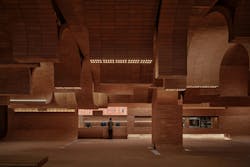
A moviegoing experience shaped by light, texture, and the rhythms of the sea
At the Haikou Gaoxingli Insun Cinema in Haikou, located in Hainan, an island off the southern coast of China, audiences are carried away well before the lights dim. Designed by One Plus Partnership Limited and rooted in the textures and tones of Hainan Island, the interior replaces familiar cinematic tropes with a spatial language drawn from sand, light, and movement. Brick—used throughout as both structure and surface—evokes the island’s shoreline, while subtle variations in pattern suggest the ebb and flow of ocean waves. Daylight filters in through custom openings, warming the space and creating a gentle transition from city to screen.
Inside the auditoriums, layered color, tactile finishes, and immersive forms heighten the sense of escape without severing ties to place. The result is a cinema that feels less like a sealed box and more like a continuation of its environment—an experience shaped as much by local context as by the films it hosts.
Night of City
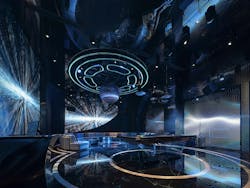
An immersive nightlife environment built on motion, illusion, and transformation
At Night of City in Hangzhou, China, entertainment unfolds as a continuous process of transformation. The multipurpose venue, designed by JFR Studio, draws on ideas of astral travel and alternate realities, creating an immersive environment where physical and virtual worlds intersect.
Curving forms, reflective surfaces, and kinetic structures combine with choreographed lighting and high-resolution digital imagery to produce a heightened sensory experience that shifts as guests move through the space. A layered palette of concrete, metallic finishes, marble, and mirrored surfaces catches and refracts light, blurring boundaries and destabilizing perception.
Rather than offering a single destination, Night of City functions as a sequence of atmospheres—an interior shaped by motion, spectacle, and the collective energy of nightlife culture.
Shanghai Library East
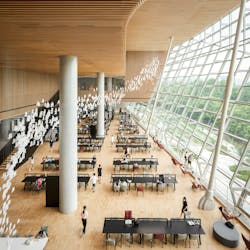
A contemporary civic forum where learning, culture, and public life intersect
At Shanghai Library East in Shanghai, China, the library is reimagined as an open landscape for learning, gathering, and reflection. Designed by Schmidt Hammer Lassen, the interior takes inspiration from the scholar’s rock, a symbol of contemplation in Chinese tradition, translating it into fluid spaces that encourage both movement and pause.
Housing more than 4.8 million books, the library’s restrained material palette allows collections, people, and daylight to take center stage, while bamboo louvres—slatted screens—wrap key volumes, softening scale and forging a tactile connection to the adjacent park.
Integrated artworks exploring the evolution of writing embed cultural narrative directly into library guests’ everyday experience. Balancing quiet study with public exchange, the library functions as both sanctuary and civic forum—an institution deeply rooted in place while responsive to the evolving needs of its community.
Art + Culture in Placemaking



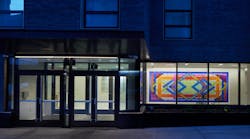 New York City School Construction Authority prioritizes visual storytelling through its Public Art for Public Schools initiative.