Why Interior Architects Belong at the Start of the Project
What Designers Will Learn
- Why interior architects add the most value during feasibility
- How modular construction raises the cost of late decisions
- What adaptive reuse demands from early spatial planning
- Where AI can speed testing — and where human judgment still leads
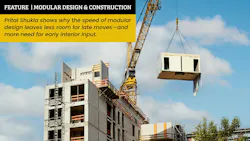
The next decade of architectural practice will be defined less by form and more by how early, how accurately, and how collaboratively critical decisions are made. Three forces—offsite modular construction, the accelerating demand for adaptive reuse, and artificial intelligence (AI) in design—are converging to reshape project delivery. Together, these trends compress timelines, shift risk upstream, and elevate the importance of early feasibility decisions.
Interior architects are now vital contributors at the earliest stages of planning, where performance, cost, and long-term adaptability are determined. Understanding where these trends intersect, what barriers limit broader adoption, and how interior architects can be strategic decision partners rather than aesthetic consultants will determine who leads this transformation.

Strategic Value of Early Interior Architecture Integration
Interior architecture has evolved beyond aesthetics and finishes to encompass spatial functionality, environmental performance, and occupant health. Yet most projects still follow a sequential delivery model in which interior architects arrive after significant decisions about building systems, structural modifications, and spatial capacity have been locked in. This timing creates a strategic vulnerability: Decisions made during feasibility—such as what can be built, how to configure units, and where core systems will run—directly determine what’s possible for interior performance later.
The consequence of late integration is predictable. Layout constraints become evident too late to address them efficiently, particularly in adaptive reuse projects where existing structural elements must meet current code requirements. Interior architects involved during feasibility can design spatial configurations that account for these realities while design flexibility still exists. Early integration isn’t a design preference; it’s a risk-reduction strategy that protects project return on investment (ROI) and timeline predictability.
This matters even more now as modular construction and adaptive reuse projects accelerate. When a developer evaluates converting an office building into apartments, interior architects can immediately test crucial feasibility questions, including how many units realistically fit within the existing structural grid, whether apartments will achieve adequate daylight, and where to locate bathrooms and kitchens given existing utility risers. These assessments determine whether the project moves forward or stops before committing significant capital.
Precision in Modular Construction Prevents Downstream Chaos
This move toward modular construction brings considerable advantages, yet it isn’t optimal for every project. Before examining the pros and cons, we must first understand what “modular construction” means. Modular construction means building sections of a home or building off-site in a factory, then delivering them to the property and putting them together on-site. It can help save time and reduce construction delays.
One key advantage is that modular construction fundamentally recalibrates the speed versus quality equation. Factory-built components arrive on site with interiors already resolved, compressing what typically requires months into days.
Modular construction also accelerates structural and enclosure phases through parallel fabrication. But this acceleration extracts a steep price: Flexibility disappears once production begins.
The window for interior architecture decisions closes earlier and more definitively in modular projects than in conventional construction. When guest rooms, bathroom pods, or residential units enter factory production with lighting, finishes, fixtures, and built-in elements already integrated, design changes become impractical or impossible.
Modular projects carry execution risk that demands early interior architecture expertise. Joineries between factory-built modules and on-site infrastructure—particularly where mechanical, electrical, and plumbing (MEP) systems connect—create coordination challenges. Modular construction projects often include 15% to 20% contingency in budgets and schedules, depending upon the delivery structure, to accommodate rework at connection points.
Interior architects who understand modular construction constraints help design for factory production rather than assuming downstream flexibility. This requires resolving wet walls, service coordination, material specifications, and spatial layouts before production, not during installation.
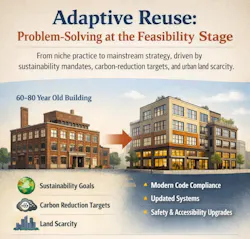
Adaptive Reuse: Problem-solving at the Feasibility Stage
Adaptive reuse has shifted from niche practice to mainstream strategy, driven by sustainability mandates, carbon-reduction targets, and escalating land scarcity in urban markets. Nevertheless, reuse projects introduce construction complexity that can erode the economic advantages of preserving existing structures. Converting buildings constructed 60 to 80 years ago to meet current code requirements creates cascading structural demands. It is critical to sister existing 2x4 wall stud framing with 2x6 studs, expand wall cavities to meet insulation standards, and replace joists that no longer comply with code. Fire rating upgrades and acoustic separation requirements are also significant cost drivers. These upgrades compound costs and extend timelines compared to ground-up construction.
Municipal policy increasingly recognizes this financial tension. Zoning incentives for affordable housing overlays, density bonuses for preservation projects, and streamlined approval processes help offset the premium that code compliance adds to adaptive reuse costs.
Interior architects who engage during the feasibility phase, rather than after approval, navigate these constraints productively. Working with structural and MEP engineers, they help interpret which structural elements remain fixed, where systems must be upgraded to meet current requirements, and how spatial layouts can work within those realities.
Redefining Interior Architecture’s Role in Project Delivery
Early collaboration among those representing diverse expertise has always been essential to a successful building project. Today, the convergence of AI-driven design, modular construction, and adaptive reuse is reshaping when pivotal decisions are locked in and who to include in the decision-making process. As modular construction and adaptive reuse projects expand, recognizing interior architects for their expertise beyond aesthetics becomes essential to protecting project ROI and long-term adaptability.
Adapted for the web. Subscribers to interiors+sources have access to the extended feature in the March/April 2026 digital issue.
Employ AI As a Tool, with Expert Human Guidance
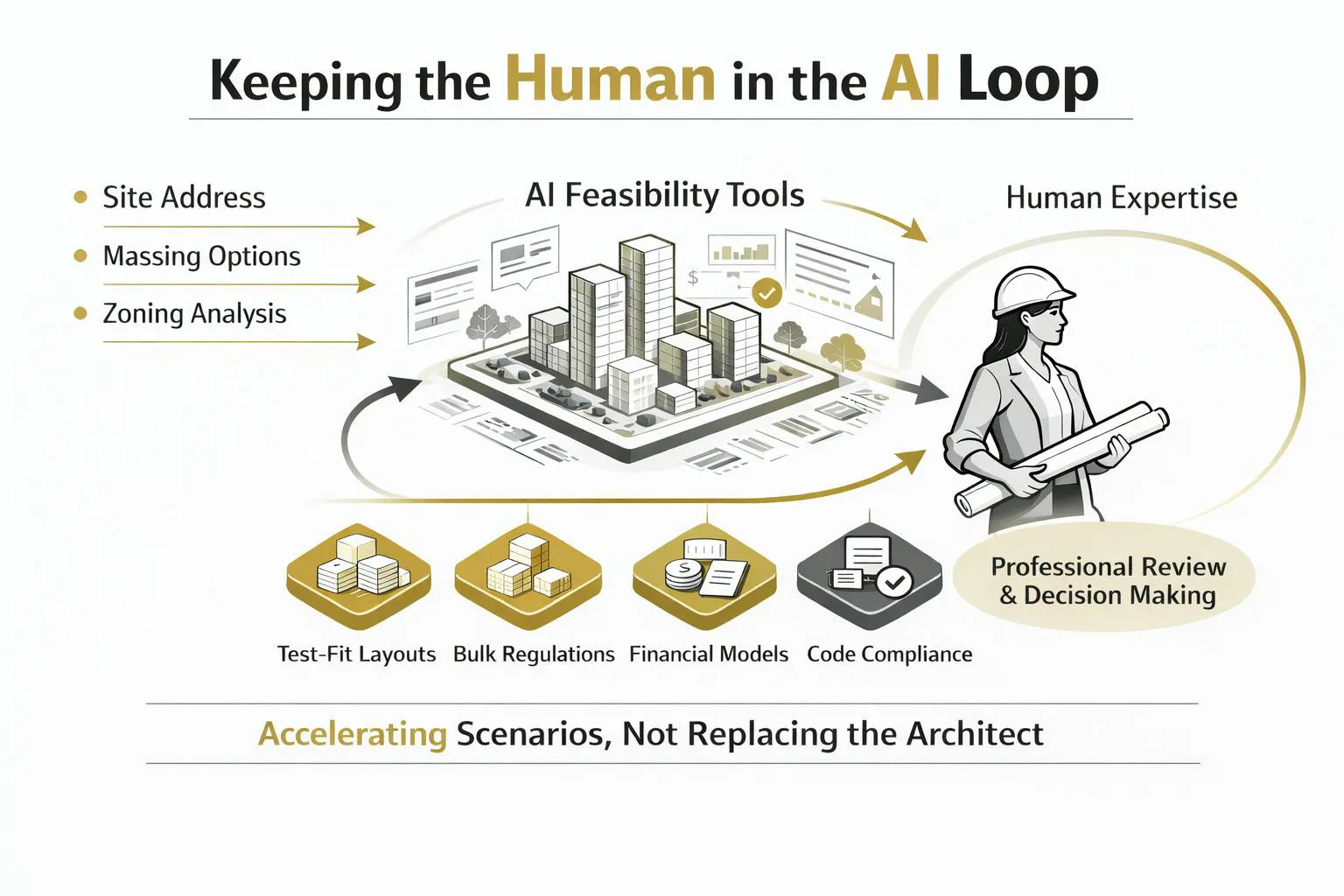
The early deliverables and compressed time aspects of modular construction provide excellent incentive for design teams to employ artificial-intelligence-based (AI) software tools.
AI feasibility tools deliver their greatest value during early project stages, when spatial scenarios, regulatory parameters, and financial models remain fluid. These platforms compress weeks of manual iteration into days.
AI software generates permutations and combinations that inform client decisions before significant capital commitment, revealing options clients often haven’t considered. For example, when a developer planned an apartment building, AI analysis revealed the site also permitted extended-stay hotel use. Given the location’s transportation access and short-term rental market strength, the hotel configuration delivered superior ROI.
Still, we cannot emphasize this enough: Integrating human professional validation with the AI outputs is vital. In our example, AI identified the extended-stay opportunity, but professional judgment was still necessary to confirm its viability, quantify the risk, and determine which spatial configuration would actually perform.
Even technically compliant scenarios require human judgment about functionality and livability. An interior architect can evaluate whether multiresidential units will achieve adequate natural light and ventilation, how circulation patterns function, and whether the layout supports the way people will realistically use the space.
While AI tools assist interpretation and accelerate scenario testing, they do not replace professional responsibility. Human specialists exercise judgment, assess for taste, and layer on design choices for a purpose-built environment.
About the Author
Prital Shukla, AIA
Prital Shukla, AIA, is a licensed architect in New Jersey and New York and the founder of PS Architecture and Design Inc. Her work focuses on zoning-driven development, adaptive reuse, and affordable housing projects across the NY and NJ metropolitan area. Prital collaborates with developers, land-use attorneys, and planners to translate zoning incentives into buildable, financially viable projects. Connect with her on LinkedIn or through her website.