Building Trust in AI-Driven Design: Enhancing Accuracy, Accountability, and Innovation
What Designers Should Know
- AI may speed up ideation, but designers still want to stay in control.
- Trust matters more when AI enters specs, sourcing, and client-facing work.
- Generic outputs often point back to generic training data.
- Strong results still rely on human direction, judgment, and originality.

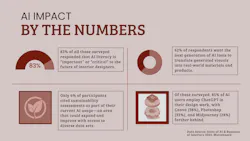
According to a 2025 survey conducted and summarized by virtual material-sampling platform provider Mattoboard, designers are embracing artificial intelligence (AI) where it feels quick, low risk, and creatively liberating—particularly during visualization and early concepting stages. But the report also shows that trust in these tools drops as the stakes rise.
In an interview with Carrie Meadows, Mattoboard CEO Guy Adam Ailion explains why AI causes some “anxiety,” what more practical AI tools will look like, and how industry resources and training can increase confidence in software-assisted design workflows.
For more of Ailion’s analysis, listen to his deeper conversation with Robert Nieminen in an I Hear Design podcast episode.

i+s: Mattoboard’s “State of AI & Business of Interior Design” report shows designers feel both energized and uneasy about AI—71% say it boosts creativity, yet around half say it can hinder it. From your perspective, what’s behind this tension?
Ailion: That the tension comes from a very simple truth in that AI gives designers superpowers, but it also threatens their sense of authorship. Anytime there is a new piece of technology or a new form of behavior that’s introduced to an industry, it is met with a mix of fear and curiosity. You always have your early innovators and adopters, but you will also have your laggards.
Designers love the speed, the range of expressiveness, and the unexpected spark that AI can bring—which is why 71% say, “This can boost my creativity.” In many ways, I think that designers don’t fear AI; they fear losing the steering wheel of their creativity. AI is great at generating ideas right now, but designers want it to be better at listening to what they want to do. We will see that tension relieve itself in the next phase of AI, which is moving from a prompt era to what I call a control era.

i+s: The report outlines where the level of trust in AI starts to fall off a bit. Survey participants revealed that they don’t use it as much for sourcing documentation and client-facing communication. What barriers are holding AI back from those parts of the workflow?
Ailion: This comes down to accuracy, accountability, and trust. Early ideation is very low risk. It can be playful, it can be fast, it can be messy. AI is excellent in this zone. But when you move into things like sourcing documentation, FF&E scheduling, or client presentations, the tolerance for error collapses. Designers understand that AI becomes dangerous when the mistakes it could make are very expensive.
This is where experience matters. Any designer who has experience will know where not to trust the AI. Someone who is not as experienced won’t necessarily know what to look at, and there is a hallucinogenic component to AI. It will always be there.
Provenance needs to be thoroughly checked or asked for. Always ask to cite sources and go over them, too. There are interesting ways to use AI against itself! For example, when AI does something, ask it to thoroughly review it, and pull out sources. Where it can’t find the sources, flag that as a mistake it made; and when it can find the sources, ask it provide them to you and a rationale of why it has used those sources.
i+s: 54% of surveyed designers worry that AI could lead to homogeneity. What steps should the wider design ecosystem take to ensure that AI strengthens their originality rather than flattening it?
Ailion: That’s a good question. All of these large language models (LLMs) are built upon data. When [the tool] is trained on the same data and that [...] doesn’t evolve, it will produce the same answers for everybody. So it’s not necessarily a design problem; it’s a data problem.
To protect originality, data sets need to be a lot more diverse, right? From a design industry perspective, we do need to train our models on global aesthetics, not just Western “Pinterest-friendly” things.
i+s: How can we ask an AI tool to be more original? Because it needs to be trained, as you mentioned, on a continuous feed of data sets.
Ailion: This is the best part: It will come down to the human. We are totally in the driving seat! You want AI to produce something homogenous? Give it less of your feedback, and just say, “Give me a mid-century modern bedroom.” It will give you the most homogenized, mid-century modern bedroom.
Or you can take a bunch of ideas that are interesting and more unique to you, [...] merge those together into a prompt, and ask it to help you brainstorm around that. And that’s going to be the second half of the answer, which is that taste is about meaning—and meaning is in the eye of the human only. Computers don’t know what meaning is.
In the next phase, LLMs—the foundation models—are going to be replaced by the next wave, small language models (SLMs). Instead of these huge warehouses of GPUs and computational power that the LLMs have, we’ll be able to run small ones on our laptops or even our mobile phones. You’ll be able to own your version of your algorithm for these models.
I think it’s the most incredible time to be a designer. In fact, I go so far as to say this is the era for designers. Other industries have been emancipated by software tools. But the built environment, the 3D world of design, is all physical things. They’ve never really had tools that unlock their industry until now. And that is what we're trying to solve—to build tools the way that designers think.
This interview has been edited for length and clarity. Subscribers to interiors+sources have access to the extended Interview in the March/April 2026 digital issue.
More Artificial Intelligence
 Businesswoman using tablet with artificial intelligence application
 Black female designer works at a computer using an AI engine
 i+s Editor-in-Chief Carrie Meadows
About the Author
 Carrie Meadows
Carrie Meadows
Head of Content
Carrie Meadows is Head of Content for interiors+sources, where she leads editorial strategy, content development, and brand storytelling focused on the people, projects, and innovations shaping the design industry. With more than two decades of experience in B2B media, she has built a career connecting technical expertise with creative insight—translating complex topics into meaningful stories for professional audiences.
Before joining interiors+sources in 2024, Carrie served as Editor-in-Chief of LEDs Magazine within Endeavor Business Media’s Digital Infrastructure & Lighting Group, guiding coverage of emerging lighting technologies, sustainability, and human-centric design. Her earlier editorial experience spans across Laser Focus World, Vision Systems Design, Lightwave, and CleanRooms, where she managed print and digital publications serving the optics, photonics, and semiconductor sectors.
An advocate for clear communication and thoughtful storytelling, Carrie combines her editorial management, SEO, and content strategy expertise to help brands and readers stay informed in a rapidly evolving media landscape. When she’s not crafting content, Carrie can be found volunteering at a local animal shelter, diving into a good crime novel, or spending time outdoors with family, friends, and her favorite four-legged friends.