Gensler’s 2026 Design Forecast: A Q&A With Jordan Goldstein and Elizabeth Brink
What Designers Should Know
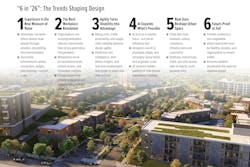
- Design agility is no longer optional. Volatility—from climate to AI—is reshaping how buildings must perform over time.
- Experience is now measurable. Data-informed insights are reframing projects around human outcomes, not just square footage.
- AI is a creative accelerator, not a replacement. The future belongs to designers who can translate data into meaningful design decisions.
- Future-fitting beats retrofitting. Adaptable, multi-use systems are emerging as a smarter path to carbon reduction and long-term value.
If there’s one word that aptly describes the moment we’re in as an industry (and as a society, even), it’s volatility. From the urgency around climate targets, economic uncertainty, and the disruption that AI is causing on a global scale, it seems the architecture and design industry is being forced to rethink nearly everything it thought it knew about how people live, work, and gather.
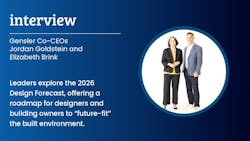
Against that backdrop, Gensler’s 2026 Design Forecast provides a timely roadmap for how designers and building owners can “future-fit” their portfolios and stay relevant in a rapidly shifting built environment. The following interview is adapted from a recent I Hear Design podcast episode, in which host and interiors+sources market content director Robert Nieminen spoke with Gensler co-CEOs Jordan Goldstein and Elizabeth Brink about the firm’s 2026 Design Forecast and what it signals for the future of the built environment. [Responses have been edited for clarity and length.]
i+s: You open the 2026 Design Forecast talking about the “extraordinary power of creativity” and calling design agility a strategic imperative in the face of constant volatility. How would you describe the moment we’re in right now for the built environment, and how do you feel this forecast speaks to challenging times?
Jordan Goldstein: We both feel like we’re in a moment defined by rapid technological acceleration, a lot of volatility, shifting human expectations, and we feel like design is a strategic lever for navigating that uncertainty. We believe in the power of design to shape our environments and create betterment. We see clients asking for clarity, adaptability, and confidence about the future. So, this forecast for us responds with a framework for making informed, future-ready decisions.
Elizabeth Brink: I think it’s great that you pulled out the idea of creativity, [which] is so at the heart of where we are in this moment. This idea that having that creative optimism and conviction that we can move things forward is so important to how we’re solving the complexity of problems. We talk about agility, we talk about complexity, volatility, dynamism in all of our markets, and to approach it with that kind of optimism that we see from designers is really critical.
“We’re in a moment defined by rapid technological acceleration, volatility, and shifting human expectations—and design is a strategic lever for navigating that uncertainty.”—Jordan Goldstein
i+s: How did you and the Gensler Research Institute arrive at the six meta trends highlighted in the 2026 Design Forecast report, and what (if anything) surprised you as the strongest signals across sectors?
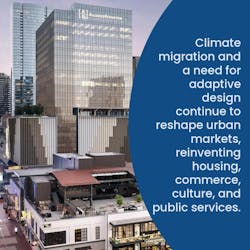
EB: We pull information from across all of our 33 practices [and] 57 offices and gather that together, along with what we’re seeing from our Workplace research and our Cities Index research, and talk through what those signals are. It’s a ground-up based approach to identifying what these trends could be. And you know what we start seeing […] there is a lot about convergence across different practices. There’s a lot about hospitality. There’s clearly a lot about technology and AI. You’ll start to see also a lot about resilience. These themes pull through some of the meta trends, and the meta trends themselves really go across sectors and across countries.
“What we need are people who can take data, understand the research, understand the anecdotal and qualitative information we have, and translate that into design insights.”—Elizabeth Brink
i+s: How are your clients measuring experience today and why is it so important?
JG: Experience is really measured now more than just the feel of a place. It’s that with a big plus, and that plus includes data. What are we gathering from dwell time, conversion, productivity, emotional response, behavioral patterns, user activity in a space? When we talk about experience, we think about it across this broad spectrum; and experience being able to be quantified early […] often reframes the brief for a project and takes the conversation from square footage optimization to more about human outcomes and long-term value. And that is so important now.
i+s: Compared to five years ago, what does a truly high-performing workplace look and feel like now, and where are companies still missing the mark here?
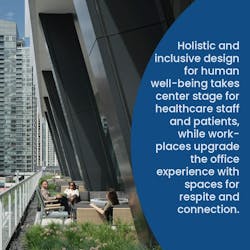
EB: What’s really interesting that we’re seeing—relative especially to five years ago—is that workplaces that were designed post-COVID are now becoming reality. They’re finally getting built. People have been moving in. All that we’ve been talking about with hospitality-driven, balance between private and collaborative spaces, being more welcoming, connecting to culture, we now see those spaces and people and how their behaviors are changing in those spaces.
We’re seeing them in technology. TikTok has a great group of spaces. They’re all very different, but they all have that sense of balance, again, between private and collaborative, of being a destination that drives people in, of having that hospitality environment. And that’s what’s starting to define a high-performing workplace. It is a place that empowers people and compels them to come back in. There’s a lot of talk about returning to the office, and it’s not going to be a mandate that gets people back in. In reality, it’s going to be a place that allows them to work really deeply.
i+s: How is AI tangibly changing your design process, and what do you see as the right balance between machine intelligence and human imagination in practice?
EB: It’s something that we are 100% leaning into and understanding as a tool. Design has been through technology revolutions before, so we’re leaning into that as a guide of thinking, ‘Let’s get ahead of it, and let’s really figure out how to use these advanced technologies and AI models in a way that benefits our design process.’ […] [Another] way I think we’re really leaning in with AI is teaching everyone how to use the data—making sure we’re gathering all the data, how to be more data literate, and how to use that to help inform design and to make it less scary.
JG: We [also] created our own Gensler Cinematic Universe, and we created a whole range of characters—families that could experience mixed-use districts; different types of employees that would go into a workplace environment; sports fans that would be going to a venue; passengers that may be going through an aviation terminal. Then what we were able to do is take those characters and start to explore ‘day in the life’ of different designs and projects that we were doing around the world. And this was creating these experience-rich, cinematic short films that were very emotive. […] As designers, we again feel very much like we are storytellers. So this new technology gave us a way to unlock storytelling at a different level.
i+s: As AI becomes a “creative partner,” what new skills do you need inside a firm like Gensler?
EB: We need to be bringing in more people who understand how to ask the right questions, how to understand the responses we get back. We see the feedback we get, the analysis is not an end to itself. We’re now able to take a vast amount of data […] and analyze it. But what we need are people that can take data, understand the research, understand the anecdotal and qualitative information that we have, and know how to translate that into design insights. So, it’s really people who can learn to speak all those different languages from data to analysis to qualitative and quantitative research to design. Sometimes that’s a single person. Sometimes that’s going to be how we put our teams together in different ways to enable and empower this to be a more integrated part of the entire process.
i+s: The report suggests a shift in thinking from retrofitting to “future-fitting.” How does that mindset change the early conversations you’re having with owners and developers about carbon, risk, and long-term asset value?
JG: Conversions are beginning with a series of very important questions: What can be retained? What should be retained? What delivers the greatest on value, and then also carbon savings? And what strengthens long-term asset value? And future fitting—under the umbrella of conversions—there’s a lot of questions that are pull-down menus of the ones I just went through that we have to analyze in a rapid way. […] The future fitting reframes buildings as adaptable systems, not as static products—and I think that’s a very important thing to stress. Adaptable systems mean that we’re looking at buildings through the lens of agility, looking through the lens of understanding multi-use, and thinking about how we can look at risk mitigation and value creation through the design lens.
i+s: For architects and designers who may not have access to the depth of resources that Gensler has at its disposal, what are the practical takeaways from this forecast?
JG: It’s interesting because there are certainly opportunities where we are out there partnering with firms around the world, depending on the nature of a given job. And it’s important for all firms to keep understanding how data scenario modeling, like we’ve talked about, can play into the work we do every day. How do we upstream and make decisions earlier and more confidently? How do we stop designing for static programs and recognize that change is inevitable? And how do we all keep a focus on elevating that human experience through the work that we’re doing?
EB: I think especially focusing on not designing for static programs—that’s just not how space is going to be used anymore. I would also say to any firms to continue focusing on the human side, the user side, the people side, and focus on their own creativity and always bringing that into the process with clients. So, both the human side of their teams, but the user side and understanding what space is going to mean for people. Even as we all talk about data and AI and technology, in the end, it’s people who are going to use the space—maybe people with their AI agent, but people in the end.
About the Author
 Robert Nieminen
Robert Nieminen
Market Content Director
Market Content Director, American School & University, Architectural Products, BUILDINGS, and interiors+sources
Robert Nieminen is the Market Content Director of four leading B2B publications serving the commercial architecture and design industries: American School & University, Architectural Products, BUILDINGS, and interiors+sources. With a career rooted in editorial excellence and a passion for storytelling, Robert oversees a diverse content portfolio that spans award-winning feature articles, strategic podcast programming, and digital media initiatives aimed at empowering design professionals, facility managers, and commercial building stakeholders.
He is the host of the I Hear Design podcast and curates the Smart Buildings Technology Report, bringing thought leadership to the forefront of innovation in built environments. Robert leads editorial and creative direction for multiple industry award programs—including the Elev8 Design Awards and Product Innovation Awards—and is a recognized voice in sustainability, smart technology integration, and forward-thinking design.
Robert's work has earned him industry-wide recognition throughout his career, including:
- ASBPE Award (2019, 2018, 2017, 2015)—Best Regularly-Contributed Column; retrofit
- TABPI Award (2017, 2016)—Top 25 Entries, Cover Story; Retail Environments
- WPA Maggie Award (2011, 2010, 2008)—Best Publication, Trade; interiors+sources
- FOLIO: Eddie Gold Award (2022, 2007)—Best Feature Article & Special Section; interiors+sources
- Contributing author of ASID’s 2020 Outlook and State of Interior Design report, as well as The State of the Interior Design Profession (Fairchild Books, 2010), which earned a place on the International Federation of Interior Architects/Designers’ “50 Must Read, Must Have” book list.