How Hendrick Designed Synovus Place Around Community, Change, and Employee Experience
Key Design Moves
- A workplace transition shaped with people in mind
- Community as both concept and connective tissue
- Flexible, visible, and calmer ways to work
- Brand storytelling that links culture to place
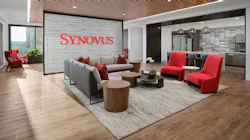
When financial services firm Synovus set out to bring several Columbus, Georgia, locations together under one roof, the challenge was about more than a new workplace. It was also about helping employees navigate change while reinforcing the financial institution’s ties to the community it has served since its 1888 origins.
Integrated design consultancy Hendrick led the effort for the new downtown building, Synovus Place, providing workplace strategy, change management, interior design, and environmental graphic design services. The team’s goal: Align the new environment with how employees work today while supporting future needs and reflecting the organization’s culture, values, and local roots.
Designing Around a Major Workplace Transition
Because the project consolidated several locations into one 122,000-square-foot building, the move itself became a meaningful part of the human-centric design story. Hendrick and partner Workflow developed a change management strategy focused on stakeholder involvement, leadership support, communication, and education, recognizing that relocation can be disruptive even when the long-term vision is clear.
The partners contemplated employee experience at multiple points in the day-to-day transition, from commuting and building entry to adapting to new processes and ways of working. Hendrick managing principal Jennifer Treter explained that these points enabled the team to develop pilot programs, educational events, and communications to help employees stay informed and adjust to the new workplace.
Community Becomes the Organizing Idea
The entire design narrative centers around community—both corporate identity and connection to the local area. Treter described Synovus as an organization invested in both its people and its local communities, with Columbus identified as a particularly important one. That idea shaped the design concept for Synovus Place, where neighborhoods are linked by a “common thread” meant to connect employees to a broader, shared experience based on their purpose and company mission.
Rather than treating community as a branding afterthought, the interior design positions it as a spatial and cultural framework—one that supports collaboration, mentoring, communication, and everyday social interaction.
Flexibility, Visibility, and Accessibility at Work
This framework allowed designers to approach contemporary workplace expectations by emphasizing flexibility and access across the office, with specification and space planning decisions that also enhance employee well-being.
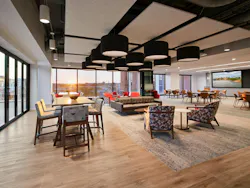
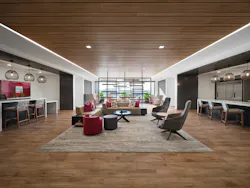
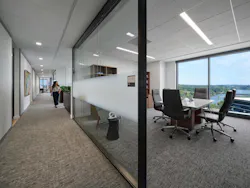
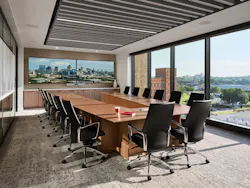
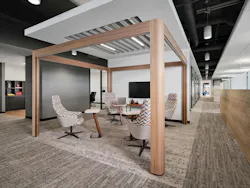
Transparency and connection are treated as both visual and organizational priorities, intended to support a collaborative and social culture, according to Treter. For example, executive offices are surrounded by transparent interior glass walls, and abundant exterior glazing provides extensive views of downtown Columbus. Throughout the facility, clear sightlines along spacious collaborative and gathering zones create a sense of direction and clear circulation paths. The interwoven neighborhoods encourage employees to work in a variety of settings instead of being tied to a single location.
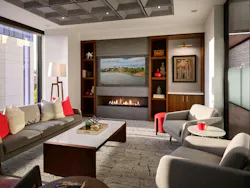
Accessibility, usability, and inclusion were prioritized through biophilic principles, ergonomic support, quiet areas for stress reduction, and social spaces for interaction. Acoustic ceiling treatments, acoustic lighting, carpeting, and partitions offer sensory relief from excessive noise and visual distractions in calmer zones and focused work areas. Cozy fireplaces and soft seating in spots like the library and lounges are complemented with adjustable window treatments and integrated lighting to support eye comfort at all times of day. Access to natural light, greenery, and outdoor terraces overlooking the Chattahoochee River complements the high-performance finishes, fixtures, and equipment for a workplace that supports restoration, comfort, and choice.
Color and Material Choices Reinforce Culture
Hendrick and partner Minnepolitan also developed an immersive brand experience, incorporating the company’s blazing red logo color into graphics that spotlight corporate values, and using it as an accent color connecting people to place and purpose throughout the building.
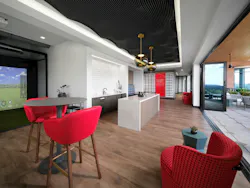
The fiery hue is anchored by black, white, and grey interior finishes and neutral wood and stone look surfaces. Linear patterns repeat but are far from repetitive: From the branded graphic walls to the wood-look ceiling cladding, patterned area rugs, subtly striped cushions, and subway-tile accent walls, surfaces are cohesive without being cold. Furnishings offer a mix of contemporary shapes and styles, with both subtle and strong curves taking hold to offer softness. Additional geometric patterns are used thoughtfully throughout the workspace: on booth seating, barrel chairs, and ergonomic chairs in palettes of soft blues, greys, orange, cream, and that signature sunset red.
The design team says that storytelling highlights Synovus’ organizational culture and sense of community and momentum. The graphic and experiential layer does more than reinforce brand identity; it helps translate company values into the workplace itself, creating an environment meant to resonate with employees, clients, and visitors alike. For instance, on a café wall, bank vacuum-tube canisters containing lollipops are displayed as an artistic element, alongside a reminder that “even the smallest things” that employees do for others can create connections.
“We really tried to get to know this organization and its people so we could help create an environment that captures that spirit,” Treter concluded.
Announcement has been edited for length and clarity, with additional design details by Carrie Meadows.