Unilever’s Hoboken HQ Becomes a Hands-On Innovation Campus
Key Design Highlights
- Right-sized + reused: 111,000 sq. ft. replaces a 350,000-sq.-ft. HQ, reusing furniture/office fronts.
- Innovation-by-design: Spaces align to Unilever’s Discover, Define, Test, Deliver workflow—built for hands-on iteration.
- Real-world labs + flexible “canvas”: Pro kitchen, salon, and company store pair with modular, mobile planning.
- Urban + sustainable performance: Hoboken waterfront access meets LED/efficient HVAC/low-flow, low-emitting materials.
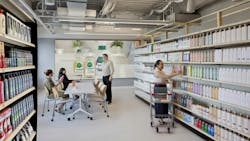
Perkins&Will New York has reimagined Unilever’s North American headquarters as an incubator for the development of new consumer products, promoting a culture of invention and collaboration. The 111,000-square-foot campus consolidates Unilever’s former 350,000-square-foot suburban headquarters into a more compact urban footprint in downtown Hoboken. The move reflects a thoughtful approach to workplace sustainability, extending beyond technological features to consider how the company’s real estate is being used by workers.
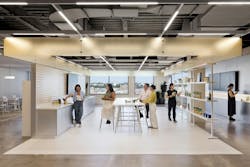
“The interior architecture of Unilever’s new workplace is designed to serve as a neutral backdrop for Unilever’s many products and the ways customers experience them,” said Mariana Giraldo, design principal at Perkins&Will New York.
“We wanted to explore how design could both connect people to the physical act of using these products, while exploring the increasingly digital ways we encounter them on social media as digital content,” explained Jeanette Kim, senior interior designer at Perkins&Will New York. “We were intentional about creating spaces that fostered innovation in both worlds.”
Designing for the Innovation Process
With Unilever’s focus on innovation front of mind, Perkins&Will organized an office design around the four stages of the company’s creative process: Discover, Define, Test, and Deliver.
Each stage is supported by distinct spatial conditions:
- Discover spaces embrace “messiness” and encourage playful, flexible, and informal encounters with colleagues and products to spark new ideas.
- As quieter, more structured environments, Define zones support idea refinement, focus, and productivity.
- Test spaces are where “everyone is a consumer,” allowing teams to showcase and solicit feedback.
- Deliver areas are polished spaces that highlight heritage and new products, featuring high-touch technology and crafted experiences.
At the heart of the new headquarters is a professional-grade kitchen that supports Unilever Food Solutions, where chefs develop new recipes using iconic brands such as Knorr and Hellmann’s. Nearby, a full-service salon showcases beauty and well-being products from Dove, TRESemmé, and Nexxus, allowing teams to experience them in use. A Company Store displays Unilever’s full range of products on aisles arranged as they would appear to consumers, allowing employees to experience their brands from the customer’s point of view.
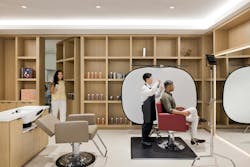
These environments create a hands-on setting that invites experimentation and play with products, allowing employees to test how the products feel and work from the perspective of a consumer. Unilever’s new campus channels that curiosity and creativity through its spatial design to support the development of products made for real people’s everyday lives.
Space as a Canvas
Unilever’s new workplace was conceived as a blank canvas for the company’s hundreds of evolving brands. In an environment where content and products are always changing, the interior design could not afford to be fixed around any one of these arrays of visual identities. To accommodate this, Perkins&Will created a design that functions as a neutral framework, allowing the products and the people behind them to take center stage.
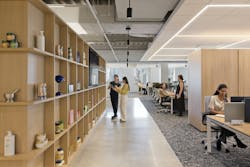
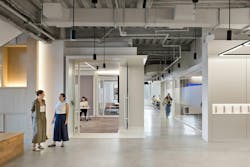
The spatial logic of the office draws heavily from other spaces built for constant change and exchange of ideas. These references include the backstage of a theatre, which enables sets to be built and dismantled, and scenes rehearsed and refined. Similarly, the design embraces visual cues from expo halls, where impermanence is a central design principle. These vast, modular spaces are inherently provisional, allowing multiple branded exhibits to coexist within the same neutral shell.
These confluences of references resulted in a Perkins&Will corporate interior design that feels flexible, utilitarian, and non-precious. Prioritizing flexibility to process through exposed structures, movable partitions, and open corridors. Thus, empowering Unilever’s teams to compose their own environments in real time around the demands of each project.
A Sustainable Move Downtown
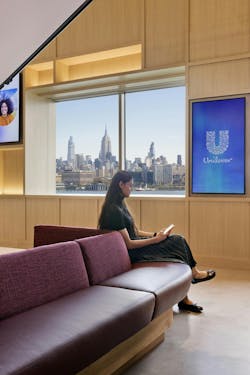
Unilever’s move from a suburban New Jersey office park to a building on Hoboken’s waterfront marks a clear shift in how the company conceives of place within its workplace strategy. Anchored in the fabric of an active downtown along the Hudson River, the three-story campus offers panoramic views of Manhattan that serve as a reminder of the company’s global reach.
Located in Hoboken’s walkable downtown core, the campus connects employees to the rhythms of city life through nearby cafés, public transit, and the waterfront promenade. This fluid exchange between corporate and civic life helps retain and reengage workers in the post-pandemic workplace.
Here, the architecture and amenities of the Unilever headquarters and the urban lifestyle of the location collaborate to elevate the overall employee experience. The master plan draws the downtown energy into the building through communal spaces, such as a central Town Hall and multipurpose event rooms on the penthouse level, providing places for teams and partners to gather and connect.
This shift underscores a broader opportunity for global companies to rethink the role of place in bringing people back to the office. Urban campuses like Unilever's can foster stronger community and innovation through greater connection to the dynamic culture of their urban surroundings.
The project was also redesigned with sustainability at its core, incorporating LED lighting, energy-efficient HVAC systems, and low-flow fixtures to reduce consumption. Construction materials were selected for low emissions and recycled content.
Unilever and Perkins&Will collaborated to take a sustainability approach in this new US headquarters with a mindset of purposeful use, acknowledging the embodied carbon of the building, its furnishings, and how employees interact with them. Instead of constructing a new suburban campus, Unilever right-sized to an existing downtown building and modified it to their purposes. The reduced office footprint lowers energy demand, while furniture and office fronts from the previous build-out were intentionally reused and integrated into the new interior. This office project demonstrates that the greatest sustainability impact can come from aligning operational needs with environmental goals.
*Announcement has been edited for length and clarity.