El Cerrito Combines Healthcare Services and Housing for Formerly Unhoused Residents
Key Highlights
- The facility integrates five stories of supportive housing with three specialized clinics for families, veterans, and individuals with substance-use issues.
- Design prioritizes resident wellbeing through natural light, healthy materials, outdoor spaces, and features like a rooftop garden and dog park to combat social isolation.
- Construction utilized hybrid methods, including modular shipping containers, reducing build time by six months and ensuring efficient, durable infrastructure.
- Partnerships between healthcare and housing providers aim to create a replicable model for future supportive housing projects that address both physical and mental health needs.
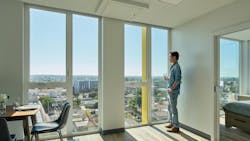
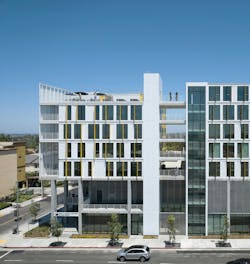
El Cerrito isn’t just another housing development—it’s a chance at a new life. Designed by LPA, this eight-story facility in Mid-City San Diego combines physical and mental healthcare services with five stories of supportive housing for its formerly unhoused residents.
The complex was developed in a partnership between Family Health Centers of San Diego (FHCSD) and PATH Ventures, a supportive housing specialist, and is focused on elevating residents’ health and sense of belonging while bringing together supportive services needed to help them recover, reskill, and reintegrate into their community.
“These services are rarely easily accessible for our target population,” said Cynthia Wong, senior project director for PATH, the housing developer on the project. “We knew from the beginning that this would be a one-stop shop for folks to have a place to call home, which we know is the very first thing people need to have any chance at a more stable future.”
Design Strategies
LPA designers needed to coordinate the needs of two distinct but complementary user groups. Early coordination meetings and work by the interdisciplinary team helped the designers understand and align housing and healthcare needs.
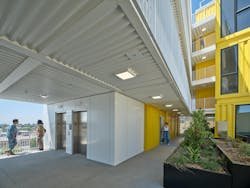
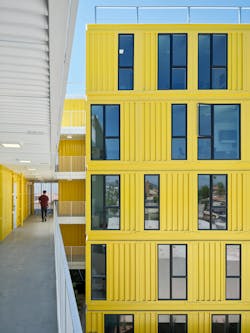
The building includes three specialized clinics on the ground floor (one each for families, veterans, and individuals with substance-use issues) and also features four levels of parking, two of which are underground. It’s crafted with a hybrid of traditional and modular construction, featuring a concrete structure for the clinic and parking with prefabricated shipping containers used for the 41 housing units. This strategy compressed the construction schedule by six months.
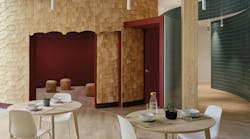
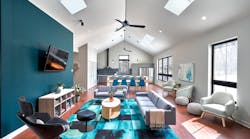
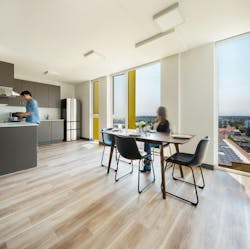
The design is also highly intentional about prioritizing resident wellbeing, from the organization of the spaces to a mix of social environments, supportive landscapes, the use of healthy materials, and spaces with fresh air and natural light. Each of the three ground-floor clinics has its own entrance to ensure personalized care, while shared back-of-house spaces improve efficiency for care providers.
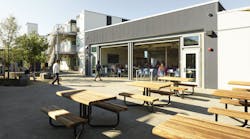
Instead of the traditional “donut” shape with an enclosed courtyard often found in affordable housing, this building is configured and oriented to capture ocean breezes, shade social spaces, provide sun for plantings, and make outdoor environments usable year-round. Landscaping connects residents to nature while promoting biodiversity, treating stormwater through biofiltration, and providing water for irrigation.
The building also features several common areas spread throughout the facility, from a rooftop community garden to a dog park. This reflects research demonstrating that open, shared spaces are crucial for combating isolation—a common issue for people transitioning from homelessness.
El Cerrito’s thoughtful mix of healthcare and housing support recovery and stability for residents. The partnership with FHCSD enabled PATH to support residents in new ways, providing access to the mental and physical health support that residents need to recover and integrate back into the community.
“With these tools, we can meet our goals of providing a stable community for individuals and families,” Wong says. “We believe this project will be an example for future collaborations between housing and health organizations.”
Contributed by LPA, with editing by Janelle Penny for interiors+sources. Abridged article published with permission from LPA. View the full-length original work, "Housing As Healthcare," from LPA’s quarterly Catalyst publication, Issue 27.