Design Has Fallen Short for Women’s Health. Here’s How Firms Are Addressing Gaps
What Designers Should Know
- Women’s health research is identifying design gaps that extend beyond reproductive care to needs across the full lifespan.
- Thermal comfort, acoustics, ventilation, privacy, and spatial planning can affect how well environments respond to women’s physiological needs.
- Strategies developed around women’s needs can benefit other building users, as Perkins&Will’s fire station work demonstrates.
- Current research could eventually inform design standards, policy, and healthy building frameworks such as WELL.
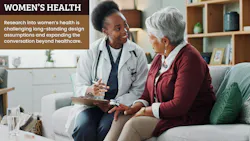
Many built-environment standards and design assumptions have historically centered men’s bodies and experiences. Even spaces dedicated to women have not always accounted for women’s experiences.
But that’s beginning to change.
Architecture and design firms, such as CannonDesign and Perkins&Will, are reconsidering past assumptions to create spaces in medical settings and elsewhere with women’s health and well-being in mind.
Some experts even see designing specifically for women’s health as a next phase of the healthy building movement, advancing efforts such as the WELL Building Standard that make human health a design priority.
“We must establish new standards, solutions, and experiences that intentionally empower women and address their physical, emotional, and social needs,” said Emily Bateman, health client leader at CannonDesign.
The emerging field of women’s health design examines how healthcare environments and other building types can respond more intentionally to women’s physical, emotional, and social needs.

Where Women’s Healthcare Design Falls Short
With few established standards specific to women’s healthcare design, some architecture and design firms are conducting their own research to better understand how the built environment can more effectively support women.
In its report Reimagining Women’s Healthcare, CannonDesign draws on conversations with women and global research to identify women’s healthcare design opportunities.
The report states that even clinical spaces, such as exam rooms, are often designed for men as the default, overlooking women’s experiences.
Design gaps identified in the report include fragmented care across multiple locations, one-size-fits-all birth and recovery rooms, and care focused on reproductive health rather than women’s needs across the full lifespan.
“Women historically haven’t been included in clinical trials,” Bateman explained. “So, it is fair to say that for generations, the onus has been on women to ‘fit into’ a healthcare system that was not designed for them.”

Design Strategies for Women’s Healthcare Spaces
CannonDesign’s research also identifies several opportunities to make healthcare environments more responsive to women’s needs. They include borrowing from hospitality to create calm, comfortable spaces.
The report also looks outside healthcare for models that could improve the patient experience—from TSA PreCheck’s to professional sports recovery programs that recognize postpartum “like the major physical and mental event that it is.”
One project CannonDesign has delivered with a focus on women’s healthcare needs is the new Women’s Center at OhioHealth Riverside Methodist Hospital in Columbus.
Scheduled to open in 2027, the 555,000-square-foot facility will house primary care, mammography, lab testing, gynecology, maternal and neonatal care, wellness clinics, and other specialties under one roof.
“This is not about making spaces more ‘feminine,’” Bateman said. “It is about creating evidence-based healthcare environments that better serve women across every stage of life.”
Designing for Women’s Well-being Beyond Healthcare
Designing for women’s health and well-being also has impacts outside of the healthcare application.
Perkins&Will is conducting research to examine how the built environment—including schools, workplaces, neighborhoods, and public spaces—influences women’s health and well-being.
The firm shares its findings through its PRECEDE (Public Repository to Engage Community and Enhance Design Equity) platform. The work is funded in part by an American Society of Interior Designers grant.
In the program’s first white paper, Designing for Her: Diagnosing the Problem, Perkins&Will draws on peer-reviewed research and other evidence to understand sex-based physiological differences and how they can influence built environment needs.
The report identifies potential differences in spatial needs related to height and body composition, thermal comfort associated with metabolic rate, acoustics related to voice characteristics, and ventilation needs associated with respiratory capacity.
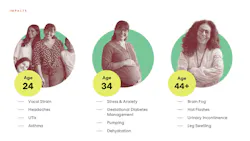
The paper also looks at women’s health and physiological needs across the lifespan, from puberty to post-menopause, and how the built environment impacts women throughout these stages.
“Just because it makes us uncomfortable to talk about these things doesn’t mean they’re not happening to our occupants,” said Erika Eitland, director of human experience research at Perkins&Will. “We have a responsibility to be mindful of what we don’t talk about and what we don’t see.”
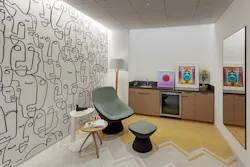
Perkins&Will identifies several ways to support women’s health and well-being beyond the healthcare setting. They include creating calm, private resting spaces within workplaces and educational facilities.
The report also suggests embedding private lactation rooms into buildings and incorporating enhanced ventilation and user-controlled thermal systems to help women manage temperature needs.
One project in which Perkins&Will focused on women’s health involved a fire station in Massachusetts. The station serves a department with over 400 firefighters, including an increasing number of women. The women shared a bunk room, bathroom, kitchen, and other spaces with their male colleagues.
Perkins&Will sought to address those needs without singling out or stigmatizing the women. The firm reimagined the station with individual bunks, a private restroom, and a separate refrigerator to store breast milk, Eitland said.
“What was good for these female firefighters actually helped the mental health, the well-being of everybody,” she explained. “So, when we are talking about women’s health design, it’s actually not in conflict with everyone else.”
Could Women’s Health Influence Future Design Standards?
CannonDesign and Perkins&Will continue to conduct research and advocate for women-focused design.
CannonDesign has launched research cohorts to advance design that supports women on their healthcare journeys. Bateman indicated that the firm is also discussing new opportunities in healthcare design with clients.

“We are talking about women’s healthcare design as much as possible,” she said. “There is still significant work to be done.”
Perkins&Will has two more research reports planned as part of its Designing for Her series—one focused on understanding the impact of the built environment on women and the other exploring design opportunities.
The firm is also conducting a national survey of K–12 educators, most of whom are women, to understand how classroom acoustics, indoor temperature, restrooms, and pregnancy- and menopause-related needs shape their health at work.
Eitland envisions work like this informing industrywide design standards, policy changes, and updates to the WELL Building Standard to explicitly account for women’s health and well-being needs.
“I hope this is the next wave of healthy buildings, where we are being really this specific and targeted in our efforts,” she said.
Key Topics in Healthcare Design


 Black male employee enjoys a window view from comfortable office
About the Author
Jenny Jones
As owner of Sprout Narratives, Jenny Jones uses her decades of communications, journalism, and editorial leadership experience to approach complex stories with curiosity, and tell them in a clear and engaging way. Her work spans engineering, technology, healthcare, science, and nonprofit sectors, as well as strategic organizational communications.