Design as Power: Cheryl Durst on What the Profession Can Do
What Design’s Human Power Requires
- Access creates agency. Durst introduces young people to design through environments and experiences they already know, helping them see themselves as participants rather than outsiders.
- Empathy requires more than intention. Deeper study of human behavior, culture, and social interaction can strengthen designers’ ability to understand how others experience place.
- Design’s value crosses sectors. Healthcare offers a visible example, while education, workplaces, cultural spaces, and mixed-use projects extend the connection between human experience and design decisions.
- Advocacy remains unfinished work. Durst argues that the profession must keep connecting design to business, health, sustainability, and the broader human condition.

The Obama Presidential Center is designed to leave an impression. Cheryl S. Durst describes the new Chicago museum as a place filled with art, architecture, storytelling, joy, hope, and a palpable sense that change is still possible. For Durst, executive vice president and CEO of IIDA, visiting carries another layer of meaning: She is among 33 contemporary “Changemakers” featured at the Center’s opening in Imagine Your Impact, an interactive exhibition centered on the power of individual and collective action.
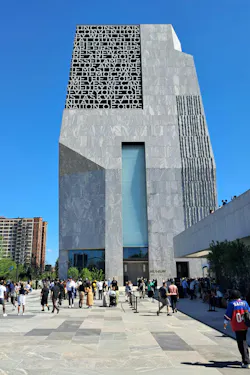
The recognition feels particularly fitting for a leader who has spent decades making the case that design is not simply aesthetic, but a social, cultural, and economic force that influences how people live and experience the world. Yet Durst sees the exhibition less as a celebration of completed legacies than an invitation to recognize our own capacity for impact—and, for designers, the power they may already be wielding without fully realizing it.
When Place Makes Possibility Feel Within Reach
Durst’s connection between people, place, and possibility began early. Growing up in the Midwest, she frequently visited Chicago with family and experienced “this sense of…accessible awe, that everything I saw around me felt accessible, felt at my fingertips.” The culture and spaces that celebrate it, from museums to libraries, “always felt like such an important part of my life,” she recalled. She still describes Chicago as possessing a “manageable majesty”—a city worthy of awe, but never beyond human reach.
That sense of access carried additional meaning for Durst. Chicago was also a major destination for Black Americans leaving the Jim Crow South during the Great Migration—a history she connects with opportunity, belonging, and the possibility of beginning again.
Belonging, equity, and inclusion have likewise defined Durst’s work to broaden participation in the design profession. “I think that is part and parcel of being a Black woman—and a Black woman in this industry,” Durst said, “ensuring that there will be others who look like me who are participating in this work of leadership or this work of design.”
That work is central to Durst’s Imagine Your Impact story: helping young people see that design is not distant or exclusive, but something they already experience—and can influence.
Design Is Power Before It Is Product
Through programs such as Design Your World, IIDA challenges the notion that design is a luxury—or something students from underrepresented and under-resourced communities cannot access.
“You have access to design every single day—from the places that you live, thinking about communities, thinking about activism in your communities, thinking about the clothes that you put on every single day,” Durst shared. “We talk about design giving you incredible agency, incredible autonomy. We talk about design as power”—whether through creation, inclusion, or helping other people live better lives.
Durst grounds that idea in places students already know. “From taking the El to healing and healthcare, to the design of a classroom, or a museum, we bring it to them in easily digestible bites: Design is for you. Design is about you.”
The more profound realization, Durst said, is that design represents an act of consideration: “There is a profession that exists that supports healing, that supports learning, that supports hospitality—[it also] supports the fact that someone thought about and considered you in the equation of the creation of place.”
Recognizing that they have been considered opens the next question: How do designers learn to consider someone else?
Empathy Needs a Knowledge Base
For Durst, empathy also requires deeper knowledge. Designers also need to understand how people behave, interact, and move through space.
Durst acknowledges that an already crowded undergraduate interior design curriculum leaves little room for additional study. Still, she sees sociology, cultural anthropology, organizational behavior, and ethnography as potentially valuable preparation for a profession “so deeply invested in the experience of the human being.”
She also sees that deeper understanding of people as a distinctly human capability in an increasingly AI-assisted profession. “This immersive understanding of human beings is…work that AI can’t do,” Durst stated. “Our connection to the human heart, the human soul, and the human brain—we are stakeholders in the destiny of humanity as a profession. And I firmly believe that can’t and shouldn’t be taken away from us.”
Design Still Has Something to Prove
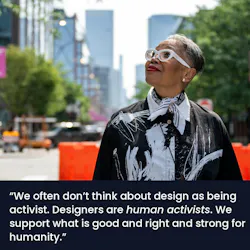
“We often don’t think about design as being activist. Designers are human activists. We support what is good and right and strong for humanity,” she said. “I think that isn’t talked about enough—an act of design being an act of optimism, but also integral to change.”
But positioning design as an act of optimism does not eliminate the profession’s longstanding challenge of demonstrating its value.
“We have gotten better as a profession and as an industry talking about return on investment. Our lexicon has expanded to include the vocabulary of our clients, the language of business,” Durst replied. “But there also is the return on emotion.”
Beyond The Story →
Learn more about the Obama Presidential Center
Explore IIDA’s Design Your World program
Get involved in design advocacy with IIDA
Healthcare remains one of Durst’s clearest examples of design demonstrating its value. Considering the needs of patients, providers, visitors, and staff can support both healing and the people delivering care—reinforcing the connection between design, well-being, and human experience.
That principle extends well beyond healthcare. Across education, commercial workplaces, cultural spaces, and mixed-use environments, designers are applying research and stakeholder input to better understand how people experience place. That work can support belonging and well-being while also helping projects reflect local culture, reduce environmental impact, and respond to broader community and client priorities.
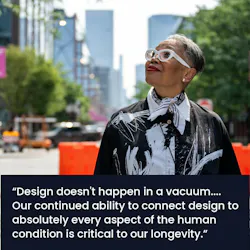
“Design doesn’t happen in a vacuum,” Durst said. “A design conversation can be a sustainability conversation. It can be a business conversation. It can be a health conversation.
“Our continued ability to connect design to absolutely every aspect of the human condition is critical to our longevity,” she continued. That advocacy increasingly reaches beyond clients to legislators, but Durst is clear that the work of demonstrating design’s necessity is not finished.

As the conversation closed, Durst returned to the Presidential Center itself. Because Barack Obama’s presidential archives are fully digital, the presidential library does not require the archival space typical of such institutions. Barack and Michelle Obama chose to use that opportunity to include a Chicago Public Library on the site—the only presidential center to have a public library. “I happened to be there one day, and a group of eight-year-olds had just gotten their first library cards,” she recalled.
That moment brings Durst’s larger argument back to human scale: access, belonging, and the possibilities that open when someone has been considered.
About the Author
 Carrie Meadows
Carrie Meadows
Head of Content
Carrie Meadows is Head of Content for interiors+sources, where she leads editorial strategy, content development, and brand storytelling focused on the people, projects, and innovations shaping the design industry. With more than two decades of experience in B2B media, she has built a career connecting technical expertise with creative insight—translating complex topics into meaningful stories for professional audiences.
Before joining interiors+sources in 2024, Carrie served as Editor-in-Chief of LEDs Magazine within Endeavor Business Media’s Digital Infrastructure & Lighting Group, guiding coverage of emerging lighting technologies, sustainability, and human-centric design. Her earlier editorial experience spans across Laser Focus World, Vision Systems Design, Lightwave, and CleanRooms, where she managed print and digital publications serving the optics, photonics, and semiconductor sectors.
An advocate for clear communication and thoughtful storytelling, Carrie combines her editorial management, SEO, and content strategy expertise to help brands and readers stay informed in a rapidly evolving media landscape. When she’s not crafting content, Carrie can be found volunteering at a local animal shelter, diving into a good crime novel, or spending time outdoors with family, friends, and her favorite four-legged friends.