Elevating Design Beyond the Default for Women’s Health
Points to Consider
- Women’s healthcare has often been defined narrowly around reproductive and maternal care.
- Economic arguments may accelerate investment, but dignity and better health should already be reason enough.
- Design standards can carry forward assumptions about whose needs and experiences are considered “typical.”
- Designers can’t solve healthcare inequity, but they can question inherited models that overlook part of the population.
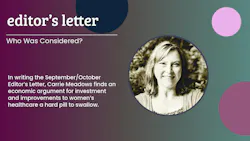
As open as I allow myself to be with our audience, I’m going to admit something unprecedented here: Background reading for this column actually brought me to the brink of tears. That isn’t the kind of admission we often make in professional spaces. But the deeper I went into the research on women’s health, the harder it became to keep the subject at a professional distance.
Women’s physical and mental health—and the lengths to which women must sometimes go to receive appropriate care—have generated plenty of discussion around equity. Still, seeing the disparities laid out plainly startled me.
In Andrea Willige’s article, “The State of Women’s Health in Numbers,” for the World Economic Forum, I learned that women tend to live longer than men but spend 25% more of their lives in poor health or with disabilities. Limited investment in women’s health research, technology, products, and services has contributed to those poorer outcomes.
The Women’s Health Investment Outlook 2026 offered another reminder: Spending remains heavily concentrated on reproductive and maternal health. I’m not minimizing those life stages or the health concerns associated with them. But women have a whole lifespan, too, and much of it doesn’t involve reproduction or raising children. A narrow view can overlook conditions that affect women differently or uniquely, including heart disease, Alzheimer’s, osteoporosis, menopause, and other hormone-driven conditions.
And then came the number that stopped me.
Willige notes that addressing poorer health outcomes among women could add at least $1 trillion annually to the global economy by 2040.
The number stopped me not because the economic argument is trivial, but because it’s unsettling that a trillion-dollar opportunity can command attention where generations of poorer health outcomes haven’t. Surely better health, dignity, and longevity should be reason enough.
As I worked through this issue of interiors+sources, I kept returning to another question—one much closer to the design profession.
Who was considered?
Our feature on women’s health design examines how healthcare environments (and others) have inherited assumptions about the people using them. Standards and systems have historically centered men’s bodies and experiences, leaving women too often to fit themselves into care models not created with their needs in mind.
Interior designers can’t solve disparities in women’s healthcare, nor can a better-designed environment compensate for gaps in research, access, diagnosis, or treatment. But designers can decide which assumptions they are willing to inherit unquestioned. Who is the “typical” patient behind a planning standard? Whose experiences informed the prototype? And when research reveals that an established model has overlooked part of the population, are we willing to reconsider the model?
Those questions extend well beyond healthcare—and get at what human-centered design actually asks of us.
We can’t design our way out of every inequity in healthcare. But we can ask whose body, whose experience, whose life stage, and whose dignity were considered when a standard became standard—and who was left outside it.
Sometimes a way forward begins just by noticing who has been missing from the room.
An abridged version of this column appears in the September/October 2026 issue of interiors+sources.
About the Author
 Carrie Meadows
Carrie Meadows
Head of Content
Carrie Meadows is Head of Content for interiors+sources, where she leads editorial strategy, content development, and brand storytelling focused on the people, projects, and innovations shaping the design industry. With more than two decades of experience in B2B media, she has built a career connecting technical expertise with creative insight—translating complex topics into meaningful stories for professional audiences.
Before joining interiors+sources in 2024, Carrie served as Editor-in-Chief of LEDs Magazine within Endeavor Business Media’s Digital Infrastructure & Lighting Group, guiding coverage of emerging lighting technologies, sustainability, and human-centric design. Her earlier editorial experience spans across Laser Focus World, Vision Systems Design, Lightwave, and CleanRooms, where she managed print and digital publications serving the optics, photonics, and semiconductor sectors.
An advocate for clear communication and thoughtful storytelling, Carrie combines her editorial management, SEO, and content strategy expertise to help brands and readers stay informed in a rapidly evolving media landscape. When she’s not crafting content, Carrie can be found volunteering at a local animal shelter, diving into a good crime novel, or spending time outdoors with family, friends, and her favorite four-legged friends.