Why Presentation Training Strengthens Design Firms
Why Invest in Presentation Training?
- Helps stakeholders understand design rationale and make decisions with confidence.
- Equips emerging designers to advocate for ideas and contribute earlier.
- Reduces misalignment that can delay approvals and disrupt project momentum.
- Strengthens client trust, team performance, and future leadership capacity.

As noted in a previous column, the way we measure design success has shifted significantly since I began my design career. Creativity, technical knowledge, and problem-solving remain fundamental to our profession, and degree programs are generally designed to nurture those qualities. But the development of soft skills—such as clear communication and presentation confidence—is often left out of an emerging professional’s education.
Building presentation confidence helps emerging designers find their voice. The next step is understanding what that voice can accomplish: aligning stakeholders, accelerating decisions, and strengthening the value a design team brings to a client. In many ways, presentation skills are not separate from project success. They are one of the factors that make it possible.
Clear Presentations Keep Projects Moving
I’ve worked on projects where the design concept was strong, the strategy was thoughtful, and the solutions were sound, yet progress stalled because the vision was not communicated effectively.

In highly collaborative environments, multiple stakeholder voices raise different priorities, concerns, and expectations, such as budget, functionality, brand identity, and occupant experience. Designers are increasingly tasked with bringing those perspectives together into a cohesive solution.
When stakeholders don’t fully understand the rationale behind a recommendation, hesitation grows. Questions multiply, decisions get delayed, and momentum is lost.
On the other hand, when ideas are presented with clarity and purpose, teams can align more quickly. Stakeholders understand not only what is being proposed, but why it matters. They can see how design decisions connect to business goals, operational needs, and long-term value. That clarity builds trust and enables faster, more confident decision-making. This is why presentation skills matter far beyond the conference room.
Translate Design Into Stakeholder Value
One of the most valuable tools within strong presentations is storytelling. Data, plans, and renderings are essential, but they become more impactful when paired with a clear narrative. To do that effectively, we need to speak in ways that resonate with varied audiences, communicating meaning beyond drawings and specifications.
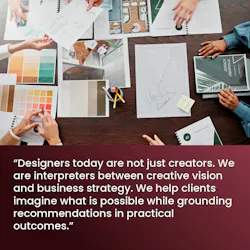
For example, a facilities leader may need to understand operational implications, such as how space planning impacts infrastructure and maintenance costs. An executive may respond to decisions that can be tied to workforce productivity, such as how circulation paths improve collaboration. Stakeholders want to understand how a design solves problems, supports people, and advances organizational priorities, such as durability, wellness, or sustainability goals.
Storytelling helps translate technical expertise into business relevance. That translation is especially important in today’s environment, where projects have become more complex and expectations continue to evolve. Clients are thinking about hybrid work, culture, talent retention, wellness, sustainability, and adaptability all at once. Design teams must communicate how physical space supports these larger objectives.
For emerging designers, this is one of the most important lessons to learn early. Many junior professionals have excellent ideas but limited experience presenting them. Without opportunities to develop those skills and build confidence, valuable ideas can go unheard.
This is where structured professional development can help emerging designers move from understanding a concept to advocating for it effectively.
Build Skills That Strengthen the Firm
During the In-Studio | Pitch Like a Pro: Elevating Presentation Skills for Emerging Designers workshop, IIDA NY Chapter hosts and invited design leaders walked through how to structure a presentation, tailor messaging to different audiences, and build confidence when speaking to clients or leadership teams. Most importantly, we emphasized preparation, repetition, and feedback.
Teams with strong communicators tend to collaborate more effectively internally because expectations are clearer, cross-functional partners engage earlier, and ideas are exchanged more openly. Junior staff also gain opportunities to make a case for their ideas, putting audience awareness, critical thinking, and communication skills into practice.
From my perspective, communication training is also leadership training. The professionals who can articulate ideas, navigate questions, and align groups around a shared vision are often the ones who grow into project leads, managers, and principals. They become trusted advisors because they know how to combine expertise with clarity.
Presentation training is not simply confidence-building for emerging professionals. It expands a firm’s capacity to communicate value, guide complex decisions, and maintain alignment from concept through execution. When more designers can connect creative ideas to stakeholder priorities, they contribute not only to stronger presentations, but to stronger projects, client relationships, and firms.
More on Talent Development

 Interior design materials samples, sketches, and models under review
About the Author
Rachel Robinson
Rachel Robinson is Creative Director and Design Principal at Ted Moudis Associates, and President-Elect of IIDA NY (2027–2028).