What Interior Design Students Need in a Strong Portfolio
What Emerging Designers Should Plan For
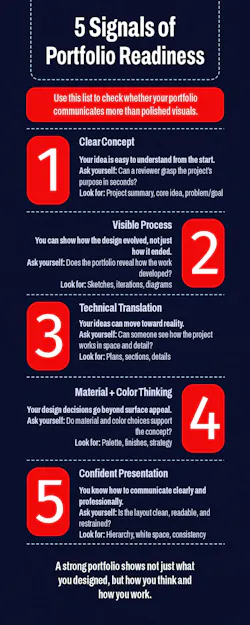
- Lead with clear ideas, not just polished final images.
- Show process through sketches, plans, sections, details, and materials.
- Use structure and white space to let the work breathe.
- Present with the same confidence your portfolio is meant to signal.

In a field where visual output is increasingly polished and expected, a strong portfolio is no longer defined by final images alone. For emerging designers, the real differentiator is not just what was designed but how they think, communicate, and translate ideas into reality.
Ahead of the American Society of Interior Designers’ (ASID’s) Student Portfolio Review at NeoCon, jurors from leading firms shared what separates a portfolio that stands out immediately from one that gets passed over. Clarity in both thinking and presentation is where that distinction begins.
Beyond the Final Rendering
“Think about the person who is reviewing your portfolio,” advised Margi Kaminski, health interiors co-leader at CannonDesign. “They are often reviewing multiple portfolios and have limited time to drill down into the details. Your portfolio must grab their attention in less than two minutes. Be concise, show what is most important, and arrange it in a way that is intuitive.”
That clarity extends beyond layout into the work itself. “A beautiful final photo is expected,” added Shundra Harris, founder and principal, Shundra Harris Interiors. “What sets a strong portfolio apart is a clear concept and how you got there, why decisions were made, and what problem you solved. Walk the reviewer through the process including the constraints, strategy, technical considerations, and outcome. That is where your value lives.”
But process alone is not enough. It has to be communicated with intention and authenticity. “A strong portfolio immediately shows personality and authenticity,” said Marianne Starke, design director and senior associate, Gensler. “It is your chance to communicate who you are and how you think creatively. Storytelling is key and you should be able to clearly convey the thinking behind each project.”
Defining Your Narrative: ASID’s Student Portfolio Strategy Review
Monday, June 8, 2:00–3:30 p.m. CDT Floor 6, Suite 6-180
Your portfolio tells your story as a designer. Join ASID to gain insight from leading designers on portfolio development. Through conversation, designers will share what makes a portfolio stand out when seeking new talent and offer advice on how to tailor a presentation based on the position you are pursuing.
Students will meet one-on-one with professionals for personalized feedback on resumes, portfolios, job and internship searches, and potential career paths. The workshop is designed help emerging designers build the strategies and confidence needed to stand out as they launch their careers.
Presenters: Margi Kaminski, ASID, RID, NCIDQ, EDAC, CLGB – Principal, Director Health Interiors (CannonDesign); Shundra Harris, FASID, RID, NCIDQ – CEO, Principal Designer (Shundra Harris Interiors (SHI)); Marianne Starke, RA, ASID, IIDA Associate – Design Director, Senior Associate (Gensler)
Moderator: Khoi Vo – CEO (ASID)
Register at: neocon.com
She also notes that confidence plays a defining role in how work is received. “Be confident in what you are showing. Be bold, be creative, and be yourself. This is your work alone, so use it to highlight what makes you different. Do not try to oversell. Confidence is not always loud. Sometimes it is quiet and restrained, and that is where its power lies.”
That authenticity is built through a range of tools—sketches, plans, sections, models, and renderings—that reveal how a designer approaches a problem, not just how they present a solution.
Still, across reviewers, a consistent gap remains: “There is often too much focus on the final image and not enough on the thinking behind it,” Harris observed. “Beautiful renders with no plans, no details, and no understanding of how it gets built.”
Kaminski points to another missing layer: materiality. “There is not always enough emphasis on materiality and color strategy. While renderings show application, without that development the work can lack the cohesiveness of a well-developed design strategy.”
Starke also emphasizes restraint in presentation. “Over-designed portfolios can compete with the work instead of supporting it. Thoughtful structure and white space signal confidence. Strong ideas should be able to speak for themselves,” she said.
Signals of Professional Readiness
Ultimately, ASID’s NeoCon 2026 portfolio reviewers are not just assessing talent, but readiness. That readiness shows up in the ability to translate ideas into something buildable and grounded in real-world constraints.
“The work needs to move beyond concept into plans, sections, details, and materials that make sense,” Harris explained. “You understand scale, coordination, and execution.”
It also shows in how designers present their work beyond the page. “The portfolio should align with interview delivery,” Kaminski said. “Candidates have the confidence to present and sometimes defend their work. This is what we do in professional practice.”
These perspectives point to a shift in how portfolios are evaluated. No longer just a visual showcase, they are a demonstration of thinking, judgment, and readiness to contribute. A strong portfolio does not just show what you have done. It shows how you work and why it matters.