Swan Dive Design Studio Transforms a Sam’s Club into a Community Hub and Pickleball Destination
Adaptive Reuse Takeaways
- A former Sam’s Club now serves as an 88,000-square-foot community hub for pickleball, dining, events, and everyday gathering.
- Swan Dive used zoning, circulation, and acoustical separation to make the big-box shell feel more welcoming and human-scaled.
- Pickleball-inspired moves—perforated surfaces, curved forms, tile grids, and bold color—give the space a playful, unified identity.
- Adaptive reuse constraints helped shape the solution, from strategic openings and structural coordination to HVAC updates connecting indoor and outdoor amenities.
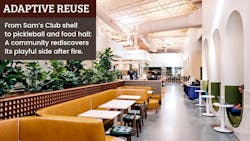
From the ashes of the 2021 Marshall Fire—the most costly wildfire in Colorado history—the former Sam’s Club in Louisville emerged as a community destination. The building briefly served as a community center immediately after the fire; now, it has taken shape as Relish Food Hall + Pickleball, a welcoming hub that blends sport, food, and social connection.
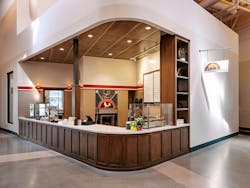
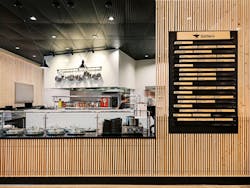
Designed by Swan Dive Design Studio, 88,000-square-foot Relish brings together 19 indoor and two outdoor pickleball courts, eight locally driven food concepts, a coffee shop, a full bar, conference areas, event spaces, an expansive outdoor patio, and a game lawn. It’s a testament to the power of play and discovery, inviting people to linger while they explore different zones.
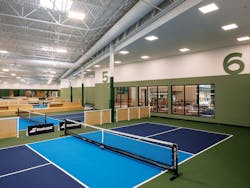
“The concept was about playfulness,” explained Aleksandra Kaplan, owner and principal of Swan Dive Design Studio. “We really thought about the idea of pickleball and how you play with someone.”
The back-and-forth nature of pickleball recalls the back-and-forth of the designer-client relationship, Kaplan said. “The concept was the play between things—things like the play between indoor and outdoor, or the play on materials and nods to the colors and patterns you see in pickleball,” she added. “There’s play on scale, because we had this ginormous box—when a Sam’s Club is empty, you realize how big it actually is. And then there’s a play of community too, where it’s about everyone being there together and creating something for all ages and having everyone feel welcome when they come there.”
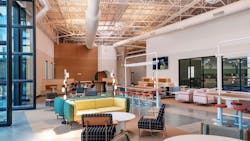
Creating a Space to Play
The interior design uses walls to rotate the interior visually and break up the big box into distinct zones, Kaplan explained. Instead of exposing the entire volume at once, elements like the central entry desk, bar, and pickleball pro shop guide guests naturally through a series of more intimate areas. An acoustically insulated wall with tempered glazing helps reduce noise between the pickleball and food areas, while oversized pivot and garage doors open to patios and the lawn to bring in nature and extend the Relish experience into the outdoors.
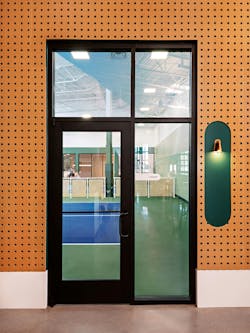
The design aesthetic references pickleball repeatedly, from the perforated exterior metal and interior pegboard walls inspired by the perforated ball, to the soft curves evoking the paddle, to the 4-by-4 tile and colorful grout that channels the net. This colorful visual language ties the entire space together, even the eight food vendors, who all came in with different visions but somehow work together visually.
“In the same way that we came up with a concept for Relish, the whole project, there are different concepts for each vendor that are specific to their food and their vision for what they wanted it to be,” Kaplan said. “They work cohesively, but they also are very different. That was a goal, where you felt like you stepped into a different concept as you walk past each one.”
Overcoming Adaptive Reuse Challenges
The nature of the building shell created several issues for the design team; namely, “Sam’s Club buildings are only built to hold a Sam’s Club,” said Kaplan. “There was literally nothing we could put on the roof. This even included HVAC units.” The team was able to reuse the existing locations of some of the HVAC units, but the rest had to be situated on the ground, with extensive ductwork running heating and cooling to their final destinations.
The client and design team also wanted a connection to the outside so they could connect the indoors to the expansive courtyard, outdoor seating, and additional pickleball courts, but they had to be strategic about how and where they punched through the walls for structural integrity reasons, Kaplan said.
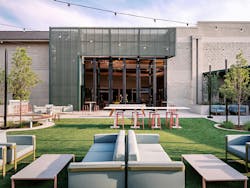
“There was a rhythm we came up with, with the structural engineer, that didn’t require a lot of structural reinforcement,” Kaplan said. “We tried to keep that rhythm with windows, and then where it really counted, we went for it and opened up the building.”
Following its grand opening in June 2025, this year-round destination now welcomes people from every stage of life for visits that range from casual drop-ins to competitive pickleball matches and celebrations. Its community-first design exudes a playful attitude and showcases what’s possible with underused big-box architecture.
“Your client’s trust is the most important thing. This is one of those situations where we really trusted our client, and they trusted us and let us flex some design muscles and come up with some bold, imaginative ideas,” Kaplan said. “It pushed us and it pushed them in this great way to create this project that’s successful for everyone.”
About the Author
 Janelle Penny
Janelle Penny
Contributing Writer, interiors+sources; Head of Content, BUILDINGS
Janelle Penny is a Contributing Writer for interiors+sources and is Head of Content for BUILDINGS. She has more than a decade of experience in journalism, with a special emphasis on covering facilities. She aims to deliver practical, actionable content for her readers.