Adaptive Reuse Brings New Life to the Historic Venice Post Office
Key Highlights
- Adaptive reuse strategy preserves a 1939 civic landmark while supporting new workplace and production uses
- Restoration and tenant improvements coordinated under a single construction manager to maintain continuity
- Interior planning balances historic architecture with flexible spaces for collaboration and specialized work
- Preservation-led façade, lobby, and mural restoration informed material choices and design detailing
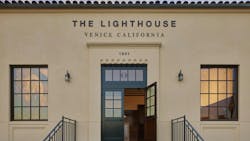
A former 1939 Venice Post Office has been adaptively reused as The Lighthouse, a California campus for content creators that balances historic preservation with interior environments tailored to contemporary modes of work. Located at 1601 Main Street, one block from the Venice Beach boardwalk, the project reflects a coordinated effort across restoration, construction management, and interior design to reposition a civic landmark for a new generation of users.
Preserving a Landmark Through Adaptive Reuse
Originally designed in 1939 by architect Louis Simon in the Mediterranean Revival style, the former Venice Post Office was carefully restored to retain its historic character while accommodating new programmatic needs. Allied Commercial led the adaptive reuse strategy, focusing on reinstating architectural features and preserving the building’s civic identity.
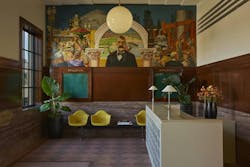
A full façade restoration included the replication of historic metalwork and the recreation of the original lobby using archival photographs and historically sourced materials. The 1941 Edward Biberman mural, Abbot Kinney and the Story of Venice, was reinstalled with guidance from an expert conservationist, reinforcing the building’s cultural significance.
Construction Continuity From Restoration to Tenant Improvements
JTM CGI served as construction manager throughout the project, providing continuity from preconstruction through final handover. The firm supported the core and shell restoration and later managed the tenant improvement phase, coordinating permitting with the city and relevant commissions, assisting with budgeting and scheduling, procuring materials, and overseeing on-site execution.
During restoration, JTM CGI worked with Chattel, Inc., BOTO Design Architects, and Pacific Edge to support historically appropriate construction methods. In the tenant improvement phase, coordination with Warkentin Associates and construction management firm JR van Dijs helped ensure a smooth transition from restoration to creative build-out.
Interior Design Supporting Creative Work
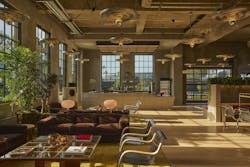
Bauhaus-inspired interiors by Warkentin Associates introduce modern spatial clarity while respecting the building’s historic envelope. Interior layouts were designed to support flexibility and collaboration, aligning with the campus’s new role as a hub for creative professionals.
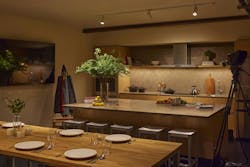
The 31,282-square-foot campus includes a raised ground floor, lower ground floor, and expansive exterior space. More than 23,000 square feet of interior programming accommodates private studios, communal workspaces, and soundproof studios for filming, recording, editing, podcasting, cooking, live-streaming, performing, presenting, screening, writing, and collaborative production.
Shared Amenities and Campus Experience
Amenities include a 50-person theater, café, conference rooms, event spaces, open-plan work areas, private meeting rooms, and an outdoor quad. Interior and exterior communal areas support shared experiences and programming, with artist installations and exhibitions integrated throughout the campus.
Recognition for Adaptive Reuse and Workplace Innovation
The Lighthouse project received the CoreNet Global Southern California REmmy Award for “Innovative Workplace – Less than 50,000 SF,” recognizing the project team’s work across both the restoration and tenant-improvement phases.
*Announcement has been edited for length and clarity.