Immersive Speakeasy Designs: Transporting Guests to Hidden Worlds
What Hospitality Designers Should Know
- Hidden entries and layered reveal sequences turn arrival into part of the guest experience.
- Salvaged materials and site history help immersive venues feel rooted, not theme-parked.
- Lighting, texture, and contrast build distinct worlds within compact or overlooked spaces.
- Strong design narratives help speakeasy concepts stand out and deepen guest loyalty.
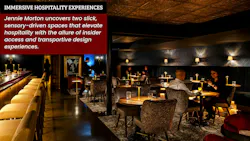
Immersive interiors deliver a showstopping experience for hospitality guests. Some destinations are turning to speakeasies as a way to delight the five senses. The key to creating a loyal following is to stay rooted in an authentic design narrative. Learn how the Naisho Room and None of the Above transport patrons out of the mundane.
![//3877 Design’s Hunter McCalla says the Naisho Room “[pays] homage to Tokyo’s underground nightlife,” integrating Japanese architectural details—including cedar wood cladding and rice paper— alongside modern elements such as neon lighting and textural artwork for an effortlessly cool and exclusive club concept.](https://img.iands.design/files/base/ebm/iands/image/2026/03/69c67f74dfa8288ea21e37b9-the_naisho_room_extra_photo_credit_joseph_d.png?auto=format,compress&fit=max&q=45?w=250&width=250)
From Sauna to Sushi
A recipe for a modern speakeasy: zest with a hidden sauna door, add a splash of neon signs, and garnish with a graffiti mural. The Naisho Room at The Watermark Hotel in Tysons, VA, is an oasis coordinated by //3877 Design.
“There’s two ways you can create an over-the-top experience. One is the ‘everything, everywhere, all at once’ approach,” explained Hunter McCalla, senior interior designer for //3877 Design. “But in a smaller space like the Naisho Room, you can make a big impact by letting one or two elements really sing.”
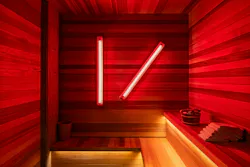
Naisho Room’s Conceal and Reveal
The Naisho Room bills itself as “a hidden cocktail and sushi sanctuary.” Guests first arrive to the hotel’s 25th floor and walk through an active fitness center. They enter through a sauna door and into a steam room before stepping into another world.
“A quirky entry sequence was part of the Naisho concept from the start,” according to McCalla. “Everything from the cedar wood cladding and waiting bench to the doors has been repurposed from an actual sauna. There’s even a fog machine for effect.”
The Naisho Room provides an omakase experience, which is a curated menu based on the executive chef’s discretion. The exclusive venue occupies around 1,600 square feet and only 52 seats. To create a vibrant atmosphere in a diminutive space, the design borrows from Japanese nightlife.
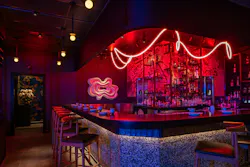
“Our concept was the Neon Den. We wanted to pay homage to Tokyo’s underground nightlife and neon lights but without being an exact replica,” McCalla said. “We also wanted to create the illusion that the space was uncovered and repurposed, even though it’s in a new building.”
The dining room is anchored by a large mural. A nod to traditional Japanese tapestry, rice paper is mixed with paint to create texture. Guests will recognize Hokusai’s “The Great Wave” alongside Da Vinci’s “Vitruvian Man.”
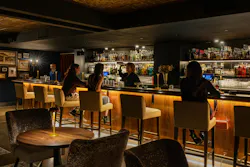
None of the Above’s Underground Glam
None of the Above (NOTA) is tucked under the City Foundry in Saint Louis, MO. Originally a subterranean space for Century Electric’s manufacturing complex, the space had suffered from a decade of neglect and flooding. But that didn’t stop Steve and Will Smith, the father-son duo leading the Lawrence Group, from seeing its potential as a nightclub.
“My team and I develop a north star for each project that we test everything against during design,” explained Galen Vassar, associate principal for hospitality with the Lawrence Group. “The north star for NOTA was creating a unique experience that speaks to the broader community of Saint Louis and the Midtown neighborhood.”
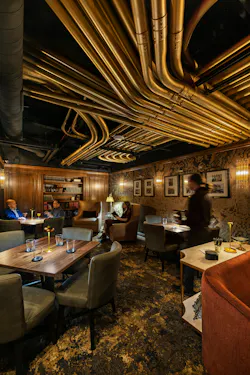
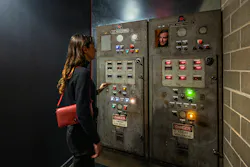
Beckoned by a red light, guests slip through a nondescript street-level door and then descend into the building’s basement. The interior entrance is disguised by electric switchboards that are still illuminated by digital readouts and pushbuttons. The journey continues down corridors lined with graffiti panels salvaged from the site’s period of disuse. In stark contrast, the bar’s atmosphere is infused with an elegant but cozy 1920s aesthetic.
“We want every guest to feel like they are entering a different time and space than the foundry’s food hall above,” Vassar emphasized. “To veer away from an industrial feel, we created a more luxe experience. For example, furniture exhibits leather and velvet looks while a tin ceiling adds flair above. We even painted overhead pipes gold to make them look aged.”
About the Author
Jennie M. Morton
A former interiors+sources editor, Jennie M. Morton is a freelance writer specializing in commercial architecture, IoT, and proptech.