Designing Pediatric Healthcare Around the Whole Family
What Designers Should Know
- Design for the family experience, not only the patient experience. Supporting parents and caregivers can help preserve connection, control, and everyday routines during hospitalization.
- Normalcy can serve a therapeutic purpose. Kitchens, recreation rooms, and gathering spaces support familiar activities while also accommodating nutrition education, rehabilitation, and recovery.
- Small privacy decisions can carry significant weight. Separating patient and family zones within rooms can reinforce dignity and autonomy during long hospital stays.
- Lived experience should inform design alongside clinical expertise. Input from former patients, parents, clinicians, and designers can reveal needs that conventional healthcare programming may overlook.

Hospitals are often remembered through emotions rather than floor plans. For Sara Gally, interior design principal at HDR, those memories are especially personal. As a child with a blood disorder, she knew what it meant to move through appointments, emergency rooms, and hospital stays with her mother by her side. Years later, that experience came full circle when she helped design the Lisa Dean Moseley Foundation Institute for Cancer and Blood Disorders at Nemours Children’s Hospital in Wilmington, Delaware—a 2025 IIDA Healthcare Design Awards Category Winner in the Hospitals (Pediatric) category.

Designed for children facing serious illness and the families navigating treatment alongside them, the institute extends care beyond clinical needs. Spaces for cooking, gathering, playing, and rehabilitation help preserve a sense of normalcy, while thoughtful details support privacy, dignity, and autonomy—small but meaningful ways of giving patients and families greater comfort and control during an uncertain time.
For Gally, designing the institute meant drawing on her experiences as a former patient and now a parent to imagine a healthcare environment where families feel fully supported and, above all, seen. Here, she reflects on the personal story behind the project and the role design can play in healing and well-being.
IIDA: As someone who spent time in hospitals as a child, what did returning to one as a designer mean to you personally?
Sara Gally: As a healthcare designer, I know that the bar for hospital design in most people’s eyes is pretty low. For most of us, finding ourselves in a hospital—whether as a patient or family member—often coincides with what might be the most difficult time in our lives. To me, designing in healthcare is an opportunity to not only raise the bar, but to provide comfort and support when we need it the most.
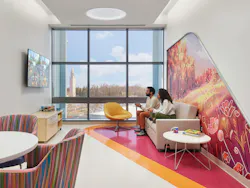
IIDA: You shared that walking through the completed institute with your mom and your own children felt like a full-circle moment. How did your personal experiences shape the way you approached the design?
Gally: While working on the Moseley Institute, I had so many memories of what it was like going to and from appointments, sitting in emergency rooms, and spending the night in the hospital with my mom sleeping beside me. At the same time, I thought of my own kids, and how difficult it would be to have to put our lives on hold to nurse them through serious illness.
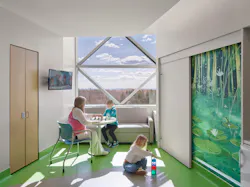
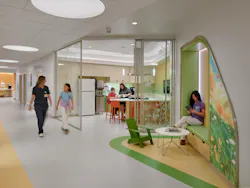
Throughout the design process, we tried our best to empathize with both the patient and the parent. How could we make the environment less intimidating and more supportive? How could we keep patients and families connected to their day-to-day lives despite the disruption of hospitalization? How could we infuse a sense of control and empowerment for families during their stay? I feel very lucky to have been able to draw on my own experience to help answer these questions, and truly hope that the families who find themselves on this unit feel seen during their stay.
IIDA: The institute creates spaces for children and families to cook, gather, play, and simply spend time together—not just receive treatment. How did your understanding of whole-person well-being shape those decisions?
Gally: During my childhood illness, I was fortunate not to have to stay hospitalized for long periods. When thinking through the design of the multipurpose areas on this unit, I drew heavily on my experience as a parent instead. When facing long and potentially repeat hospitalizations, how can we provide a sense of normalcy through meal time, play, and peer interaction?
In addition to providing that sense of normalcy, we also wanted these spaces to improve outcomes. The kitchen isn’t just a place to prepare a meal; it’s a place to work with a nutritionist to learn how healthy eating can support your recovery. The rec room isn’t just a place to decompress; it’s a space where you can work with a physical therapist to regain your strength before returning home to continue care as an outpatient. We were so fortunate to have the chance to work with the brilliant, passionate staff at Nemours to create a space designed for both healing and well-being.
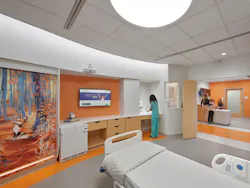
IIDA: Is there one design decision—or perhaps one space—that quietly embodies the project’s philosophy, even if visitors don’t consciously notice it?
Gally: It may seem trite, but the first thing that comes to mind is the privacy screen that separates the patient and family zone in the patient room. The suggestion for privacy between kids and their parents came from a mom whose son had once been a patient on the unit. Her son was a teenager, and she told me, “He didn’t want me seeing him getting changed, and he certainly didn’t want to see me changing either!” So often as parents, our inclination is to stay as connected as possible to our children, but when facing a long-term hospitalization, it’s important to recognize the dignity and autonomy of both the patient and the parent.
I’ll never forget seeing her again on opening day and touring through the unit with her. She was thrilled with the final result and thanked our team for listening. It was one of the most rewarding experiences of my career, both as a former patient and as a parent.
The Lisa Dean Moseley Foundation Institute for Cancer and Blood Disorders was a 2025 IIDA Healthcare Design Awards Category Winner. Explore past winners and learn more about the annual IIDA Healthcare Design Awards at iida.org.
IIDA: Hospitals can leave lasting emotional memories. What feeling did you hope children and families would carry with them long after leaving the building?
Gally: More than anything, I hope the patients and families who use this space feel seen. Like the designers, builders and clinicians who worked together to bring this space to life did so with them in mind. The road to healing can be so difficult, particularly for kids. I hope this environment has a positive impact not only on their recovery, but on their path to becoming who they’re meant to be.