3 Workplace Design Strategies That Support Focus and Well-Being
Key Design Moves -
- Use layered, indirect lighting instead of uniformly bright illumination.
- Balance visual access with enclosure to reduce distraction without creating isolation.
- Provide opportunities to stand, shift posture, and move without introducing constant motion.
- Give employees more control over sensory conditions and focus settings.
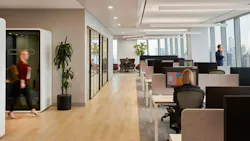
New research from Corgan and the University of Arkansas suggests that workplace design can play a measurable role in helping people manage distraction, cognitive load, and sustained attention.
Focus by Design: What the ADHD Brain Teaches Us About Better Workspaces for All was led by Corgan’s research and innovation group, Hugo, in partnership with the University of Arkansas and supported by the AIA Upjohn Research Initiative, with additional academic collaborators from Virginia Tech and Drexel University. Researchers studied 20 adults with inattentive-type ADHD as they completed cognitive tasks in open and enclosed office environments. The mixed-methods study combined EEG brain monitoring, wearable physiological sensors, behavioral observation, and participant surveys to examine responses to changes in lighting, spatial orientation, movement, acoustics, and other sensory conditions.
While the study focused on people with inattentive-type ADHD, researchers say the findings can inform workplaces for a broader range of employees navigating distraction and sensory demands. Three findings offer particularly practical applications for commercial interior designers:
1. Layer Lighting Instead of Relying on Uniform Brightness
Participants reported feeling calmer, less stressed, and more focused under dimmer, indirect lighting, while bright, direct light increased distraction and eye strain. EEG measurements also showed greater sustained attention under diffused lighting conditions. For designers, the findings favor layered illumination and individual control—such as adjustable task lighting—rather than uniformly bright environments.
From a neurodivergent worker’s perspective: As someone with ADHD and a chronic neurological condition, I wholeheartedly support these findings on lighting. It’s the number one uncontrolled variable that can make me go from casual watercooler conversation to “Where is the least amount of direct light in this space?” in mere minutes. (Second to that is overpowering scents.)
2. Balance Visibility With a Sense of Enclosure
More enclosure did not automatically produce better focus. In open-office testing, configurations that limited direct visual distraction while giving participants a wall or protected area behind them produced the lowest measured cognitive load. Researchers found that controlled visibility—maintaining some awareness of surroundings without constant exposure to movement—can support attention better than either complete isolation or unrestricted openness. Designers can apply that principle through workstation orientation, partial screens, acoustic hoods, and varied focus settings.
From a neurodivergent worker’s perspective: I can say at least from where I sit, every day and even every hour is different as far as distractability is concerned. While focus can certainly depend on the task at hand, I believe having multiple workspace options with different levels of visibility and acoustic management would go a long way toward increasing productivity, as well as offering that novelty many neurodivergent minds need in order to stay motivated.
3. Design for Purposeful Movement, Not Constant Motion
Small posture changes appeared to help participants regulate attention. Sit-stand desks improved reported comfort and mood and, in the open-office setting, were associated with EEG changes interpreted as reduced cognitive load. Continuous-motion seating, however, reduced comfort and perceived attention. The takeaway: Give employees opportunities to shift posture, fidget, stand, or take larger movement breaks without assuming that more movement is always better.
From a neurodivergent worker’s perspective: Now I don’t assume that everyone is like me. Yet at the same time, I do know how I respond to the sit-stand desk situation, and in my case, it just hasn’t worked in the long term. It’s already a struggle for me to establish an ergonomic and comfortable seating and desk/keyboard/mouse configuration. When I alternate standing, it feels like I can never get the comfort level just right. Plus, standing still is no better for me than sitting still, because it causes joint pain. I imagine that if you are specifying workstations with more granular levels of lift and additional modifications to ensure adaptability to different employees, it would be a welcome solution to many. —Carrie Meadows
About the Author
 Carrie Meadows
Carrie Meadows
Head of Content
Carrie Meadows is Head of Content for interiors+sources, where she leads editorial strategy, content development, and brand storytelling focused on the people, projects, and innovations shaping the design industry. With more than two decades of experience in B2B media, she has built a career connecting technical expertise with creative insight—translating complex topics into meaningful stories for professional audiences.
Before joining interiors+sources in 2024, Carrie served as Editor-in-Chief of LEDs Magazine within Endeavor Business Media’s Digital Infrastructure & Lighting Group, guiding coverage of emerging lighting technologies, sustainability, and human-centric design. Her earlier editorial experience spans across Laser Focus World, Vision Systems Design, Lightwave, and CleanRooms, where she managed print and digital publications serving the optics, photonics, and semiconductor sectors.
An advocate for clear communication and thoughtful storytelling, Carrie combines her editorial management, SEO, and content strategy expertise to help brands and readers stay informed in a rapidly evolving media landscape. When she’s not crafting content, Carrie can be found volunteering at a local animal shelter, diving into a good crime novel, or spending time outdoors with family, friends, and her favorite four-legged friends.