How AWI Is Helping Designers Build Bolder Ideas
Why This Matters to Design Leaders
- Integrated portfolios can help designers connect material expression, performance, and execution earlier in the process.
- A&D feedback is shaping how AWI develops, acquires, and adapts products for more complex interior environments.
- Early design assist can help protect design intent across budgets, codes, acoustics, installation, and owner expectations.
- Custom solutions may point manufacturers toward scalable innovations that support future specification needs.
During Chicago Design Week, interiors+sources sought opportunities to speak with exhibitors keen to provide deeper insight into their product development. Several industry leaders connected the strategies behind their launches with current design pressures: creating spaces that support people first, reduce environmental impact, and make complex ideas achievable.
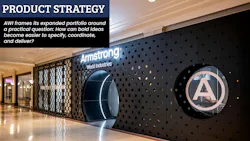
Armstrong World Industries (AWI) offered one of the clearest examples of that shift during NeoCon at The MART, using its showroom presence to demonstrate how manufacturers can respond to designers’ need for integrated, high-performance systems.
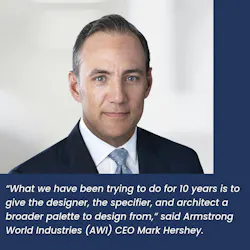
In conversation with interiors+sources during a NeoCon walk-through, AWI CEO Mark Hershey explained how the company has evolved its strategy around expanded material choice, early design collaboration, and product development that starts from real challenges.
“What we have been trying to do for 10 years is to give the designer, the specifier, and architect a broader palette to design from,” Hershey told us at the outset of the tour, led by head of marketing Alex Kreitman.
A Broader Palette for Built Experience
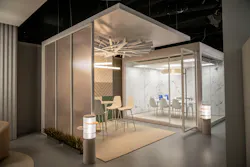
To strengthen the point that AWI’s growing brand portfolio is intended to support experiences, the team used the showroom to demonstrate how its offerings can work together across applications.
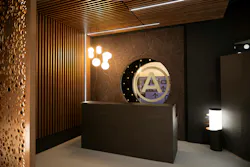
The showroom made that strategy visible from the entrance. A perforated metal exterior façade treatment from Zahner created a threshold moment before visitors moved into interior zones organized around “Day” workplace settings and “Night” hospitality-driven expressions. Together, the vignettes showed how AWI’s brands can support a more continuous conversation between surface, system, material, and experience.
When A&D Input Shapes the Portfolio
In fact, Hershey noted, AWI’s development decisions and acquisitions are often the result of challenges or customization questions surfaced by design and specification customers with sales representatives. “Almost all our new product development and our acquisition activity draws from that ‘voice of the market,’” he said.
Long-term product development partnerships—such as the one AWI cultivated with panel and surface materials brand 3form and its partner lighting brand LightArt—ultimately led to an acquisition. In turn, that combined brand expertise allows AWI to pursue more architectural integration that helps solve design problems.
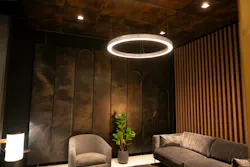
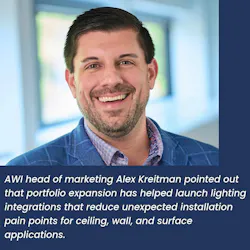
For example, Kreitman pointed to linear lighting made possible by LightArt, integrated in the Woodworks Grille ceiling installation in the “Night” zone’s bar area. It was a response to challenges brought up by the A&D community, Kreitman said. Lighting specified separately from the wood ceiling would often result in installation problems on site. “We partnered with LightArt to manufacture that light to perfectly fit the system, so it literally snaps into place,” he explained.
Similarly, the Zahner acquisition extended AWI’s reach to exterior façade systems, while the brand’s engineering capabilities introduced new interior panel designs and finishes that complement acoustic offerings from Turf, feature-wall styles from Arktura, and backlit dividers from Móz.
The Business Case for Earlier Collaboration
Over time, Hershey added, complementary brand acquisitions have also enabled AWI to expand its consultative capabilities and bring more early support to designers—whose role increasingly extends beyond finish selection into early planning conversations around performance, experience, coordination, and long-term value.
“Five years ago, we weren’t using this phrase: ‘design assist.’ In the last 24 months alone, we’re using the phrase design assist all the time,” Hershey said. For designers balancing visual ambition with budgets, installation realities, energy goals, acoustics, codes, and owner expectations, that early feasibility support can help protect design intent before it’s diluted by project constraints.
And Hershey made clear that consultative relationship doesn’t come at an additional cost: “It’s not a charge. It’s not a service fee. It’s actually a partnership, a collaboration mindset that happens very early.”
He reiterated the idea that partnering with designers on custom solutions can open a path to scalable product innovation—a mutually beneficial venture for AWI and its customer base. “Oftentimes, there will be an ultra-expressive, custom one-off project that has never been done before,” Hershey said. Not only does such custom work solidify business relationships, it also focuses the company’s efforts toward examining which architectural solutions can be translated into more broadly useful offerings.
That may be where AWI’s legacy matters most. The company’s history in ceiling systems gives it a practical understanding of performance, documentation, installation, and long-term reliability—requirements that rarely disappear from a project, no matter how expressive the design vision becomes. Its expanded portfolio now builds from that foundation, positioning future innovation around a more collaborative question: How can manufacturers help designers preserve bold ideas while making them easier to specify, coordinate, install, and sustain over time?
About the Author
 Carrie Meadows
Carrie Meadows
Head of Content
Carrie Meadows is Head of Content for interiors+sources, where she leads editorial strategy, content development, and brand storytelling focused on the people, projects, and innovations shaping the design industry. With more than two decades of experience in B2B media, she has built a career connecting technical expertise with creative insight—translating complex topics into meaningful stories for professional audiences.
Before joining interiors+sources in 2024, Carrie served as Editor-in-Chief of LEDs Magazine within Endeavor Business Media’s Digital Infrastructure & Lighting Group, guiding coverage of emerging lighting technologies, sustainability, and human-centric design. Her earlier editorial experience spans across Laser Focus World, Vision Systems Design, Lightwave, and CleanRooms, where she managed print and digital publications serving the optics, photonics, and semiconductor sectors.
An advocate for clear communication and thoughtful storytelling, Carrie combines her editorial management, SEO, and content strategy expertise to help brands and readers stay informed in a rapidly evolving media landscape. When she’s not crafting content, Carrie can be found volunteering at a local animal shelter, diving into a good crime novel, or spending time outdoors with family, friends, and her favorite four-legged friends.