Design Innovation at Salone 2026: Embracing Resilience, Sustainability, and Digital Fabrication
At a Glance
- The event attracted over 316,000 attendees from 167 countries, emphasizing its global significance and the increasing importance of international collaboration in design.
- Growth in markets like the U.S., Canada, South America, and South Korea presents new opportunities for international projects and cultural understanding.
- The fair’s focus on contract design and upcoming masterplans like OMA’s signals a booming global market for large-scale commercial and hospitality developments.
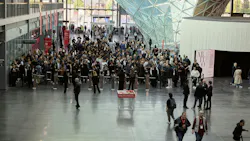
The 2026 edition of Salone del Mobile.Milano reinforced what many interior designers and architects are already experiencing: The global design market isn’t slowing down, it’s shifting.
The six-day event underscored a growing demand for cross-border collaboration, giving firms greater access to international vendors, materials, and clients. For practitioners, that translates into expanded sourcing opportunities and increased competition to deliver globally informed design solutions.
“With 316,342 presences from 167 countries, the 2026 edition has reaffirmed the strength of a system that, even in the most challenging of times, has chosen to move forward,” said Maria Porro, president of the Salone del Mobile.Milano. “It was a success not just in terms of the trade fair itself, but for the entire sector: a result of teamwork, a shared vision, and dialogue between different worlds that find a concrete synthesis here. The Salone does not merely bring the world of design together: It sets it in motion. It transforms attendance into relationships, content into opportunities, and complexity into direction.”
Doubling Down on Resilient Luxury
One of the overarching takeaways from the 2026 edition of Salone del Mobile.Milano was a departure from flashy novelty toward what I’d call “resilient luxury.” These are products and spaces designed to last longer, age better regardless of traffic usage, and justify a designer’s endorsement through durability, material integrity, and adaptability. Products in the bathroom and surfaces categories are the movers of this resilient luxury, where brands displayed:
- stainless steel instead of plated finishes
- engineered longevity
- repairability
- recyclable materials
- prioritizing timeless details over trendy styles.
Highlighted during EuroCucina and the International Bathroom Exhibition, key sectors like kitchen and bath continue to evolve as central drivers of residential and hospitality projects. The integration of technology, performance, and lifestyle-focused design in these areas signals rising client expectations for highly functional, experience-driven spaces.
This matters because hospitality, workplace, multifamily, and healthcare clients are increasingly asking manufacturers and designers to prove the long-term performance of their projects and products, beyond the aesthetic appeal. Such conversations show that sustainability and circularity messaging is maturing as general public awareness grows. See how Fantoni shared its sustainability story at Salone, courtesy of Kenn Busch.
Circular and sustainable specification has infiltrated all product categories as an expectation for project and product longevity and viability.
Brands also presented bathrooms as regenerative spaces or spa-like retreats, not utility rooms. Moving past sterile white minimalism, Salone exhibitors presented warm, natural palettes in these spaces. Biophilic elements like natural wood and stone combinations enhanced the space, which was more in line with hospitality-style emotional design than previous bathroom aesthetics.
If this proves to be a long-term trend beyond the residential setting, bathroom design will become a stronger occupant-experience conversation in the workplace, senior living, higher education, and hospitality sectors.
Invisible Tech
Commercial interior clients are prioritizing wellness, neurodiversity consideration, emotionally restorative environments, and hospitality-inspired experiences across markets. But the presence of technology in those spaces evolved at Salone. Brands are integrating technology into their products, rather than displaying smart-tech interfaces. Salone exhibitors debuted concealed wellness systems; seamless lighting and washing function integration; ergonomic automation; and digitally fabricated materials that feel handcrafted.
The development of invisible technology speaks to a larger fatigue with overly digitized environments and a need for spaces with warmth, tactility, and emotional comfort at the forefront, with integrated technological functionality. I’m curious to see how invisible technology shows up in healthcare spaces where access to these systems must be quick and accessible to the care teams, without affecting patients’ emotional and physical healing.
Computational Craft
Traditional craftsmanship is no longer at odds with advanced fabrication, as many winning projects at SaloneSatellite combined robotics, computational design, algorithmic patterning, 3D printing, and bio-material experimentation, merged with handmade or culturally rooted design. The winning designs successfully used technology to enhance the material richness, human touch, sustainability, and story of the finished product.
Tradeshow recognition suggests a new lane for artificial intelligence (AI) and computational design tools to support human craft. Time will tell if these tools will enable more scalable custom fabrications for contract environments. Regardless, material storytelling within the space remains essential and may require additional quality checks as digitized production system integration continues. As with anything related to AI, verifying the finished product is of high quality and reflects the design intention becomes more important to avoid a breakdown in the overall project outcome.
Distributed Global Design Influence
Geographically, growth in markets such as the United States, Canada, and emerging regions like South America and South Korea points to new business pipelines. For designers, this means greater potential for international projects, but also a need to understand regional preferences, codes, and cultural nuances.
The launch of Salone initiatives in Saudi Arabia, and partnerships in Hong Kong and Miami, suggest the industry is diversifying outside European markets. This may promote more cross-cultural material palettes, regionally inspired craft influences, and products designed for global flexibility for contract designers around the world. Manufacturers are seeking global reach, so designing for international specification standards and hospitality expectations is becoming more common.
Beyond products, the fair’s emphasis on contract design, particularly with the upcoming 2027 masterplan led by OMA, highlights a booming global contract market. This presents opportunities for architects and designers working in large-scale commercial, hospitality, and mixed-use developments to engage with more complex, systems-driven design challenges.
Equally important is the event’s role as a networking engine. With a high percentage of international trade professionals, Salone continues to function as a critical space for building relationships with manufacturers, developers, and collaborators—connections that often translate directly into project opportunities.
The presence of emerging designers and experimental exhibitions also signals where the industry is headed. For firms, this offers a preview of future design directions and a chance to tap into new talent and ideas that can differentiate their work.
“First and foremost, the Salone del Mobile.Milano 2026 has given a concrete shot of confidence to the entire sector,” said Claudio Feltrin, president FederlegnoArredo. “Against a complex international background, the results have exceeded all expectations, as the figures clearly show. A successful challenge that allows us to look ahead to the coming months with cautious optimism, but above all enables us to state that, once again, the Salone del Mobile was called upon to send a signal of recovery and confidence to the country, and it did not disappoint.”
Despite global market uncertainty, Salone’s continued growth reinforces its value not only as a showcase but also as a strategic tool. For interior designers and architects, it’s a place where market shifts become visible, trends turn into specifications, and connections evolve into business.
What This Means for A&D Professionals
Indicator of Global Market Stability and Demand
The strong attendance and international participation suggest that, despite economic and geopolitical uncertainty, the design and furnishings sector remains resilient. This provides industry professionals with a benchmark for assessing market confidence and future business outlook.
Insight into Shifting Geographic Demand
Data highlighting growth in countries such as the United States, Germany, and emerging regions offers a clearer picture of where demand is increasing. This helps professionals identify potential markets for expansion, partnerships, or targeted business development.
Emphasis on Key Product Sectors
The prominence of exhibitions focused on kitchens, bathrooms, and technology reflects evolving priorities in residential and commercial design. This signals to designers and manufacturers which categories are driving innovation and client interest.
Role of the Event as a Networking and Business Platform
The concentration of industry stakeholders—including buyers, investors, and media—demonstrates the event’s function as a hub for relationship-building and deal-making. For professionals, this underscores the importance of such events in generating partnerships and project opportunities.
Salone del Mobile.Milano Product Highlights
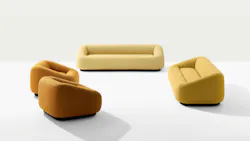
Arper
A radical rethink of upholstered seating, Aom by Arper, designed by Jean-Marie Massaud, simplifies form and construction through a two-component system. Built from interlocking expanded polypropylene (EPP) and recyclable Breathair padding, it eliminates polyurethane entirely for a more sustainable, circular design. Lightweight and modular, Aom is available in one-, two-, and three-seat configurations, seamlessly adapting from indoor lounges to outdoor terraces. Its breathable, water-resistant materials ensure comfort, durability, and ease of reconfiguration.
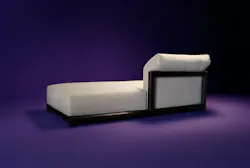
B&B Italia
B&B Italia Untitled seating system by Vincent van Duysen redefines modern sofa design through a refined balance of structure and comfort. A visible solid wood frame—available in brushed light oak, brushed dark oak, or ebony-stained beech—creates an architectural foundation, enhanced by subtle chamfered edges that catch the light. Soft, inviting cushions contrast with the structure, delivering ergonomic comfort. This modular seating system includes sofas, armchairs, and ottomans, offering flexible configurations for residential and contract interiors, both indoors and out.
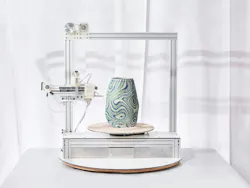
Jüngerkühn
Jüngerkühn Soft Touch Porcelain Vases merge robotic precision with tactile craftsmanship, redefining contemporary ceramic design. Created using a custom-built digital fabrication system, each vase features material-driven textures that feel organic and almost human. Layered porcelain is shaped through responsive, subtractive techniques like scraping and cutting, enhancing material depth and individuality. Ideal for collectible design and high-end interiors, Soft Touch embodies the future of craftsmanship—where advanced technology meets the expressive, sensory qualities of handmade objects.
Lodes
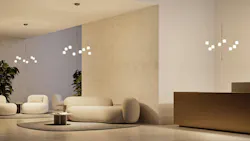
Axia by Lodes is a sculptural suspension lamp that balances light, form, and technology through a contemporary chandelier expression. Measuring 78 cm wide with a 66-cm fixture height and adjustable suspension up to 400 cm, it features a central conductive axis that eliminates visible cables. Branching arms enhance its sense of lightness, while integrated LED illumination (2700K or 3000K) provides a soft, diffused glow. Available in Black Chrome or Polished Bronze.
Neolith
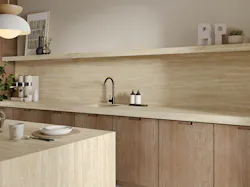
Colosseo by Neolith reimagines classic travertine with a luminous beige palette and refined mineral depth, delivering a serene, architectural surface for modern interiors. Available in 6 mm for continuous wall and floor applications and 12 mm for high-performance kitchen and bathroom countertops, this sintered stone features a soft matte finish that diffuses light beautifully. Ultra-hygienic, UV-resistant, and easy to clean, Neolith Colosseo is ideal for residential and commercial projects seeking durability, elegance, and sustainable surfacing solutions.
Pedrali
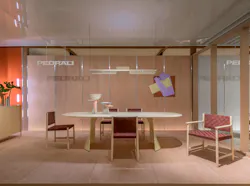
Pedrali Kawara Pendant Lamp by Yusuke Kawai draws inspiration from traditional Japanese roof tiles, translating cultural form into a refined, contemporary lighting solution. Crafted from extruded aluminum, it features a modular design with one, three, five, or seven adjustable elements for precise light direction. A dimmable LED strip enables brightness control, while elegant grooves add visual depth. Ideal for hospitality, workplace, and residential settings, Kawara delivers customizable, design-forward illumination with scalable configurations up to 82.3″ wide.
Russo Betak
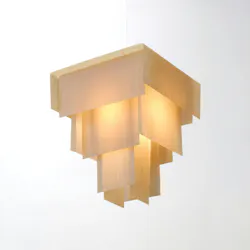
Russo Betak NIPPON Pendant Light redefines sustainable lighting through a fusion of bio-engineering and craftsmanship. Part of the ARK collection, it is 3D printed using biomaterials derived from recycled sea shells, such as oysters and scallops. Then it is hand-shaped to preserve fluid, sculptural gestures. This innovative process creates a unique light diffusion and organic form. The pendant is available in a short and long version. Inspired by Danish and Japanese design traditions, NIPPON delivers a refined, minimalist aesthetic, making it an ideal statement pendant for contemporary residential, hospitality, and gallery spaces.
Tuuci
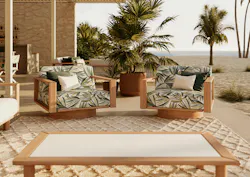
Tuuci Swivel Lounge Chair within the Luma, Sail, and Horizon collections offers a refined, all-weather seating solution with a full 360-degree swivel for effortless comfort and interaction. Used in pairs, groups, or as a single accent, it introduces a more versatile way to define the environment. Built with Tuuci’s Aluma-Forge cold-weld construction, it ensures longevity across indoor and outdoor environments. Available in Classic and Deep seating depths, it features high-performance, waterproof cushions with a range of finishes, accent trims, and fabrics. Each collection expresses a distinct aesthetic—ranging from architectural to minimal to relaxed—while maintaining consistent performance, customization, and luxury appeal.
Blå Station
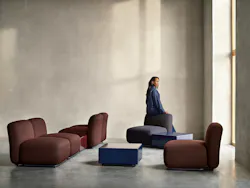
Designed for dynamic interiors, the Blå Station Soma seating collection by Geckeler Michels pairs minimal components with maximum versatility. Featuring modular seating units, integrated tables, and removable slipcovers, Soma enables endless configurations for lounges, waiting areas, and workplace environments. Its contract-quality construction ensures durability, while refreshable covers enhance sustainability and lifecycle performance. With options ranging from armchairs to three-seat sofas, Soma delivers scalable, design-forward seating for architects and interior designers.
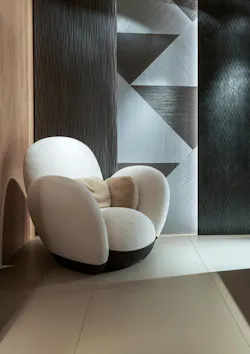
With its bold, botanical inspiration, the Laurameroni Succulenta Armchair by Bartoli Design delivers a striking visual element for high-end interiors. Its generous 146 x 112 x 148 cm dimensions create a cocooning experience, while the continuous silhouette enhances ergonomic comfort. Available in a wide range of upholstery options—including custom fabrics—this armchair supports tailored design solutions. Perfect for architects and interior designers, Succulenta elevates lounge environments with texture, form, and luxury performance.
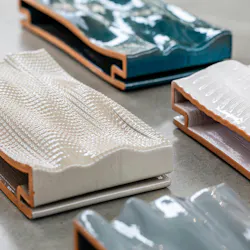
IOUS Studio 3DP Ceramic Tiles redefine architectural cladding through advanced computational design and digital fabrication. Developed by IOUS Studio, this innovative system uses 3D-printed clay extrusion to create highly precise, customizable ceramic surfaces with minimal material waste. Blending machine accuracy with the tactile richness of clay, it introduces a new form of craftsmanship. Ideal for contemporary façades and interior applications, 3DP Ceramic Tiles offer architects and designers cutting-edge solutions for expressive, resilient, and sustainable surface design.
About the Author
 Lauren Brant
Lauren Brant
Staff Writer, interiors+sources and BUILDINGS
Lauren Brant is Staff Writer for both interiors+sources and BUILDINGS. She is an award-winning editor and reporter whose work has appeared in daily and weekly newspapers. In 2020, the weekly newspaper won the Rhoades Family Weekly Print Sweepstakes—the division winner across the state's weekly newspapers. Lauren was also awarded the top feature photo across Class A papers. She holds a B.A. in journalism and media communications from Colorado State University-Fort Collins and a M.S. in organizational management from Chadron State College.