Fantoni Shows What Circular Furniture Manufacturing Looks Like at Scale
What Designers Should Know
- Fantoni’s recycled wood story is backed by national recovery infrastructure, not just product-level claims.
- The company’s particleboard uses 100% recycled wood, while its MDF incorporates recycled content in the core layer.
- Its “Dracula” sorting system helps turn post-consumer wood waste into usable fiber for new panels.
- New surfaces, upholstery alternatives and acoustic panels connect circularity with performance and specification value.
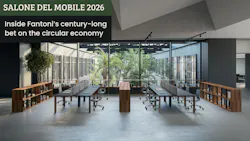
I’ve been covering furniture and materials fairs in Europe for decades now, and have learned that if you start a sustainability—and now circularity—discussion with a supplier from Italy, for instance, you’d better buckle up.
While not quite “light years” ahead of the North American industry, you do get the feeling that they’ve left the rest of us in the (saw)dust.
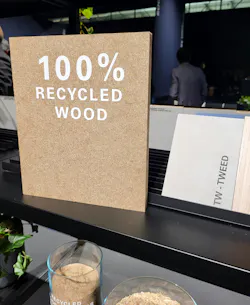
A visit with Fantoni, the vertically integrated materials and office furniture manufacturer, during this year’s Salone del Mobile fair brought this message home.
“At past exhibitions, you’ve had signage declaring that your furniture is made from 100% recycled wood,” I said. “I don’t see that this year; did something change?”
The answer: For many customers, especially in Europe, high sustainability performance is becoming table stakes for Italian suppliers. Here’s why.
Post-War Resources Demanded Ingenuity
Italy emerged from World War II with devastated forests, a bombed-out industrial infrastructure, and almost no raw material resources. It faced enormous demand for wood-based products to rebuild, but manufacturers in the Udine region where Fantoni was founded couldn’t harvest their way to production. They had to rethink the feedstock itself.
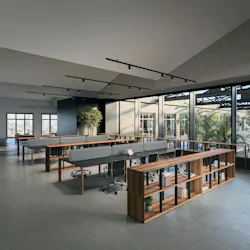
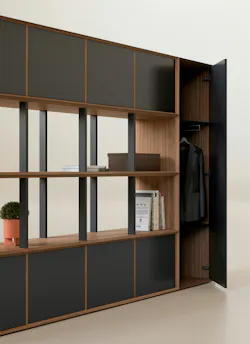
Particleboard producers, who were already transforming low-grade virgin fiber and post-industrial waste wood (offal) from forestry and furniture plants into engineered panels, were uniquely positioned to also make use of post-consumer wood waste.
In 1998, Italy launched Rilegno (“re-wood”), the national wood packaging recovery consortium. By the early 2000s, that initiative had signed collection agreements with thousands of Italian municipalities and was moving nearly two million tonnes of recovered wood annually—roughly 95% of it destined for panel production.
Without this infrastructure investment and the sorting technologies it inspired, Fantoni would not have achieved 50% recycled content across 70% of its MDF, nor would it have developed its 100% recycled content particleboard.
“We’ve been producing panels from recycled wood for thirty or forty years,” marketing director Rosita Venturini said. “This is why Italy has the best technologies for recycling materials in Europe.”
Manufacturing and Material Innovations
The company’s sorting facility also processes approximately 450,000 tonnes of post-consumer wood waste annually using a sorting system referred to as “Dracula.”
“The role of Dracula is to select the material,” explained Venturini. “It collects waste wood—offcuts from the furniture industry, fruit and vegetable boxes, old furniture—and carries it on a belt through a long series of sorting plants, where we remove paper, glass, metal frames, inerts. At the end, you have only wood waste.”
Dracula delivers 1,000 cubic meters of wood fiber a day—wood that is, effectively, back from the dead.
Fantoni’s own closed-loop production is even able to recover fiber from end-of-life MDF panels themselves, which the industry has long considered unrecyclable at scale.
“We have a patent for a production of MDF that allows us to use more recycled content in a material that is usually made with all virgin fiber,” Venturini said. “Our panels have three layers. The top and bottom are virgin-fiber MDF, and the middle has between 40 and 50% recycled wood.
“It’s a huge investment of around 85 million euros to produce this panel,” she revealed. “And at the moment, we’re the only one in the world to produce it, and we are very proud of that.”
The broader message Fantoni projects is that environmental responsibility and market leadership are not in tension—they’re the same strategy. By designing their own process engineering rather than adopting off-the-shelf solutions, they’ve turned circularity into a competitive differentiator: premium panels with high recycled content, produced with largely renewable energy, in a campus that has been continuously designed and refined by a single architectural partnership (Studio Valle) for over 50 years.
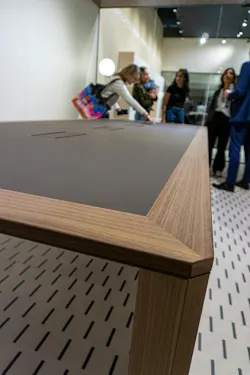
Beyond wood, Fantoni is also addressing other materials trending in office furniture. One was a new faux leather developed by an Italian supplier from cotton jersey backing coated in a blend of apple waste from Trentino Alto Adige and soy—approximately 50% agricultural residue—and used as upholstery on executive furniture.
“It’s not necessary to use real leather,” Venturini observed, “where all the activities to produce and finish it are very unsustainable. These new solutions have the same spirit, the same feeling, but they are far more responsible.”
For the A&D community, Fantoni essentially argues that specifying their products means participating in a genuinely circular material economy—not just checking a certification box.
A Sound Idea
Fantoni’s Nanofor acoustic panel line drew equal attention, particularly a demonstration installation pairing two adjacent rooms: one treated with the company’s Helmholtz-resonance acoustic panels, one untreated. The difference in reverberation was immediately perceptible.
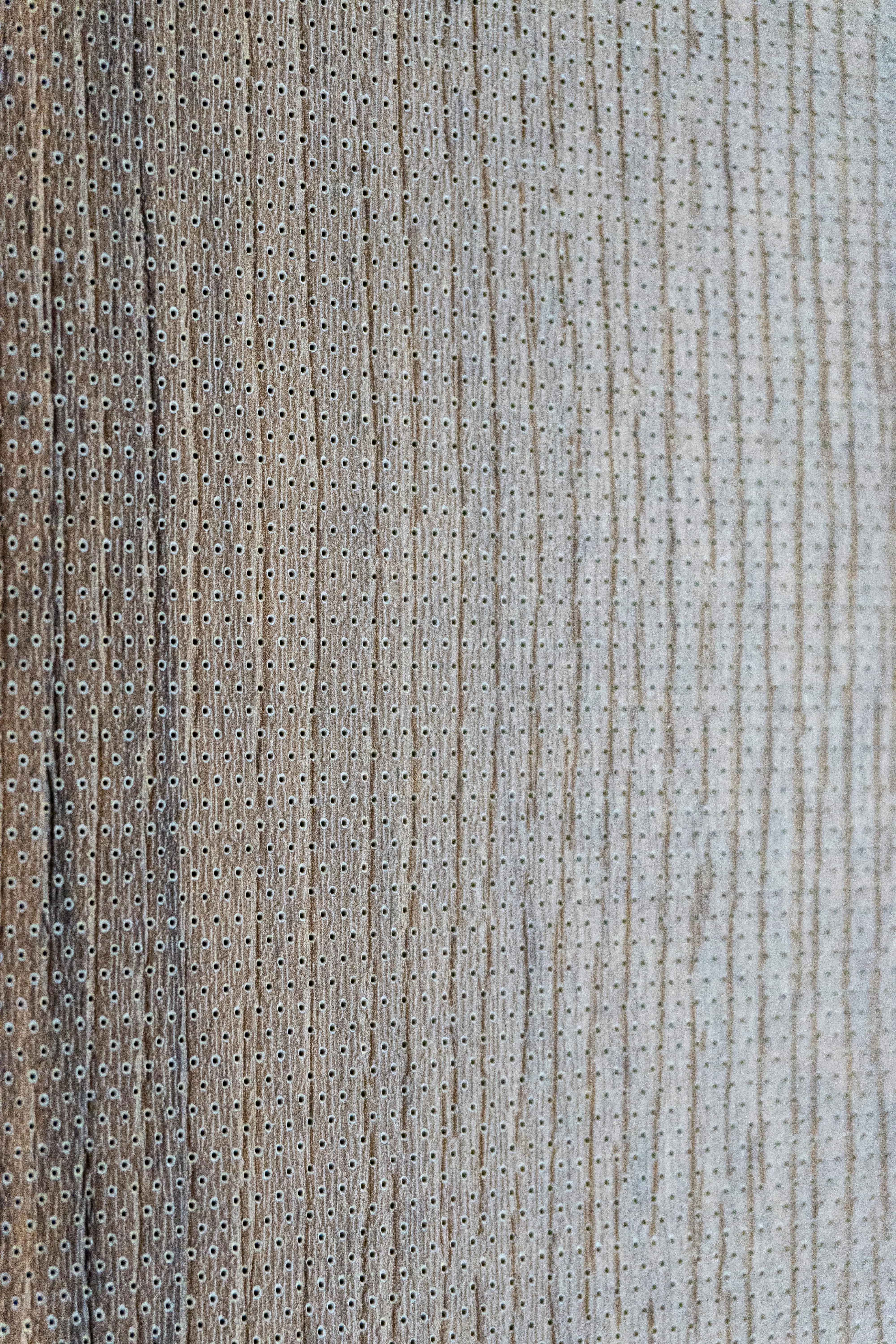
The panels work by trapping sound. Nano-scale holes in the MDF face capture incoming waves, which spread into a cavity behind the panel and cannot re-emerge. The system is specified for offices, restaurants, auditoriums, and concert halls—any environment where voice intelligibility matters.
“Whenever you need quality of sound, to reduce reverberation, that’s the main topic,” Venturini said.
About the Author
 Kenn Busch
Kenn Busch
Contributing Editor
Kenn Busch is a longtime journalist, educator and public speaker dedicated to bridging the knowledge gap between materials, sustainability, and furniture and interior architecture. He is the founder of MateralIntelligence.com and ClimatePositiveNOW.org, two major resources for design and manufacturer specifiers.