Airport Design in 2026: Modernization, Amenities, and Resilience
Why It Matters for Interior Design
- Terminal upgrades are creating new opportunities to improve comfort, circulation, and amenity planning within existing airport footprints.
- Hospitality-inspired design is influencing seating, lounges, restrooms, and other spaces that shape the passenger experience.
- Sustainability strategies now extend beyond systems to include material choices and healthier, more welcoming terminal environments.
- Inclusive design features—from sensory-friendly spaces to family and mobility-support amenities—are becoming core to terminal planning.

Global air travel has rebounded, yet the airport construction boom taking shape in 2026 looks different from past cycles. The global airport construction market is projected to be about $1.25 trillion in 2026—a $40 billion increase from 2025. According to Dodge Construction Network data, about 75% of terminal projects slated to begin this year involve alterations or renovations, while 15% are additions and just 10% are entirely new terminal builds.
Many architecture and design firms are seeing clients invest in optimizations over expansion of existing facilities. For architects and interior designers, that often means rethinking how terminals support circulation, comfort, accessibility, and amenity planning within existing footprints.
“Over the next 12 to 24 months, airport terminal investment will be driven less by headline-grabbing, single-phase new terminals and more by targeted modernization, reconfiguration, and system upgrades that unlock capacity, extend asset life, and improve operational resilience,” said Julie Wienberg, managing principal, aviation practice leader, Perkins&Will.
In recent months, airport design trends and innovations have clustered around three priorities—technology, passenger experience, and sustainability—all of which increasingly shape how terminals perform operationally and how they serve travelers day to day. With major hubs like Atlanta, Chicago, and Los Angeles leading the way—according to STV’s technical director of architecture, buildings, Bing Zheng—the latest trends are not centered on what’s new, but rather longevity.
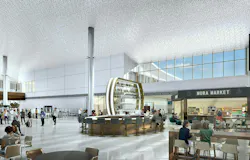
An Energetic Proposition
Significant projects demonstrate a keen sense of urgency around resilience, increasing the use of sustainable materials, decreasing traditional energy dependency, and supplementing with renewable energy—all while supporting the comfort and performance expectations passengers now bring into terminal spaces.
For instance, the Hollywood Burbank Airport’s new state-of-the-art terminal will be fully electric—only the second airport in the U.S. to do so. Designed by Corgan, in association with CannonDesign and Syska Hennessy Group on the MEP side, the terminal will pursue LEED Gold certification, incorporating solar technology to supplement power generation, maintain thermal comfort, and reduce energy dependency.
The project also reflects how identity and placemaking are becoming more deliberate in terminal design. The new terminal is “inspired by old Hollywood glamour,” said Brent Kelley, managing principal and aviation sector leader at Corgan. “The facility will feature dramatic, sweeping lines with hints of art deco and mid-century design.”
With 14 new replacement gates, the terminal will offer localized amenities/retail, centralized check-in and security checkpoint, streamlined baggage and curbside flows, a new airline support facility, and a new six-level parking garage.
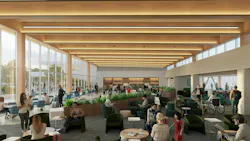
Sustainable Selling Points
With sustainability as a key driver of design innovation in aviation facilities, green infrastructure and lower-carbon material strategies are being embedded to reduce energy use, improve resilience, and shape healthier, more welcoming terminal environments.
Materials like mass timber are a “strong fit for aviation facilities,” said Swinerton VP and national director of aviation Carrie Shaeffer. “Its warm, biophilic qualities enhance large terminals and concourses while supporting sustainability goals.”
In fact, Swinerton (contractor) and ZGF (architect)’s Portland International Airport has delivered measurable performance outcomes, including a 53% reduction in energy use, a 90% decrease in fossil fuel heating, a 70% reduction in embodied carbon, and elimination of fossil fuels at the central plant, according to Swinerton.

Elevated Experiences
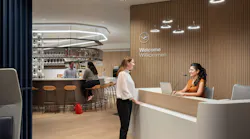
Today’s airport terminals draw from hospitality design, offering passengers an experience of elevated luxury and comfort. That shift is influencing everything from waiting-area layouts to lounge access, restroom design, and the mix of amenities that help terminals serve a wider range of traveler needs.
“Fresh air” environments—ones with ample natural lighting, unobstructed views, outdoor sightlines—are “paramount” to the passenger experience, according Brian Rush, vice president, preconstruction, W.E. O’Neil Construction.
In gate waiting areas, rows of tandem seating are now balanced by lounge seating, workstations, and acoustic pods, noted Kashyap Bhimjiani, airports practice leader, Skidmore, Owings & Merrill (SOM).
Gensler finds that lounges are now becoming the expectations for all passengers, although this leads to a reduction in shopping revenue. This is especially true as “bleisure”—business trips that are extended for leisure purposes—becomes commonplace, noted Kimley-Horn. This trend is fueling demand for airport lounges, co‑working spaces, enhanced technology, and family‑friendly amenities.
“Other amenities such as kids’ play areas, pet relief areas, mother’s rooms, and spaces for passengers with reduced mobility are making terminals more inclusive spaces,” Bhimjiani added.
Together, these moves point to a broader design shift: terminal amenities are being planned less as add-ons and more as core parts of the passenger experience.
HDR’s “Accessibility For All” approach reflects how inclusive design is becoming more fully integrated into terminal planning, from sensory-friendly spaces and ASL technology to service animal relief areas, lactation suites, and family/gender-neutral restrooms.
In fact, restrooms are “one of the clearest indicators of quality” for airport design, said Kirsten Fordyce-Wheeler, practice leader, aviation interiors, HOK. Lighting, soft acoustics, touchless fixtures, and layouts that accommodate travelers and their luggage all signal care and competence.
Overall, the passenger experience benefits from greater access to local concessions, a wider variety of seating options that support different traveler needs, and the incorporation of biophilic design elements to improve comfort and well-being, observed Sharron van der Meulen, managing partner, ZGF Architects.
For 2026, it appears that the next wave of airport investment will focus more on unlocking capacity, resilience, and performance from existing assets, while treating passenger experience—and the design decisions that direct it—as a competitive necessity.
*Article adapted for interiors+sources. Originally published in full by Building Design+Construction, March 30, 2026; bdcnetwork.com/55359651.
More Transporting Experiences
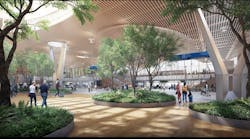
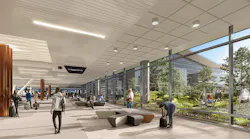 Airport terminals such as Boston Logan's Terminal E will soon be upgraded, thanks to the Federal Infrastructure Bill. Architects and designers will be presented with opportunities and challenges to manage ever-increasing client and end-user expectations.
 public-space-aerial-view
About the Author
 Quinn Purcell
Quinn Purcell
Quinn Purcell is the Managing Editor for Building Design+Construction. He is a graduate of Idaho State University with a Bachelor of Arts in Communication, and an emphasis in Multiplatform Journalism. He specializes in video, photography, copywriting, feature writing, and graphic design.