Designing Industrial Workplaces for the People Who Power Them
Top Takeaways for Designers
- Apply human-centered design beyond the office. Industrial and lab environments benefit from the same people-first principles.
- Use transparency to connect teams. Glass and visual sightlines help reduce silos and support collaboration.
- Share amenities to build culture. Common spaces and wellness features unify office and production teams.
- Design for change, not just today. Flexible layouts support growth, shifting workflows, and long-term performance.
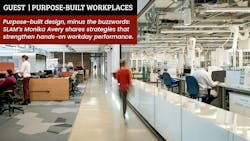
While the conversation around workplace design has typically centered on the corporate office, one where the C suite reigns supreme and hybrid work is an ongoing consideration, we’re seeing an equally important transformation in the places where work is always hands-on.
Workplace design plays a vital role in shaping the culture, collaboration, and innovation in labs, light manufacturing, and warehouse offices across the globe, defining a new kind of purpose-built workplace. Increasingly, we’re seeing design dollars invested across this production cycle, and the result is more engaged employees, faster workflow, and better results. Whether it’s the production floor or an office, the focus is on building community and bringing purpose to the in-office workday.
“Good design belongs everywhere
that work happens.”
What Does ‘Purpose-Built’ Mean, Exactly?
From our firm’s perspective, the purpose-built workplace is one designed with people at the forefront. For far too long, industrial working environments have been overlooked when it comes to working interiors. A sole focus on function meant that employees saw industrial, light manufacturing, science and technology, labs, or warehouses as places to simply clock in and out. Without care for collaboration and workplace culture, these environments can stifle creativity, demotivate employees, and fail to foster the innovation and excellence crucial to business success in today’s landscape.
Designers and employers are beginning to make a concentrated effort to understand the needs of these employees and how to design a functional and beautiful workplace that reflects this purpose-built framework. The following projects reveal how the workplace is changing, and how design features in manufacturing facilities or labs can be strategic tools to improve teamwork and promote culture, collaboration, and creativity—just as they do in corporate offices.
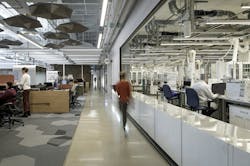
Infusing Labs and Offices with Advanced Design Principles
For an international cosmetics company’s Research & Innovation Center, The S/L/A/M Collaborative (SLAM) was challenged to blend innovation, an ever-evolving brand identity, and sustainability to create a workplace that truly reflects the company’s culture. This design took five separate, function-specific buildings and blended them into a single, integrated facility that reflects the company’s deep commitment to its unique, end-to-end innovation model. By breaking down physical and functional silos, the unified facility furthers collaboration, creativity, and speed, enabling teams to deliver safe, high-performance, and responsible beauty solutions with even greater impact.
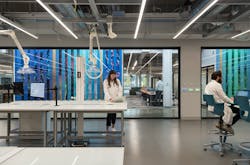
Rather than treating the industrial spaces as a second thought, this design aligns laboratory and office spaces through interior glass, in turn promoting visibility and interdisciplinary collaboration. Bold colors, natural materials, and biophilic design weren’t just reserved for the corporate office workers, and this attention to detail across the product cycle helps enforce the company’s vibrant culture.
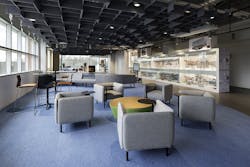
Breaking Down Silos and Sharing Spaces
In the case of a global leader in HVAC technology, SLAM designed a 195,000-square-foot structural steel framed facility to accommodate a research lab, office, manufacturing, shipping and receiving, and warehouse spaces. For many industrial leaders, room to grow is imperative as company needs are constantly shifting. This purpose-built workplace was specifically formulated to accommodate future growth, incorporating two areas for expansion of manufacturing and office space. While this project blends corporate with industrial, the latter wasn’t an afterthought. Instead, we took the principles of good corporate design and blended them with the complex needs of manufacturing space.
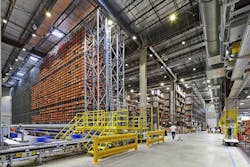
The large scale of the building is moderated by first punctuating the long manufacturing component with the adjacent office component. A visual relationship is affirmed with framed expanses of glass curtain wall. Throughout all three stories of the building, bright orange actuators can be viewed in intentionally carved-out ceiling plenum vignettes, highlighting the HVAC product they specialize in.
The office is further blended with manufacturing through the sharing of design elements and finishes. The company’s manufacturing employees have direct access to office staff and share facilities such as the cafeteria, multifunction spaces, and the fitness center. Similar to the cosmetics company, we used design to physically break down silos between employees and teams, like corporate and manufacturing, to improve workflow and encourage thoughtful lines of communication.
Learning From Tradition
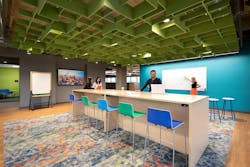
By drawing on our experience in designing corporate offices, we have been able to incorporate creative design elements that we know improve staff morale, office attendance, and company performance into the warehouses, factories, and labs across our client portfolio. As the largest competitive power generator and one of the largest competitive electricity providers in the United States, Vistra’s new 436,000-square-foot workplace emphasizes the firm's guiding principle of one culture, one team. The priority here was to encourage teamwork and put employees, customers, and the communities where Vistra is active at the forefront of the design.
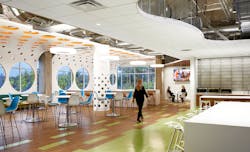
The five-story workplace offers Vistra’s 1,300 employees abundant wellness amenity options, including work cafés, collaborative work zones and neighborhoods, Zoom rooms, social gathering spaces, focus rooms, conference rooms, a health clinic, a fitness center, a conference center, and landscaped gardens. The number of shared workspaces far exceeds the number of dedicated individual workstations, thus providing all Vistra employees multiple options for working alone or with a team, either in focused and enclosed settings or larger group settings.
“We encourage every organization to look again at the places that power their business and ask: Are these spaces designed for people,
or just for production?”
Reframing Industrial Design as Good Design
Good design belongs everywhere that work happens. The companies leading the way recognize that investing in thoughtful, human-centered spaces isn’t a luxury; it’s a strategic advantage. Manufacturing and industrial spaces require arguably more precision, efficiency, and flexibility than your traditional corporate office. The work SLAM has done to thoughtfully design purpose-built workplaces continues to benefit employers and employees alike and has provided a benchmark for every workplace interior project we approach.
We encourage every organization to look again at the places that power their business and ask: Are these spaces designed for people, or just for production? The purpose-built workplace proves that when we design with employees in mind, we produce not only better spaces, but also better work, better ideas, and ultimately, better business.
About the Author
Monika Avery
NCIDQ, IIDA, LEED AP
Monika Avery, NCIDQ, IIDA, LEED AP is a principal with The S/L/A/M Collaborative (SLAM) and has over 20 years of experience as an interior designer. Passionate about high quality design and commercial real estate, she specializes in workplace environments and has led major workplace project designs across SLAM’s corporate and higher education markets.
Ms. Avery is a published, award-winning thought leader and a founding member of SLAM’s Workplace Innovation Think Tank, a team which creates “Ideas for Working with Purpose and Joy.” She has been an active member of the Commercial Real Estate Women (CREW) Network for 20 years and has served on the Board of Directors of CREW CT and CREW Orlando chapters.
Ms. Avery is a member of the CREW Government and Education Council and has taught Interior Architecture as an adjunct professor at Paier College of Art and at the University of Hartford. She is also co-chair of the SLAM in the Community Committee.