Your Design Work Is Distinct. Can Clients Tell?
What Design Businesses Can Learn About Originality
- Distinctive work starts with influences, expertise, and experiences that competitors cannot easily reproduce.
- Designers and manufacturers need to explain value beyond appearance, including performance, longevity, safety, construction, and provenance.
- Specification choices affect more than project cost; they can reinforce—or weaken—a designer’s professional reputation.
- Building community around process, expertise, and values helps customers recognize and communicate what makes the work different.
Originality has historically been difficult to quantify as a business asset. Today, it may be even harder to protect—yet more important to communicate.
Design professionals and manufacturers operate in a marketplace overflowing with imagery, products, social media, data, and now AI tools that can make it easier to identify popular aesthetics and reproduce commercially successful ideas. For Massimo Minale, founder of London-based design brand Buster + Punch, the result is a strange contradiction: Original ideas face more competition from imitation at precisely the moment customers seem increasingly interested in authenticity, craft, and experiences that feel distinctly human.
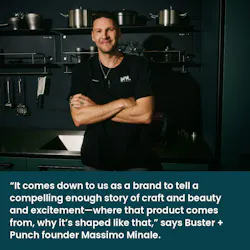
Minale has experienced that tension firsthand. An architect by training, he started making custom motorcycles and machining metal parts in his spare time before those interests collided in Buster + Punch. The brand eventually translated details from motorcycle culture—including its distinctive cross-knurling—into interior fittings such as lighting, switches, and hardware. That visual language has since attracted plenty of imitators.
But Minale’s response to imitation goes beyond protecting intellectual property. His experience points toward a broader business strategy for designers and product manufacturers: Know what makes your work recognizable, make its value easy for customers to understand, and build a community around the ideas that competitors cannot simply reproduce.
Protect the Conditions for Original Thinking
Minale remembers beginning his company in an environment with fewer digital distractions. Today, he sees a much greater volume of information competing for designers’ attention.
“Nowadays, we’re barraged with lots of information, lots of images, lots of social media, and it’s very hard to declutter all that and come up with original thoughts,” he said.
His own response is deliberately analog. Rather than looking primarily within interiors for inspiration, Minale draws from London counterculture, friends, other industries, making, and experimentation.
The business lesson extends beyond creative inspiration. If every firm or product team studies the same references, follows the same digital conversations, and responds to the same market signals, differentiation becomes harder to sustain. Distinctive work requires developing sources of knowledge and perspective that belong specifically to the people creating it.
Business Tip: Audit where you and your team get ideas. Look beyond competitors and industry feeds for influences, expertise, experiences, and processes that can yield a point of view the market does not already have.
Make the Difference Easy to Understand
The design industry still faces a harsh truth: Original work does not automatically communicate its own value. For an interior designer comparing products—or a client weighing budgets—two options may appear nearly identical in an image even when their construction, performance, durability, safety testing, or provenance differ considerably.
Minale argues that manufacturers bear responsibility for helping customers understand those differences.
“It’s very hard for those consumers to understand the differences, which is where it comes down to us as a brand to tell a compelling enough story of craft and beauty and excitement—where that product comes from, why it’s shaped like that,” he said.
That doesn’t mean piling on more marketing language. Minale advocates virtually the opposite: Build what he calls a clear “world” around the brand and explain, in simple language, what makes the product special and original.
For design firms, the same principle applies to expertise. A distinctive process, material specialty, research capability, or design philosophy becomes more valuable when clients can readily understand what it does for them.
Business Tip: Identify one thing customers should understand about your work that they cannot see in a photograph. Explain it in plain language—and connect it to performance, experience, longevity, or another outcome they value.
Treat Specification as Reputation
Minale also turns the originality conversation toward professional accountability. For designers, he argues, specification decisions become part of the reputation attached to the finished space.
“If I am designing a space and I’m an interior designer or architect, that space is my brand,” he said. “If I fill that space with beautiful, original product that’s going to last the test of time, then my brand or product will be beautiful and last the test of time.”
That framing makes price only one part of a larger value equation. Product provenance, certification, construction, longevity, and performance can ultimately affect how the client experiences not only the manufacturer’s product, but the designer’s judgment.
It also creates an opportunity for stronger collaboration across the specification chain. Manufacturers that equip designers with meaningful evidence about why a product is different give those designers a stronger case to carry into client conversations.
Business Tip: When evaluating or presenting a specification, go beyond appearance and first cost. Ask what evidence supports its construction, safety, longevity, performance, and origin—and whether you could confidently explain that value to the client.
Build a Community, Not Just an Audience
Legal protection remains part of Buster + Punch’s approach to defending its intellectual property, and the company has joined the non-profit Be Original Americas to support broader education about authentic design. But Minale places equal emphasis on something less formal: community.
“It’s really down to the brands to explain why they’re special in very simple language to both end consumers and A&D customers, so they too can go and talk about it to their friends, their customers, and their clients,” he said.
For Buster + Punch, that increasingly includes real-world experiences and greater transparency into how its products are made. The goal is to make the differences customers cannot see in a product image more tangible: its weight, feel, manufacturing, origins, and emotional connection.
Minale gives emerging designers similar advice: “It’s important to try and be something to somebody rather than everything to everyone.”
That may be the clearest business case for originality. Differentiation does not require appealing to the entire market. It requires giving the right customers enough reason to recognize what is distinct, understand why it matters, and care whether it survives.
Business Tip: Define the community your work is genuinely for. Then give those people more than finished-project or product imagery: Share the process, expertise, choices, values, and people behind the work so they can understand—and articulate—what makes it different.
For a full download on Massimo Minale’s perspective and experience with developing original design that builds a community, listen to the I Hear Design podcast episode “Fighting the Fakes: Why Original Design Still Matters with Massimo Buster Minale.”
This article was developed by interiors+sources editors using AI tools and reviewed for clarity and accuracy.
More on Craft, Authenticity + Brand Building
 Vector graphic of male and female colleagues consulting on a project


About the Author
 Robert Nieminen
Robert Nieminen
Market Content Director
Market Content Director, American School & University, Architectural Products, BUILDINGS, and interiors+sources
Robert Nieminen is the Market Content Director of four leading B2B publications serving the commercial architecture and design industries: American School & University, Architectural Products, BUILDINGS, and interiors+sources. With a career rooted in editorial excellence and a passion for storytelling, Robert oversees a diverse content portfolio that spans award-winning feature articles, strategic podcast programming, and digital media initiatives aimed at empowering design professionals, facility managers, and commercial building stakeholders.
He is the host of the I Hear Design podcast and curates the Smart Buildings Technology Report, bringing thought leadership to the forefront of innovation in built environments. Robert leads editorial and creative direction for multiple industry award programs—including the Elev8 Design Awards and Product Innovation Awards—and is a recognized voice in sustainability, smart technology integration, and forward-thinking design.
Robert's work has earned him industry-wide recognition throughout his career, including:
- ASBPE Award (2019, 2018, 2017, 2015)—Best Regularly-Contributed Column; retrofit
- TABPI Award (2017, 2016)—Top 25 Entries, Cover Story; Retail Environments
- WPA Maggie Award (2011, 2010, 2008)—Best Publication, Trade; interiors+sources
- FOLIO: Eddie Gold Award (2022, 2007)—Best Feature Article & Special Section; interiors+sources
- Contributing author of ASID’s 2020 Outlook and State of Interior Design report, as well as The State of the Interior Design Profession (Fairchild Books, 2010), which earned a place on the International Federation of Interior Architects/Designers’ “50 Must Read, Must Have” book list.