Walking the International Contemporary Furniture Fair (ICFF) for the first time, I thought about how the fair’s exhibitors focused not only on the quality of their products but also on what feels usable, lasting, and emotionally resonant now and into the future. Yes, there was plenty of visual excitement at the Javits Center, but what stayed with me were the products and conversations that felt grounded in how people actually live, work, gather, and move through space. I left New York with pages of notes on color, craft, modularity, and material health—and a strong sense that the most compelling ideas right now are those that balance beauty with practicality.
Key Takeaways from ICFF 2026
What I noticed was a move away from anything that felt overly trend-driven. Even when products were colorful or sculptural, the messaging was often about longevity: pieces designed to last for generations, systems meant to adapt to different users, and finishes or materials chosen with both performance and wellness in mind. I kept hearing versions of the same story across booths—designers and brands are being asked to do more, whether that means integrating power, improving acoustics, offering washability, reducing VOCs, or bringing a more residential sense of comfort into commercial settings.
Design Signals I Noticed Across the Show Floor
- I saw color used with a lot more confidence: Mustard, green, burgundy, pink, and warm leather tones kept appearing across booths, but not in a loud or overly trendy way. The palettes felt grounded and intentional—more about warmth, softness, and staying power than novelty.
- Modularity felt smarter and more human: I noticed this especially at Ethnicraft, Ligne Roset, and Bernhardt Design, where flexibility was less about endless configurations and more about creating options for different postures, privacy levels, and ways of using space.
- The residential-commercial crossover is still getting stronger: Some of the most interesting pieces combined comfort-forward details with contract relevance—washable covers, soft seating, integrated power, acoustic function, and tactile materials that made spaces feel more inviting without sacrificing performance.
- Sustainability conversations felt more specific: I heard much more precise language this year around recycled content, low-VOC adhesives, FSC certification, reclaimed wood, and zero crystalline silica. That specificity made a difference; the strongest brands were the ones connecting sustainability to real specification needs. Craft and story mattered as much as product: Some of the booths I lingered in longest were the ones where technique, culture, and process were clearly part of the design story. Rugs, wallcoverings, lighting, and limited-edition pieces all seemed stronger when there was a real sense of authorship behind them.
Highlights from the Show Floor
A few booths really stayed with me across my two-day visit. Whether you attended ICFF and saw these products in person or are seeing them now, I’d like to explain my show floor highlights because they need additional recognition.
Ethnicraft stood out for its emphasis on organic forms and pieces that felt designed to endure rather than chase a moment. The idea of vintage hospitality spoke to a divergence from trend-driven design and more to quality pieces that can remain relevant to a space across generations.
I also kept coming back to the idea of integrated functionality after seeing Juniper + HBF’s power-enabled furniture concepts, which felt especially relevant for airports, waiting areas, and other transitional spaces. Designers shared insights about airport projects requesting powered furniture for travelers, so this need may inspire a crossover from educational products into the travel and leisure sector.
HBF Textiles’ new Paint By Numbers collection with artist Liam Lee brought a more expressive energy into the mix. Lee's debut textile collection was inspired by his recent paintings that blur abstraction and figuration. Designs include Magic Eye, Pointillist, Gridwork, and Impasto.
Bernhardt Design’s student-designed privacy lounges offered a youthful perspective on what comfort, focus, and flexibility can look like in open-plan environments.
I was also drawn to the booths where materials did a lot of the storytelling. Warp & Weft’s four rugs showcased the company’s journey thus far, with references to antique textiles and handcraft traditions from Nepal, Iran, and Turkey. A Kia Sar rug celebrated geometry and cultural tradition. The Arts and Crafts era design represented the company’s history and material integrity. A Himalayan hand-knotted rug signaled a modern voice and the melding of tradition and new form. Finally, a Turkish kilim represented the raw beauty of flatweave textiles. The booth illustrated the heritage, soul, authenticity, and sanctuary aspects of rugs that have served as guiding principles for the company and now represent a manifesto of work. Techniques from hand pulling and the warp and weft of 100 knots per square inch on display showed the love for the craft and respect for the product.
Submaterial caught my attention for its modular acoustic solutions and cork-backed construction, especially because the removability felt genuinely useful rather than just a talking point. ECHO, the newest modular tile, comes in cactus leather. The new biomaterial contains no animal byproducts and no plastics—made from Nopal cactus. Submaterial also displayed Ripple Wood Wall Covering, offering a dimensional surface that transforms a wall into an architectural feature with pools of light and shadow. The best part is the wallcovering secures with z-clips for easy installation and evolution of any space.
Cosentino’s ÉCLOS also stood out to me as a surface story worth watching because it tied aesthetics to a very clear health and sustainability angle. The company’s first in-layered mineral surface category is made from Inlayr technology with integrated 3D design. Rather than applying a surface-level pattern, ÉCLOS uses advanced robotic engineering and integrated decorative techniques for a finished product with realism, depth, and consistency. The new collection strengthens Consentino’s history of innovation, like Silestone and Dekton, and offers a conversation starter with architectural firms about the future of sustainable design.
And across brands like Northern Wide Plank, Infinity Drain, Fireclay, and Idelli, I kept seeing the same commercial thread: products that are customizable, specification-aware, and increasingly conscious of both environmental impact and user experience.
Take the Quick Video Tour
Booth Moments I Kept Thinking About
There were also a few very specific booth moments I kept replaying after I left the floor because of the powerful stories that inspired the products and drove the companies to produce quality products while being mindful of the planet.
At Submaterial, I was struck by how practical the story felt: modular acoustic and wall solutions with cork interiors, water-based adhesives, low VOCs, and removable installation methods that seemed genuinely useful for evolving interiors. At Cosentino, the conversation around ÉCLOS stood out because it directly connected design language to health concerns, especially given its zero crystalline silica composition and high recycled content.
REUP stayed with me for a different reason—it had an inventive, scrappy energy, especially in the Fideo chair with its magnetized boucle elements and customizable seat components, which made the product feel playful without losing its specification potential. Fideo is Spanish for macaroni, and this modular seat features customizable fabric and wood finishes that add to the adaptability of the product across spaces.
Fireclay Tile unveiled the Foundry Collection, designed by Avi Abel, a new bath category with colorful ceramic handles. The Groove and Pebble ceramic handles fill a gap in the market, transforming traditional flat tile ceramics into three-dimensional fixtures with 16 finishes and 16 glazes. Pebble is more organic in shape, whereas Groove is more structured. Abel said the collection was well received during the show, exciting him about the future lever options launching later this year. This collection seems so obvious to do, and now that it’s here, I can see applications across projects that allow clients to elevate their kitchen and bath designs beyond the classic silver and black faucet and knob finishes.
And at Idelli, I kept returning to the brand’s broader sustainability thinking, from replanting forests around the factory to reusing water, cardboard, and packaging waste, all while presenting high-end pieces with integrated lighting and a polished, architectural finish.
Bernhardt Design’s Student Work Was One of My Favorite Stops
One of the areas I found myself thinking about the longest was Bernhardt Design’s presentation of student work from its ArtCenter College of Design partnership. The project brief centered on the evolving “privacy lounge,” and the results felt especially relevant right now—not just for workplace settings, but for hospitality and education environments that need to support focus, retreat, and casual conversation within more open plans.
What I appreciated most was that the concepts did not all solve privacy in the same way. Some leaned softer and more cocoon-like, some used wood structure to avoid the heaviness that privacy seating can sometimes create, and others explored modularity and different levels of enclosure depending on how the piece was used. It felt like a thoughtful snapshot of where younger designers see seating going: more adaptive, less rigid, and much more tuned into emotional comfort.
Jungwen Gu’s Reverie Lounge, inspired by natural elements and the warmth of stone, tried to balance privacy with comfort through a softer, grounded form and details like contrast stitching in leather or wool. Another concept, designed by Ayrlron Arellano, approached the category more lightly, aiming for a cocoon rather than a closed-off pod, with pillowy interior cushioning set against harder outer curves and legs. Sophia Metzger’s Sofie Lounge offered acoustical properties, a soft recline, and swivel options for users to adjust their connection to the surround space. I was also intrigued by Zifan Hua’s proposal that used wood as part of the privacy structure, as opposed to relying entirely on upholstery, which connected the piece to the room rather than being overly isolated. And Titouan Le Roux’s modular concept stood out for the way it explored different levels of privacy in a single product, allowing people to adapt the seating based on how and where they sit.
Closing Thoughts
By the end of the fair, what I kept coming back to was how human so much of the design felt. The pieces that stayed with me were not necessarily the most dramatic—they were the ones that solved a real problem or created a stronger feeling in a space. Whether that meant more privacy, easier maintenance, healthier materials, or simply a better sense of warmth and personality, ICFF felt full of ideas that could translate well beyond the show floor. For me, that was the takeaway from New York: the most exciting design is not just expressive, but thoughtful about how people actually want to experience interiors.
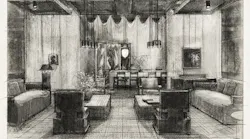 Post Company Bespoke Salon Sketch for ICFF 2026.
About the Author
 Lauren Brant
Lauren Brant
Staff Writer, interiors+sources and BUILDINGS
Lauren Brant is Staff Writer for both interiors+sources and BUILDINGS. She is an award-winning editor and reporter whose work has appeared in daily and weekly newspapers. In 2020, the weekly newspaper won the Rhoades Family Weekly Print Sweepstakes—the division winner across the state's weekly newspapers. Lauren was also awarded the top feature photo across Class A papers. She holds a B.A. in journalism and media communications from Colorado State University-Fort Collins and a M.S. in organizational management from Chadron State College.