A Designer’s Guide to Bio Material Terms
What Designers Should Know
- How bio-sourced, bio-attributed, bio-based, and USDA BioPreferred® differ
- Why some bio claims are lab-verified while others rely on supply-chain tracking
- What ASTM D6866 measures and why it remains a key benchmark
- Why higher renewable-content claims do not always tell the full performance story

Interior materials conversations are increasingly framed by the language of ‘bio’—bio-based, bio-attributed, bio-sourced, BioPreferred®. The terms show up everywhere, but they do not all describe the same thing.
For interior designers evaluating materials claims, the challenge is not just understanding what these terms mean in isolation, but knowing what they actually signal about sourcing, verification, and performance. The vocabulary is evolving quickly, and not every “bio” claim points to the same thing.
At the broadest level, bio-sourced refers to materials or ingredients that originate from biological sources such as plants, animals, or microbes. That can include biomass substances like cactus fiber or coffee dust, bio-based chemicals, or wood-derived materials such as rayon. In that sense, the term points to progress toward more renewable, plant-based inputs. At the same time, it remains a flexible label. It is not always tied to testing or certification, and its sustainability implications can vary significantly depending on how the material is made and what role those ingredients actually play in the final product.
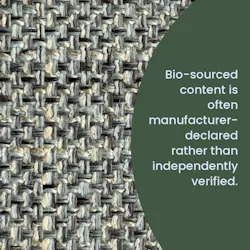
For designers and specifiers, that is where caution becomes useful: Bio-sourced content is often manufacturer-declared rather than independently verified. In some cases, producers may increase “bio” content by incorporating natural powders or fibers into polyurethane foam. While that can reduce fossil-based inputs and, in some cases, cost, it may also affect long-term durability if the overall formulation is not properly balanced.

A more specific term is bio-attributed. These materials replace a portion of fossil-based ingredients with renewable ones, such as sugarcane or corn, at the chemical-input stage. In finished form, the material may look and perform just like a conventional product, but part of its origin has shifted upstream. Because that renewable content is not physically distinguishable in the final material, it is typically tracked through supplier documentation, chain-of-custody systems, and related certifications rather than identified by sight or touch.
For polyurethane (PU) applications, that can mean using a renewable ingredient such as plant-based PDO polymer to replace part of the fossil feedstock. In practice, that approach allows renewable inputs to enter the process without necessarily requiring major changes to existing manufacturing systems or material performance. In coated fabrics, the chemistry can be even more nuanced. A bio-attributed PU coating may also include a protective finish layer, such as a silicone-PU blend, to maintain surface performance over time. So while bio-attributed content can support lower fossil dependence and a reduced carbon footprint, it still requires designers to look closely at how the claim is documented and how the full material is engineered.
Bio-based is often the clearest and most verifiable of these terms. Bio-based materials are made from renewable sources such as soy, castor oil, or corn, and they contain biologically derived carbon that remains physically present in the finished product. That content can be measured through ASTM D6866, a third-party lab test that compares modern, renewable carbon to fossil-based carbon. For that reason, bio-based content offers one of the clearest ways to quantify how much renewable material is physically present in a product.
ASTM D6866 has become an important benchmark in this conversation because it provides a consistent method for verifying renewable carbon content. It is also widely used in qualification for the USDA BioPreferred® program and other sustainability frameworks. In the context of specification, that makes it a useful reference point when comparing claims that may otherwise sound similar on the surface.
The USDA BioPreferred® label builds on that verification process. As a federal program, it is intended to promote the purchase of verified bio-based products in both government and private-sector markets. To qualify, products must undergo ASTM D6866 testing, meet category-specific thresholds, and complete USDA review and documentation requirements. Once approved, they can carry the BioPreferred® label and appear in the USDA catalog.
That label can be especially relevant for projects connected to federal funding, including schools and government facilities, where bio-based purchasing requirements may come into play. But even outside of public-sector work, BioPreferred® status can give specifiers and buyers an additional layer of confidence that renewable content claims have been independently reviewed.
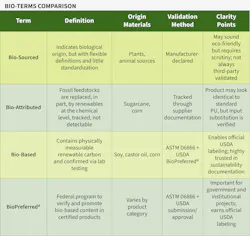
The conversation gets murkier when comparisons collapse into a numbers race. It is tempting to ask which product has the highest bio content, but percentage alone does not tell the whole story. Different materials arrive at their sustainability profiles in different ways. In coated textiles, for example, actual bio-based content may fall in the 10% to 20% range, while higher percentages may reflect bio-sourced or bio-attributed inputs that are measured through feedstocks in the supply chain rather than renewable carbon physically present in the finished fabric.

That does not make those approaches less legitimate. It simply means the figures are not always directly comparable. And as bio-based percentages rise, performance still has to hold. Whether the renewable input comes from castor oil, corn, cactus, or another source, the formulation has to be balanced for durability. Some products may also incorporate recycled backings, which can significantly improve the material’s broader sustainability profile even if that contribution sits outside a narrow discussion of bio-based content alone.
For designers, the takeaway is less about memorizing jargon and more about asking better questions. Where do the renewable inputs enter the process? Is the claim manufacturer-declared, chain-of-custody tracked, or lab verified? Which standard is being used? And how does the material perform in the conditions it is actually meant to serve?
As sustainability conversations become more sophisticated, clearer definitions help everyone make more informed choices. They also support more credible material storytelling—grounded not in shorthand or aspiration, but in sourcing, verification, and performance. There may never be a single, one-size-fits-all “bio” solution for teams balancing sustainability goals with performance expectations, but understanding the differences among these terms is a meaningful step toward specifying with more confidence and clarity.
More on Materials & Circular Design




About the Author
Roslyn Muney
Roslyn Muney is the director of brand strategies at The Mitchell Group, leading the messaging and education behind the company’s sustainability platforms and performance‑coated fabrics. She translates complex material science into clear, design‑forward language that equips sales teams, design professionals, and customers throughout the contract market.