Why Durability and Delight Don’t Have to Compete in Interior Design
What Designers Should Consider
- Lasting materials can still support spaces that feel fresh, expressive, and memorable.
- Durability and delight are not opposing goals; the best projects increasingly ask designers to hold both.
- Reuse, reinterpretation, and thoughtful specification can be just as innovative as something entirely new.
- Designing for what endures may become one of the profession’s most meaningful creative opportunities.
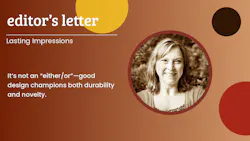
When we talk about interior design innovation, we often mean what is emerging: a new material, a new finish expression, a new guest experience, or a new way of working or gathering. There is energy in that instinct. Certainly, design is a discipline built around change—responding to cultural shifts, advancing technologies, and evolving expectations for how spaces should feel.
But at this moment, another question feels just as urgent: What should last?
That may sound almost unfashionable in a profession so often pulled toward the next idea, the next launch, the next aesthetic cycle. Yet climate change, resource constraints, and resilience demands are pushing architecture & design (A&D) professionals and their clients to think more carefully about what is specified, how often it gets replaced, and how long materials should be expected to serve once installed.
I don’t think this means designers must abandon beauty, novelty, or the emotional experience of space. In fact, some of the most fascinating recent projects suggest the opposite. The challenge is not choosing between durability and delight. It is learning how to hold both.
We can see that tension playing out across sectors. Airport modernization projects, for example, are increasingly focused on extending the life and performance of existing environments while also improving comfort, accessibility, amenities, and identity. In hospitality and adaptive reuse, too, designers continue to demonstrate that memorable spaces do not always require starting over. Sometimes the stronger move is to preserve, reinterpret, and layer in what is needed with more care.
Even in materials conversations, there is reason to resist the false choice between timelessness and freshness. At Coverings 2026, one of the clearest takeaways was that durable surfaces like tile are still evolving in ways that feel tactile, expressive, and visually current. Longevity doesn’t have to imply sameness. It may simply mean being more intentional about where novelty lives—in color, texture, pattern, storytelling, and atmosphere rather than in constant replacement.
That distinction matters. A space can feel new without being wasteful. It can feel transportive without being disposable.
Interior environments can offer people comfort, surprise, and beauty while still respecting the realities of maintenance, climate impact, and long-term use.
Perhaps that is where the profession is headed next—not away from innovation, but toward a more mature definition of it. One that values not only what catches attention today, but what continues to serve people and the planet well tomorrow.
For interior designers, I see that balancing act as both a challenge and a source of creative energy: imagining spaces that are meaningful now and worthy of lasting longer.
About the Author
 Carrie Meadows
Carrie Meadows
Head of Content
Carrie Meadows is Head of Content for interiors+sources, where she leads editorial strategy, content development, and brand storytelling focused on the people, projects, and innovations shaping the design industry. With more than two decades of experience in B2B media, she has built a career connecting technical expertise with creative insight—translating complex topics into meaningful stories for professional audiences.
Before joining interiors+sources in 2024, Carrie served as Editor-in-Chief of LEDs Magazine within Endeavor Business Media’s Digital Infrastructure & Lighting Group, guiding coverage of emerging lighting technologies, sustainability, and human-centric design. Her earlier editorial experience spans across Laser Focus World, Vision Systems Design, Lightwave, and CleanRooms, where she managed print and digital publications serving the optics, photonics, and semiconductor sectors.
An advocate for clear communication and thoughtful storytelling, Carrie combines her editorial management, SEO, and content strategy expertise to help brands and readers stay informed in a rapidly evolving media landscape. When she’s not crafting content, Carrie can be found volunteering at a local animal shelter, diving into a good crime novel, or spending time outdoors with family, friends, and her favorite four-legged friends.