Biamp’s AudiaFLEX Optimizes Boardroom Acoustics
Exelon Corp. is one of the nation's largest energy companies, distributing electricity to approximately 5.4 million customers in Illinois and Pennsylvania and gas to 480,000 customers in the Philadelphia area. Headquartered in Chicago, Exelon's operations include energy generation, power marketing, and energy delivery.
In 2006, the company decided to consolidate some of its offices to create a streamlined and seamless corporate headquarters in the Chase Tower in Chicago. It chose TALASKE as its acoustics and AV consultant for the project, to oversee the integration of audio and video systems and design a system for its executive boardroom that would emphasize aesthetics and optimize communications. TALASKE was also charged with the design of other systems including various AV presentation and videoconferencing rooms, soundmasking for open office areas, network-delivered Video-on-Demand for archived and training videos, streaming video for public displays, and an audio system for the fitness center.
David Injeski, senior video and AV consultant, TALASKE, recounts his initial impression of Exelon's previous boardroom. "Even at the design level it became readily apparent that the previous room had some flaws - background color selection, lighting, acoustics - that really challenged the AV system. We set out to work as closely as possible with the architects and other contractors, as well as the IT department and even Exelon's executive team, to ensure that the new system would be optimized for video and audio conferencing but also very intuitive and familiar to any user who picked up a controller."
As part of the design process, TALASKE constructed a mock-up of the executive boardroom at an external location. This allowed the AV integrator, AVI Midwest, to temporarily install all of the components planned for the project in a space that closely mimicked the size and shape of the planned new boardroom. It then invited executives and members of the IT team in to interact with the test system. "This turned out to be an invaluable approach to the project," says Injeski. "We spent 2 weeks building the space, then 10 days bringing in executives and Exelon employees who would actually use these components, to gather their feedback and hold various sessions to find out what worked and what didn't."
The Details
The executive boardroom features a table that seats between 24 and 26 people in an oblong horseshoe shape, allowing presenters to move about the table freely. The room also features galleries along the north and south walls that seat up to 24 people and a smaller gallery along the east wall for an additional four people.
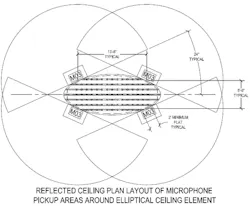
"One of the biggest challenges we faced in the executive boardroom was the propensity for meeting participants to use digital cellular devices during a conference," says Injeski. "The digital signal often times radiates from the devices and permeates everything, creating 'digital chatter' that gets picked up by the microphones and rebroadcast through the speakers. This was a concern that Exelon specifically asked us to address. We examined the room and determined that the best solution would be to reduce the number of microphones to the absolute minimum and integrate the microphones so they were not in close proximity to where cell phones are typically used, i.e., where the person is sitting. We accomplished this by installing six microphones total in the boardroom: four in the ceiling around an elliptical element positioned above the table and following its contour; one at the presentation podium; and one at the opposite corner of the presentation podium at an attendant's station."
"To make the microphones as effective as possible, we took advantage of a bit of architectural detail. The four ceiling-mounted Crown PZM 6D microphones are positioned around an elliptical-shaped architectural element, where the element meets the ceiling. This keeps the microphones far away from cell phones and provides the added benefit of a very natural acoustic-gain control as a result of the pressure zones created by the intersection of the vertical and horizontal sections of the architectural element, i.e., an inside corner. In this set up, each microphone has approximately 17 feet of acoustic coverage - enough for the entire room with one microphone per room quadrant. People can simply sit at the table or in the gallery or walk around the room and still have natural, full duplex conversation with remote conference participants."
The microphones don't provide this natural audio alone. TALASKE fed each of the six microphones, along with other source inputs, into a Biamp AudiaFLEX for digital signal processing as well as acoustic echo cancellation (AEC). Each of the three Biamp AEC cards processes two microphone lines at once and ensures each microphone in Exelon's boardroom isn't picking up audio from the 16 Electro-Voice ceiling speakers in the room and retransmitting that same audio back to its source location.
"The Biamp AEC input modules are allowing us to use these microphones in close proximity to a number of speakers without concern for feedback, double-talk, or audio attenuation. Of course TALASKE's acoustics people worked to ensure a complimentary acoustic environment, achieving a Room Criteria measurement of RC25 (a measurement of background noise). The AudiaFLEX can do this without drawing power from its other processing functions. It's very complex with regard to the demands this system puts on the processor, but we've had success with AudiaFLEX in the past and are very happy with the performance of it in this boardroom. It is just a very natural and very reliable system, despite its sensitivity."
The end result: the project was completed in time for Exelon's corporate board meeting in January, to rave reviews from the staff. Injeski recalls that even a company executive commented on "how quick it was to execute commands" using the control system's custom Graphic User Interface, a project-specific customization developed by TALASKE and implemented by Progressive Communications Inc., the project's control systems contractor, along with AVI Midwest. "We were very successful in meeting the AV design and performance goals," she remarks.