Can Campus Design Solve Higher Ed’s Identity Crisis? With Martin Kimmel
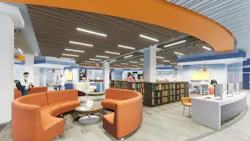




Colleges and universities are under pressure to prove their value as they navigate enrollment challenges, affordability concerns, student retention, and changing expectations around the campus experience. In this episode of the I Hear Design podcast, host Robert Nieminen speaks with Martin Kimmel, founding principal and chief creative officer of Kimmel Architecture, about how the physical campus can help institutions clarify who they are and why students should choose them.
Kimmel discusses what a higher ed “identity crisis” looks like from an architect’s perspective, how buildings can either reinforce or dilute an institution’s mission, and why campus design should align with recruitment, retention, wellness, belonging, and long-term value. The conversation also explores the evolving role of libraries as student-success hubs, the importance of designing spaces where students can feel “alone together,” and how colleges can achieve meaningful transformation through extraordinary solutions for ordinary budgets.
Meet Our Guest

Martin D. Kimmel, AIA, NCARB, Co-Founder & President, Kimmel Architecture
Martin is a president and co-founder of Kimmel Architecture (formerly Kimmel Bogrette Architecture + Site) and has more than 30 years of architectural design, land planning, historic preservation/restoration and project management experience. Martin’s work spans a variety of building types, including higher education, municipal, ecclesiastical, corporate, healthcare, geriatric care, retail, industrial and residential projects, ranging in scale up to $150 million. His experience has been broadened by almost three years of training in a historic preservation and restoration firm in Philadelphia. Martin has a strong ability to take a project’s design goals and interpret them into a sound architectural design concept. His no-nonsense approach ensures that all projects are given special attention and care throughout the project’s life.
Key Moments in This Episode
00:11 | Introduction: Higher ed’s campus identity challenge
Robert opens the episode by framing the uncertainty facing colleges and universities, including enrollment, affordability, retention, and the value of the campus experience.
02:23 | Why the campus environment matters more than ever
The conversation begins with the idea that colleges need to communicate their value clearly, and that the physical campus plays a major role in how prospective students and families understand that value.
03:08 | Designing for mission-driven institutions
Martin Kimmel explains his role at Kimmel Architecture and describes the firm’s work with mission-driven, not-for-profit clients focused on serving people and communities.
04:24 | When the built environment tells a different story
Kimmel discusses how many campuses claim a distinct identity, but their buildings, housing, and student-facing spaces often do not directly reflect the institution’s mission.
05:45 | The “incognito campus tour” test
Kimmel shares how his team assesses alignment by taking admissions tours anonymously, then comparing what leadership says, what marketing communicates, and what the student tour experience reveals.
07:48 | Creating a project mission statement
Rather than jumping immediately into schematic design or programming, Kimmel explains why his team starts by aligning each project—large or small—with the institution’s broader mission and success goals.
10:32 | Reinvigorating older campus buildings
The discussion turns to aging midcentury buildings, deferred capital challenges, and how campuses can realistically improve what they already have without trying to fix everything at once.
12:13 | Honoring the past without faking it
Kimmel explains why campuses should avoid both fake historicism and disconnected “lunar lander” buildings, instead finding ways to honor tradition while looking toward the future.
14:48 | What architecture can communicate that marketing cannot
Kimmel describes how campus spaces can help students imagine themselves belonging there, especially through environments that offer different ways to sit, study, gather, and be in community.
17:05 | Why libraries still matter in a digital-first culture
The conversation explores why libraries remain vital—not simply as places for books, but as spaces for information literacy, research support, collaboration, and campus connection.
19:58 | Reimagining the library as a student-success center
Kimmel describes how libraries can become central hubs for tutoring, mentoring, writing support, language support, food support, and other student-success services.
22:48 | Wellness beyond daylight and natural materials
Kimmel cautions that daylight and natural materials are important but “low-hanging fruit,” then connects wellness to academic stress, isolation, belonging, and the need for spaces where students can be together without feeling overwhelmed.
23:52 | The indoor campus commons
For campuses where weather limits outdoor gathering, Kimmel describes the value of creating a bright, connected indoor hub that functions like a campus great room.
25:19 | Designing mental health and belonging into campus life
The conversation turns to mental health support spaces, comfort, visibility, and how even small residence hall renovations can create better opportunities for students to gather instead of remaining isolated.
27:53 | Extraordinary solutions for ordinary budgets
Kimmel explains why meaningful design transformation does not always require a major capital project, arguing that small projects can move the needle when institutions are honest about budget guardrails.
29:49 | Why a good idea can survive value engineering
Kimmel makes the case that if the design idea is the project’s DNA—not just a visual flourish—it is much harder to strip away during cost cutting.
31:40 | Bundling deferred maintenance into donor-worthy projects
Kimmel discusses how campuses can pair less visible needs, such as roofs and air conditioning, with more compelling capital projects to help address deferred maintenance while advancing institutional value.
34:30 | Bringing students, faculty, and staff into the process at the right time
Kimmel explains why broad “blue sky” focus groups are not always effective and why stakeholder input can be more useful once there is a mission-driven framework and options to respond to.
36:24 | Questions leaders should ask before the next project
Kimmel advises presidents and facilities leaders to revisit the institution’s founding mission, ask whether it is visible on campus, and identify “surgical strike” projects that can build momentum.
38:07 | Why the physical campus still matters
Kimmel reflects on the importance of campus life, student engagement beyond academics, and the spaces that encourage students to remain connected to the campus experience.
40:08 | Sustainability as an operational strategy
The conversation closes with a discussion of energy-saving strategies, solar, better building envelopes, geothermal systems, and why sustainability goals are more likely to survive value engineering when they are embedded in the project mission and budget from the start.
About the Author
 Robert Nieminen
Robert Nieminen
Market Content Director
Market Content Director, American School & University, Architectural Products, BUILDINGS, and interiors+sources
Robert Nieminen is the Market Content Director of four leading B2B publications serving the commercial architecture and design industries: American School & University, Architectural Products, BUILDINGS, and interiors+sources. With a career rooted in editorial excellence and a passion for storytelling, Robert oversees a diverse content portfolio that spans award-winning feature articles, strategic podcast programming, and digital media initiatives aimed at empowering design professionals, facility managers, and commercial building stakeholders.
He is the host of the I Hear Design podcast and curates the Smart Buildings Technology Report, bringing thought leadership to the forefront of innovation in built environments. Robert leads editorial and creative direction for multiple industry award programs—including the Elev8 Design Awards and Product Innovation Awards—and is a recognized voice in sustainability, smart technology integration, and forward-thinking design.
Robert's work has earned him industry-wide recognition throughout his career, including:
- ASBPE Award (2019, 2018, 2017, 2015)—Best Regularly-Contributed Column; retrofit
- TABPI Award (2017, 2016)—Top 25 Entries, Cover Story; Retail Environments
- WPA Maggie Award (2011, 2010, 2008)—Best Publication, Trade; interiors+sources
- FOLIO: Eddie Gold Award (2022, 2007)—Best Feature Article & Special Section; interiors+sources
- Contributing author of ASID’s 2020 Outlook and State of Interior Design report, as well as The State of the Interior Design Profession (Fairchild Books, 2010), which earned a place on the International Federation of Interior Architects/Designers’ “50 Must Read, Must Have” book list.