How Gensler Is Reimagining Hybrid Workplaces for Longevity
What Brandon Larcom Is Watching
- Circularity as a baseline: Cradle-to-cradle thinking and manufacturer take-back programs
- Tech-enabled adaptability: Flexible spaces for hybrid work, wellness, and community
- New sustainability frontiers: Solar rain screens and responsive furniture systems
- Blurred boundaries: Furniture, architecture, and tech converging through hackability
- Hybrid-driven design: Interactive, ergonomic furniture that adapts to users
What does it really take to “future-proof” workplace products in an era of hybrid work, rapid tech evolution, and tightening climate commitments? In this interview, excerpted from a recent conversation from the I Hear Design podcast, interiors+sources Market Content Director Robert Nieminen spoke with Gensler Product Development Leader Brandon Larcom, who shares how the firm’s circular approaches to materials and emerging smart technologies are converging to create flexible, wellness-driven environments that are relevant for the long haul.
i+s: How does Gensler approach the balance between form, function, and future-proofing when developing new workplace products?
Brandon Larcom: This keyword—future-proofing—especially in a world right now of dynamics where economically there’s a lot of changes that are happening politically—all of the regulations are shifting. Manufacturers, brands—all of the above—clients, they’re looking for this keyword of future proofing.
And how we’ve been able to do it, at least for our products in the practice area that I lead, is based on our Gensler Product Specification Standards (GPS). We focused on what were the largest emitters of landfill waste and worked our way backward in looking at our specifications. One was carpeting, setting a standard of regulation for circularity in carpeting.
When we can take a standardization and set that benchmark, we’re suddenly shifting the model from being from cradle-to-grave, where it just ends up simply in a landfill, to cradle-to-cradle. Our manufacturing partners, in order to meet GPS standards that we’ve set, they have to have a take-back program. That itself is a game changer. And I will tell you, it was not easy.
When we launched these, we reached out to each of our manufacturing collaborative partners, identifying, “Is this possible?” Because we do want to push the industry. So that’s one example of how we’re trying to future proof—and we are. Gensler made a commitment to the United Nations that by 2030, we would reach embodied new carbon neutrality in all of our projects.
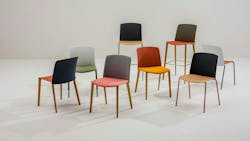
i+s: Sustainability and material innovation are front and center in workplace design. Where do you see the biggest opportunities for progress in the next five years?
BL: Technology allows people to be less tethered to their space and have more mobility. So when you’re creating flexible spaces that are adaptable, you’re suddenly no longer having a space that is utilized for one specific purpose. You have an openness to the way people are working in a hybrid work environment.
That’s leading to less waste, solving for productivity, and a better enjoyment in the workplace. All of this coupled together is moving the needle. It is about sustainability. It is about wellness. It is about appreciation in the workplace. It’s about fostering community. And our products aim to bring that solution.
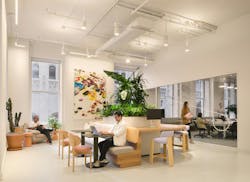
i+s: What are some of the most exciting product categories or technologies you’re exploring right now?
BL: We are shifting beyond what we have traditionally done, which are the tangible products, into a more experiential side. For example, we’ve collaborated with a company that does solar rain screen façades. Imagine you have an entire building that is skinned right now in a standard, static-type material. We now have the ability to clad that entire building, whether it looks like it’s mirrored glass, concrete, marble, a slated tile, and it all puts energy back to the grid.
They say that the most sustainable buildings—and our Research Institute confirms this—are buildings that are being repurposed because you’re not starting from fresh. Yet there are a lot of intricacies that go into repurposing a building. So this suddenly shifts us fully into the technology side.
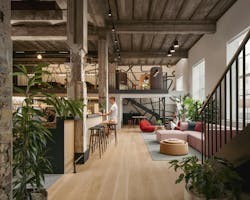
i+s: How do you see the line between furniture, architecture, and technology evolving as workplaces become smarter and more responsive?
BL: I would say hackability and flexibility. The words seem strong, but they’re also broad enough to be able to understand that we’re looking to give employees who we are designing for agency in their spaces. And that is what links to wellness and hospitality focused areas. We’re seeing more wood tones. We’re seeing integrity that is going into the products and spaces.
Think back to the ′80s and the cubicle era of the ′90s. Everything was more homogenized. And now you’re seeing this whimsicalness about the workplace where people come in because they want to feel energized and focusing on that workplace sector.
The moment that you feel connected, and you recognize what intention you’re putting into the story you’re telling or the work that you’re doing, your productivity increases, your efficiency increases. It’s what I call the three E’s—the ease of execution and efficiency.
Take prototyping: You’re developing a product and you change a spot here, change a spot there. It might be too expensive to manufacture it a certain way, but when you soften the edges or you remove one unnecessary part... Think of it: One adaptable wheel or caster that’s being taken off of a product, that actually reduces the cost of what the product is, but it also can make it more efficient. Not always, but it can do that. So [we’re] looking at how to streamline and make more items present, connected, and I think what we’re all after is efficient.
i+s: Hybrid work has fundamentally changed what organizations need from their spaces. How is that shaping the types of products you’re developing today?
BL: Furniture is no longer static. It’s becoming interactive; it’s becoming personalized. For example, desks and chairs and even collaborative pods [are] being embedded with power sensors and adaptability to support these hybrid work and wellness examples.
When you’re having a worker come into a space—and they may only be there three days a week—but suddenly they have their personalized touch of being able to come in and adapt to it [by] utilizing technology. We have some systems that as soon as you walk into the room and it’s tethered to the phone, it adjusts to the level that they have it preset at. Even when we’re looking at hoteling spaces, having this technology built in, so even height adjustable desks that remember the user preferences—that feels personalized, yet it’s also adaptable for everyone.
Or looking at seating that also tracks occupancy and posture levels. What are we looking at for ergonomics? How can we make and improve the wellness of people, employees, designers? All of those [people who] are experiencing a workplace, how do we make that a personalized touch?
And then you have tables with integrated touchscreens and wireless charging. You don’t have to be flopping around looking for the cable. It’s simply coming back to those three E’s: the ease of execution and efficiency with a personalized touch. So, I really see the transformation happening with enveloping more technological interfaces and that’s bridging the user and the digital environments together. That’s the future proofing that I’m seeing.
This article has been edited for space and clarity.
About the Author
 Robert Nieminen
Robert Nieminen
Market Content Director
Market Content Director, American School & University, Architectural Products, BUILDINGS, and interiors+sources
Robert Nieminen is the Market Content Director of four leading B2B publications serving the commercial architecture and design industries: American School & University, Architectural Products, BUILDINGS, and interiors+sources. With a career rooted in editorial excellence and a passion for storytelling, Robert oversees a diverse content portfolio that spans award-winning feature articles, strategic podcast programming, and digital media initiatives aimed at empowering design professionals, facility managers, and commercial building stakeholders.
He is the host of the I Hear Design podcast and curates the Smart Buildings Technology Report, bringing thought leadership to the forefront of innovation in built environments. Robert leads editorial and creative direction for multiple industry award programs—including the Elev8 Design Awards and Product Innovation Awards—and is a recognized voice in sustainability, smart technology integration, and forward-thinking design.
Robert's work has earned him industry-wide recognition throughout his career, including:
- ASBPE Award (2019, 2018, 2017, 2015)—Best Regularly-Contributed Column; retrofit
- TABPI Award (2017, 2016)—Top 25 Entries, Cover Story; Retail Environments
- WPA Maggie Award (2011, 2010, 2008)—Best Publication, Trade; interiors+sources
- FOLIO: Eddie Gold Award (2022, 2007)—Best Feature Article & Special Section; interiors+sources
- Contributing author of ASID’s 2020 Outlook and State of Interior Design report, as well as The State of the Interior Design Profession (Fairchild Books, 2010), which earned a place on the International Federation of Interior Architects/Designers’ “50 Must Read, Must Have” book list.