Notes on RGB Color Skew in Video over UTP Systems
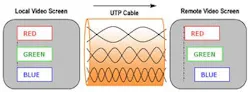
UTP and STP cables, including Cat-5, -5e, and -6, are constructed using four twisted pairs. In all standard cables the twist rate (number of twists per inch) is different among the various pairs inside the cable. This is an intentional design feature because they were originally developed for LAN application. The twist ratio difference cuts down on the crosstalk in bidirectional data communication. Due to the low cost, availability, and ease of termination, these cables are now being used in high resolution video extension. Many manufacturers, including Hall Research, offer a wide array of products that can use UTP cables for this purpose.
Regardless of the manufacturer, virtually all RGB or RGBHV (e.g. PC’s VGA) video over UTP systems transmit each color component over its own dedicated twisted pair: Therefore, three pairs are used for the transmission of color. The fourthpair can be used for other purposes such as: phantom power (such as HRTs Mini-Cat® series of products), audio, data, serial port, keyboard/mouse, etc.
The following block diagram shows only three of the four pairs used in an RGB over UTP extension. It clearly depicts the misalignment that occurs at the remote end due to the twisting rate (which makes the overall lengths of each pair different).
The Spec 568B.2 says 45 nanosecond (nsec) maximum delay skew for Cat-5, -5e, and -6 at 100 meters; This means that if you initiated a pulse on one end of the cable simultaneously on each of the four pairs, on the other side, this pulse will not arrive at the same time on the different pairs. The time difference between the appearance of the first and last pulse could be as much 45 nanoseconds.
Hall Research Technologies, Inc
1163 Warner Ave.
Tustin, CA 92780
Phone: (714) 641-6607 Fax:(714) 641-6698
How much skew can you expect in terms of pixels on the screen?
Here are pixel times for typical resolutions used today:
1024x768 @ 60 Hz 1 pixel=15.3 nsec
1024x768 @ 75 Hz 1 pixel=12.7 nsec
1280x1024 @ 60 Hz 1 pixel= 9.3 nsec
1280x1024 @ 75 Hz 1 pixel= 7.4 nsec
For example, I am typing this paper on my Viewsonic® LCD with native 1280x1024 resolution, so I have set my video card to 1280x1024 at 60 Hz to match the display. I am using small fonts and, in fact, the characters displayed have 1 pixel elements (like the dot in “i”).
Let’s assume that the average Cat-6 cable that you can buy has 25 nsec/328 feet (or 100 meters), this means that without skew correction, I would have color separation of 1 pixel at a length of 122 feet of Cat-6 cable. If I was watching a video or looking at a PowerPoint™ presentation with big fonts this would not be a big problem. But if I were using it to show small text, it would drive the viewer crazy - and 122 feet is relatively short for video over Cat-5 solutions because suppliers boast 300 feet to 800 feet or more. That's why convincing installers to use low skew cables (be it Cat-5 or -6) is important for video, and if they refuse to acknowledge this and the end-user is dissatisfied with the results, that's when the SKU-RGB will come in handy.
One advantage of the SKU-RGB is that it has standard VGA input and output connectors. This makes it independent of the method used by different manufacturers to embed the VGA signal in the UTP cable. Customers often confuse skew correction with high-frequency compensation, and so they may think that the system they have purchased has this adjustment. Some of lowest cost Baluns and devices have no compensation or adjustment at all. Most do have a means to boost the gain of high frequency components of the signal to make up for the losses, which occurs in long cables. This is often referred to as "peaking." But the vast majority of devices on the market have no adjustment for skew, which is entirely a different mechanism, and those that do are pricy. Skew adjustment shouldn’t be necessary if the cable used has low skew to begin with or if the distance wasn’t too long.
It is worth noting that RGB color skew is not unique to UTP setups and can, in fact, be a problem in video extension when standard multicoaxial video cables are utilized as well. Again, because cables (such as VGA extension cables) use three separate coax lines for the RGB, the arrival times at the remote end depends on the propagation speeds in each coax line. Small variations in geometry or the coax foam insulation properties can cause one color component to travel slower than others, which would necessitate skew correction if one desires the clearest image possible.