AIA’s Materials Pledge Report Reveals Progress—and What Comes Next
At A Glance
- Firms report meaningful gains in understanding human and climate health—and it’s reshaping their materials vetting process.
- New project-level data reveals how designers are integrating healthier product attributes across real-world work.
- Social health and equity remain the least-understood category, prompting fresh industry conversations.
- Opportunities are emerging around reclaimed materials as firms look to refine circular strategies.

One of a project’s greatest impacts is its material selection. From the paint on the walls to the lighting overhead, every item within the built environment has an impact beyond its end use. A product’s entire lifecycle ripples into the natural world, influences human health, and intersects with social justice.
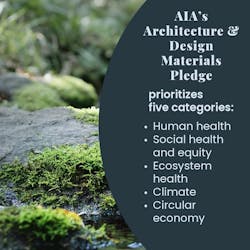
As designers know, navigating the selection process requires intentionality and forethought. The AIA Architecture & Design Materials Pledge recognizes that there are myriad ways to quantify material health and is squarely addressing the challenge. The materials program asks signatories to prioritize five categories: human health, social health and equity, ecosystem health, climate, and circular economy.
The pledge’s 2024 report findings, released with a new reporting framework, outline a number of encouraging signs as well as areas for improvement.
Key Wins
Making informed choices about healthy products is no small feat, requiring dedicated resources and staff expertise. Even so, the 2024 report highlights significant momentum. The pledge’s signatories are demonstrating their commitment to creating a better built environment in three key areas:
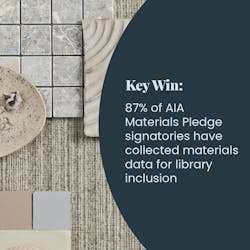
- 87% of firms have collected materials data for library inclusion, indicating the effectiveness of having an intentional process in place.
- Human and climate health are the strongest knowledge categories, a sign of how ongoing conversations, learning opportunities, and material disclosure have improved awareness.
- Carpeting, acoustical ceilings, and resilient flooring are cited as top products, which is supported by manufacturers’ willingness to commit to Health Product Declarations (HPDs), Environmental Product Declarations (EPDs), the Declare Label, Cradle to Cradle Certification, or the Science Based Targets Initiative (SBTi).
The report also reflects deeper insights beyond firm-level data. The majority of the 121 signatories volunteered to provide data on 400 projects, with over 300 of those containing product attributes. This furthers the groundwork necessary to document how design professionals are successfully strengthening their holistic materials procurement.
Three Growth Opportunities and Next Steps
As firms continue to improve product selection, it’s important to pursue the next level of benchmarks. Supported with insights by Melanie De Cola, AIA’s director of Climate Action Pledge Programs and a LEED Green Associate, here are three areas to consider strengthening.
1. Elevate materials with a social health and equity profile.
Out of 120 firms, over 60% cited low familiarity with social health and equity. This is compounded by the uphill battle of locating qualifying products in this category in the first place.
“The lack of clear benchmarks, standardized labels, and a general understanding of material supply chains are significant contributing factors,” De Cola told interiors+sources. “In response, AIA aims to develop educational opportunities in 2026 to address these knowledge gaps.”
2. Push education at the client level.
The report found that a firm’s core mission and values typically drive healthy material selection, often dovetailing with certification. Only 10% cited clients as the primary motivation for project material usage strategies. Yet stakeholders are important to engage in product discussions because they are the long-term stewards of a project—and designers are well positioned to educate them.
“While we believe cost remains a primary driver for most material selection, it highlights a crucial opportunity for firms,” De Cola stressed. “Signatories of the Materials Pledge are uniquely positioned to advocate for healthier material choices. They can educate clients on the long-term benefits, which often extend beyond the initial budget, and integrate these considerations into the selection process from the start.”
3. Incorporate a higher percentage of reclaimed materials.
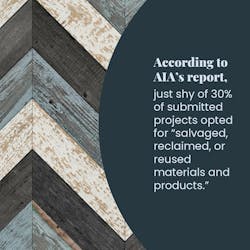
Despite the popularity of salvaged barnwood in home renovation shows, only 3% of firms are maximizing reclaimed materials as a dedicated strategy for diverting design materials from the waste stream. In fact, just shy of 30% of submitted projects opted for “salvaged, reclaimed, or reused materials and products.”
For interior projects, selecting pre-owned or updating current furnishings can meaningfully contribute to material reuse and preserve or even reduce embodied carbon. From reupholstering to modifying the original piece, there are many ways to revive an item for its next iteration. There are abundant options for refurbished office furnishings, not to mention a healthy marketplace for vintage offerings if it fits a client’s brand aesthetic. Any of these efforts concretely keep materials from a gloomy fate in the landfill.
For example, this Perkins+Will project saved 16% of the total material cost during a 2020 office move by reconfiguring existing items from the previous location. They also repopulated 68% of the new layout with available furniture, scoring $100,000 in savings and demonstrating that sustainability opportunities don’t need to inflate project budgets.
“A significant barrier to a circular economy is the inconsistent availability of reusable materials and the difficulty in connecting these materials with firms that can use them,” De Cola acknowledged. “Implementing local and state ordinances for material capture and reuse can address this challenge by fostering an active and reliable market for reclaimed resources.”
About the Author
Jennie M. Morton
A former interiors+sources editor, Jennie M. Morton is a freelance writer specializing in commercial architecture, IoT, and proptech.