Four Educators Win $50K thanks to KI's Classroom Furniture Giveaway
Key Highlights
- The program awarded four educators $50,000 each.
- Design highlights include multifunctional furniture for STEM, collaborative spaces for social sciences, flexible setups for special education, and creative library media centers.
- Additional prizes are also provided to support the ongoing development of versatile, human-centered interiors.
- Learn how KI's giveaway inspires commercial design projects focused on inclusivity and well-being.

The fourth annual KI classroom furniture giveaway demonstrates how design innovation can transform educational environments while giving back to communities. This national initiative awarded four K–12 educators $50,000 each to reimagine classrooms and library media centers with furniture that promotes engagement, adaptability, and inclusivity based on the public’s 131,000 votes from across the nation.
“These educators dreamed big, and their designs reflect how deeply they understand their students’ needs and how committed they are to creating meaningful learning experiences,” said Bryan Ballegeer, KI’s vice president of education markets. “We’re honored to help turn their visions into inspiring spaces and grateful to the communities nationwide who rallied behind them by voting.”
For commercial interior designers and architects, these projects offer real-world examples of human-centered, flexible design solutions that support diverse learning needs. The winning spaces showcase how thoughtful furniture selection and spatial planning can foster collaboration, sensory well-being, and comfort—principles that translate directly to commercial and institutional interiors.
As part of the KI classroom furniture giveaway, the teachers used KI’s Classroom Planner Tool to design floorplans of their dream classroom. Those plans were incorporated into videos outlining their classroom designs, and were shared via KI Furniture’s YouTube channel for the public to learn more about the projects before voting.
Design Highlights

- STEM Classroom (Khadijah Mosely, Hornets Nest Elementary, NC): Multifunctional furniture and abundant storage create a dynamic environment supporting various postures and learning styles.
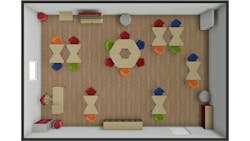

- Social Sciences Classroom (Andy Goveia, Thomas Metcalf Laboratory School, IL): Active and collaborative spaces blend comfort with flexibility, encouraging student connection and focus.
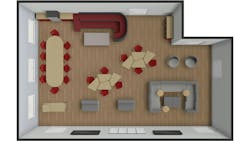

- Special Education Classroom (Angelyn Obray, Northridge High School, UT): Movable, flexible furniture accommodates diverse needs, enhancing student confidence and engagement.


- Library Media Center (Lisa Floyd, Twin Rivers High School, MO): Warm, collaborative spaces to honor former teacher Holly Johnson’s legacy and foster creativity, providing a model for adaptive library design in commercial and institutional projects.
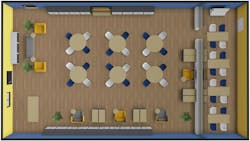
Beyond the $50,000 furniture installations, each winning learning space will receive a 3-pack of Thesis Battery Powered Modules by Byrne to reinforce modularity and adaptable solutions—key considerations for designers seeking to create versatile interiors. The installations will begin in early 2026.
The eight runners-up will receive a Civara task chair for their participation.
These winning classrooms illustrate how design professionals can impact learning environments and social outcomes, offering inspiration for commercial and institutional projects. KI’s initiative underscores the broader role of the design community in shaping spaces that are functional, inclusive, and human-centered.
By connecting product specification with purpose-driven design, KI’s giveaway is a reminder that the impact of thoughtful interiors extends far beyond the immediate space—it touches people, communities, and the future of design itself.
Takeaway for Design Professionals
This program exemplifies how adaptable, multifunctional furniture and intentional spatial design can create meaningful experiences, whether in a classroom, workplace, healthcare setting, or public environment. The design industry’s investment in education demonstrates the power of human-centered design to drive engagement, inclusivity, and well-being—a principle that resonates across all commercial interior projects.
This piece was created with the assistance of generative AI tools and was edited by our content team for clarity and accuracy.