Do You Have an App for That?
Professionals all around the world are embracing mobile technology to make their lives easier—that includes tech-minded interior designers. Thanks to the rise of fully featured mobile platforms, including Apple’s iOS and Google’s Android, apps have made it easier for designers to communicate, collaborate and research on the go.
“Communication is why mobile technology exists. I think it makes it much easier to interact with clients and other designers on a more rapid and pervasive level than previously before,” says Bryan Flaig, a partner of emerging design firm Undisclosable.
Apps such as Skype, GoToMeeting and the new Google+ allow you to collaborate and communicate with your team members and clients in real time, from anywhere in the world (provided a strong Wi-Fi or 4G signal). The possibilities for mobile collaboration are really only limited by your imagination. For example, you could use a video app to show a remote client a product or potential space before making a decision.
And it’s not just about video chatting anymore. Full-featured apps like SketchBookPRO, Notability and GoodReader allow you to mark up PDF and DWG files with edits, eliminating the confusion and potential for mistakes caused by calling staff members at the office and talking them through changes. Edits to plans or drawings can be instantaneously and seamlessly integrated while onsite.
“Mobile technology has helped me enormously on one level, because with my iPad my team can send me drawings wherever I am and I can mark them up, where I couldn’t before,” says David Ashen, president of D-Ash Design. “I was traveling and was with my client working on a design for a café in London. My office sent me a document, and I was able to work with my client in London to sketch on top of the document and work on the development of the floor plan. I could then send it back to my office and have them work during the time difference and get something back to me before we woke up. We used that to work with the team there and show progress.”
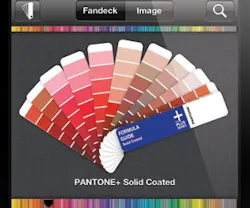
Mobile apps have also revolutionized the research process—product images and information are now available with just a few taps of the finger. An array of manufacturers have now put product catalogs into app form, including Bretford, Centiva, InterfaceFLOR, Desso, Steelcase and Teknion, with the majority of apps formatted to take advantage of larger tablet screens. Talking colors, not products? PANTONE’s myPANTONE app (shown, left) now allows you to create color palettes and reference PANTONE colors on the go, and then share what you discover via email or social media.
Enterprising designers have also begun using mobile technology as a guide to help pinpoint unique places of interest or inspiring locations while traveling.
“I can use it to do a store search or to look for cool design stuff,” says Ashen. “For example, I was in Austin a few weeks ago. I brought my iPad with me and was able to use it as a resource to find things—it’s becoming a mobile guide to tell you what’s cool and what’s new.”
Unfortunately, the app versions of your favorite design programs probably won’t operate exactly like they do on your computer and there isn’t a way around it—for now. Existing tablets just aren’t designed to fully operate power- and processor-hungry programs, such as Revit or Google SketchUp, although that will likely change in the coming years.
“Mobile applications tend to be highly focused and workflow specific. We recognize that in the mobile world, users are looking for apps that achieve a specific task in a streamlined and efficient way,” says Shanna Tellerman, product line manager of web services for Autodesk.
In short, mobile technology is well worth the cost due to its communication, research and time-saving benefits. And while apps aren’t quite ready to take over the world’s larger design tasks, they are already capable of greatly enhancing your existing design capabilities.
“Mobile devices are valuable tools if used with wisdom,” says Filo Castore, associate principal, market sector leader—corporate + commercial + civic, Perkins + Will’s Houston Office. “Unfortunately, less experienced architects and designers are inclined to ‘design’ through the application, and are not actually using the tool to elevate their already strong solution. We are continuously challenging the application engineers to create tools that can better communicate our creative ideas.”
Kylie Wroblaski is a former editor for BUILDINGS magazine, and has written previously about architecture and facilities management.