How Designers Can Plan for Biologically Effective Light
What Designers Should Know
- Measure light where occupants receive it. Circadian performance depends on vertical illumination at the eye, not only the light reaching a desk or task plane.
- Plan around real occupant behavior. Window orientation, seating direction, shading habits, and where people spend their time can determine whether daylight actually provides biological benefit.
- Automation still needs an escape hatch. Circadian schedules should support normal operations, with simple occupant overrides when work extends beyond programmed daytime conditions.
- Interior materials affect the lighting strategy. Reflectance and spectral absorption—including from wood surfaces and foliage—can change how biologically useful light moves through a space.
For years, circadian lighting has faced a practical challenge: translating evolving science into metrics, standards, and products designers can confidently apply. Disagreement over appropriate benchmarks, unfamiliar terminology, and the need to balance biological efficacy with visual quality and energy use have all slowed adoption. More recently, the Illuminating Engineering Society (IES) and CIE, the International Commission on Illumination, reached consensus around melanopic Equivalent Daylight Illuminance (melanopic EDI or m-EDI), providing guidance on biologically-effective light levels at different times of day and where that light should reach occupants.
As founder and chief scientist of BIOS Lighting, Robert Soler has spent much of his career translating circadian science into practical lighting guidance. His work has included NASA, elite sports organizations, the International WELL Building Institute, and the National Institutes of Health. In a recent conversation with interiors+sources staff writer Lauren Brant, Soler explains why biologically effective lighting requires designers to think beyond the fixture—considering daylight, spatial planning, occupant behavior, controls, visual comfort, and energy use as part of one integrated strategy.
For a deeper dive on circadian lighting, listen to our “Product Talk” podcast episode at: iands.design/55400656.
i+s: Circadian lighting can be a complex element to work into an interior design. Where do designers sometimes oversimplify or misunderstand circadian lighting?
Robert Soler: I think where they oversimplify is in how much daylight can contribute. You might think, “This space has lots of daylight, lots of windows, so it probably supports your circadian rhythm just fine.”
We now have a metric—melanopic EDI—and criteria. You need 250 melanopic EDI in the daytime, less than 10 in the evening hours, and less than 1 at night. Where you measure is at your eyes, not at the task plane.
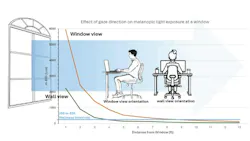
If you have great window access, in order to get that 250 melanopic EDI, you have to be looking at the window and within 5 feet. The second your body turns away from that window, you’re getting about half of that.
The challenge from the designer standpoint is that the window is almost always opposite the door. You’re asking someone to face the window and have their back toward the door. Oftentimes, they face the wall that has the window on one side and the door on the other. We’ve done measurement after measurement, and with that side-window application, you’re probably getting about 40% of that blue-sky criteria that you need.
i+s: What separates a biologically effective lighting solution from a product simply marketed as “circadian”?
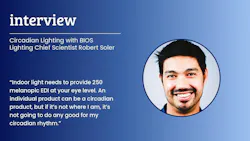
Soler: It comes down to the application. Indoor light needs to provide 250 melanopic EDI at your eye level. An individual product can be a circadian product, but if it’s not where I am, it’s not going to do any good for my circadian rhythm.
There are visual criteria, but also physiological criteria. A majority of the lights in the ceiling are designed to put light on the task plane below them. They’re not very efficient at putting light in your eyes. Application is so important to delivering effective biological lighting.
If a product claims to deliver circadian lighting, ask: How does it need to be applied to meet those criteria? Look at the spectrum, melanopic ratio (MDER), and application guidance. A rule of thumb is that you’d like to see an MDER greater than 1.
i+s: How should daylight and electric lighting work together within the space?
Soler: The designers doing this well are understanding human behavior. If shades are manually controlled, you close them one time and you may not open them again, so automation is important.
Daylight is really important for biophilia, energy efficiency, and a lot of other things. But thinking it automatically checks the circadian box is a little short-sighted.
Electric light has to support what the windows are doing. If I’m looking in any other direction, will the electric lights cover me? We have to get to the point where electric light supports the design narrative, the connection to nature, and the benefits daylight gives us, but does it equitably throughout the space—no matter where you sit, where you face, or where you are in the building.
i+s: How can designers balance automation with occupant control?
Soler: If you require an individual to change the lighting from day to evening, they will never do it. That part has to be automated. But it can’t simply reproduce what’s happening outside. For example, if you’re in Boston in winter and the lights go into a “sleepy” mode at 5 p.m. when you’ve got a deadline, that doesn’t support the people or the activity in the space.
I generally promote 7 a.m. to 7 p.m. as daytime, and after that it can fade into an evening mode. But you need the ability to override it. Somebody has to be able to say, “I’m not ready for that,” push a button, and return it to daytime mode for a certain amount of time.
One of the biggest hurdles for circadian lighting has been controls that are complicated and expensive to install and commission, only to find that the end user doesn’t know how to use them. Simplify it as much as possible.
i+s: How can designers deliver biologically effective light without compromising visual comfort?
Soler: That’s one of the hardest things. If you don’t handle glare, you can undermine the whole value proposition. Size and contrast ratio are important. As light sources get smaller, the brightness increases. If you bounce light off a wall, you’re distributing that light over a very large surface, so it’s not as glary.
You can have lighting where performance and energy levels go up, but if you ask people whether they want that light or the warmer, more comfortable light, they almost always choose the comfortable light. If you want people to enjoy the space, the lighting has to check the glare box. Otherwise, it undermines the point of what you’re doing.
i+s: Where can wellness and energy-efficiency goals support—or conflict with—each other?
Soler: The focus has traditionally been on providing enough light to satisfy visual criteria with the least amount of energy. That’s why the lighting spectrum and distribution often have very little biological impact.
We have to get smarter about application efficiency from a health and wellness standpoint. The light that falls on the task plane is the light that you see, but the light that falls on your face is the light that you feel. How do you address those two efficiently and independently?
Daylight is one place where wellness and sustainability agree. But if sustainability is measured in lumens per watt and you need 90 foot-candles to achieve the wellness target, you’ve missed the point. If you can achieve wellness at something like 0.4 watts per square foot, you’ve done a really good job of combining the two.
i+s: What other interior design decisions can affect circadian performance?
Soler: Materials are an interesting one. Mass timber absorbs a lot of sky-blue light, so it doesn’t distribute it well throughout the space. The same is true with green foliage—it reflects green and absorbs blue and red.
Things that are biophilic can therefore also conflict with this aspect of wellness. You have to consider the reason you’re designing the space—collaboration, social interaction, connection to nature—but also satisfy the biological requirement.
Ultimately, ask how occupants are using the space. Is it primarily a daytime activity space, or is it somewhere people sleep? Shift work is a different animal because schedules matter. The lighting solution has to support the occupant functions and why people are in that space to begin with.
About the Author
 Lauren Brant
Lauren Brant
Staff Writer, interiors+sources and BUILDINGS
Lauren Brant is Staff Writer for both interiors+sources and BUILDINGS. She is an award-winning editor and reporter whose work has appeared in daily and weekly newspapers. In 2020, the weekly newspaper won the Rhoades Family Weekly Print Sweepstakes—the division winner across the state's weekly newspapers. Lauren was also awarded the top feature photo across Class A papers. She holds a B.A. in journalism and media communications from Colorado State University-Fort Collins and a M.S. in organizational management from Chadron State College.