The New Economics of Workplace Design: Early Pricing, Procurement Strategy, and Real Value
At A Glance
- Rising costs driving earlier pricing alignment and deeper team collaboration
- Compressed timelines pushing value engineering upstream to protect quality and schedules
- Shifting program priorities favoring shared amenities and hybrid-ready meeting spaces
- Evidence-based design decisions supporting resilient workplaces and performance-driven budgets

As inflation, tariffs, and supply chain volatility increase costs for commercial office interior projects, designers are recalibrating the design process to meet the changing demands of property owners and end users, a shift that mirrors broader commercial interior design trends shaped by rising office build-out costs.
In many decisions, financial feasibility has taken priority over aesthetic ambitions. The focus has shifted beyond simple budgetary planning to project viability, with increased importance being placed at the project’s outset on determining if goals can be delivered in the current environment without compromising quality. This shift has altered the traditional workflow, reorganizing how projects launch, sequence, and finish.
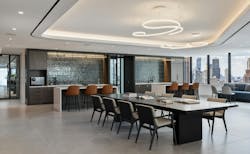
Schedules that once allowed generous room for exploration and iteration have been reduced by at least half, making early decisions more consequential and removing the luxury of backtracking.
With pricing feedback expected earlier, designers, contractors, and consultants must coordinate up front to produce accurate estimates. The emphasis on early price discovery is particularly acute in finish-intensive front-of-house zones—areas where value engineering in interior design often becomes a deciding factor—where the cost difference between options can be steep.
Designers now deliver conceptual packages and strategic layouts focused on high-impact zones, aligning these early choices with broader workplace design strategies paired with early input from building partners, so clients can assess budget from day one. With that visibility, teams can make informed tradeoffs before committing to specific materials or features. The payoff is tangible: fewer surprises, fewer redesigns, and a cleaner alignment of vision and cost.
Equally important is the compression of timelines. Schedules that once allowed generous exploration have been cut at least in half, making early decisions more consequential and removing the luxury of backtracking. In this environment, value engineering is not a late-stage rescue mission but a proactive, built-in strategy that begins on day one. Teams set alternates, vet lead times as part of design selection, and lock critical-path packages earlier to protect delivery schedules. In many ways, procurement strategy is now fully linked to design strategy, creating a more integrated procurement strategy for commercial interiors.
In an era defined by cost scrutiny, the most successful interior projects are those that treat budget as a design consideration rather than an obstacle.
Program priorities are evolving alongside the process. Many clients are budgeting less for workstations and offices, while elevating shared amenity spaces and digital meeting hubs that produce outsized functional return and support evolving workplace design needs. A well-equipped client lounge or multipurpose forum can eliminate off-site hosting costs; a suite of flexible rooms can absorb peak meeting demand that might otherwise require overflow rentals.
The thread connecting these choices is utility over novelty, a theme increasingly reflected in workplace design trends. After years of rapid workplace evolution, the industry has a clearer view of what decisions have tangible effects on productivity and well-being, and which aren’t worth the expense. For example, acoustics and digital integration—such as frictionless audiovisual (AV) technology, multi-monitor setups, and rooms designed for hybrid work functionality—have moved from attractive extras to baseline requirements.
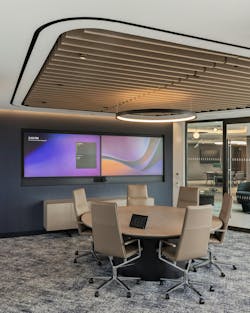
Driving this is a cultural shift from experimentation to refinement. The 2010s embraced lounge-oriented informality and residential cues; today’s brief is more selective, directing dollars to features that deliver demonstrable value and represent more intentional commercial interior design strategies. The workplace has shifted from novelty to necessity, and the market is rewarding clarity of intent. This doesn’t mean cutting back on ambition. It simply means designing with purpose, sequencing decisions intelligently, and measuring return in practical use.
In an era defined by cost scrutiny and increased focus on cost management in design, the most successful interior projects are those that treat budget as a design consideration rather than an obstacle. By leveraging early pricing, collaborative delivery, and evidence-based choices, designers can achieve spaces that are both resilient and resonant. The result is a more dependable path from concept to occupancy, where every dollar is asked to perform and where performance produces a successful investment.
More Contemporary Workspace Design

About the Author
 Saemi Lee
Saemi Lee
Saemi Lee, LEED AP is Senior Associate and Design Director at Vocon, a WBENC-certified woman-owned firm with offices in Cleveland, New York, and Chicago.
Lee’s two decades of experience include all phases of the design process as well as client-facing design presentations, visioning sessions. and interviews. She strives to work collaboratively with key stakeholders to establish functional and aesthetic goals, and deliver them into a complete design experience.