When Architecture Listens: Community Spaces Shaped By History And Land
Practical Design Guidance for Landmark Community Spaces
- Translate precedent—don’t replicate it. Study what the original is saying, then reinterpret.
- Design for transformation, not “primary use.” Let layouts and furnishings shift with the day and season.
- Treat land as a program driver. Frame views, weather, and movement patterns as core inputs.
- Build continuity through long relationships. Multi-commission partnerships deepen institutional and design intelligence over time.
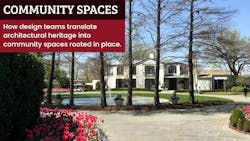
If you had been standing at the edge of Alex Camp’s property near White Rock Lake in 1938, you might have witnessed masons laying long bricks in the unforgiving Dallas sun, their movements choreographed in drawings by architect John Staub, who had spent decades refining a new style. Here, Staub married Latin Colonial restrained elegance to English Regency proportion, with just enough Art Deco lines to feel modern without chasing fashion.

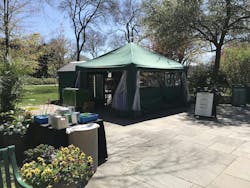
Staub understood something essential about the Backland Prairie landscape—how light falls, the way people seek shelter, when a building should offer presence without imposing itself. It was precisely this understanding our team would need to recover eight decades later, at this same site, now the expansive Dallas Arboretum and Botanical Society (DABS). We were tasked with replacing a tattered vinyl tent and plastic folding table that had overstayed their welcome by at least a decade.
That green tent, an overflow ticket counter used during busy events and described by our clients with the sheepish phrase “permanently temporary,” had become the kind of problem that public institutions like DABS eventually learn to unsee. These are banal objects, functional enough to justify leaving alone, aesthetically negligible enough to avoid in photographs. These makeshift structures slink into the background, quietly confessing that somewhere along the way, the conversation between historic buildings and contemporary institutional needs had simply broken down.
Listening Before Drawing
The temptation for a designer, when inheriting a site with this much architectural history, is to respond with one of two reflexes: either genuflect before the original and produce a careful replica in modern materials, or drop something conspicuously modern nearby and call it “dialogue.” Both approaches share the same flaw—they treat the existing building as an object to be referenced rather than a voice to be understood.
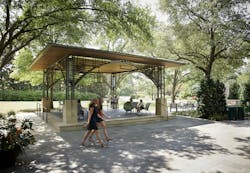
For our 396-square-foot Camp Gatehouse, we chose a third path, one that required becoming students of Staub’s work long before we allowed ourselves to design its new permanent neighbor. What emerged from that period of study was something closer to translation than imitation. In our hands, Staub’s window shutters became an ornamental steel frame paired with acid-etched glass screen walls; his chimney forms we reinterpreted as a brick tower anchoring the center of the hipped roof, rhyming asymmetrically with the original without repeating it verbatim. The pavilion offers a deeply respectful gesture that stops just short of reproduction—close enough to the Camp House to feel like family, different enough to make clear it arrived in a different century.
This methodology—entering through the gateway of precedent long enough to reinterpret rather than merely replicate—has become central to how our studio approaches community architecture. We have come to believe that resilient buildings are rarely invented from whole cloth: They emerge instead from ongoing conversations between past and present, and the architect’s primary obligation is to listen carefully enough to discern what the site and its history are already trying to say.
A Pavilion That Refuses to Be One Thing
A second commission at the Dallas Arboretum tested this principle in an altogether different register. The Shadow Garden Pavilion, sited along the garden’s main paseo between the Camp House and the DeGolyer Estate, arrived with a program that seemed almost impossible to reconcile: The structure needed to function as a covered tram stop, a small-scale café venue, an intimate concert stage, and a ceremonial dais for outdoor weddings. How could four distinct functions, four orientations to the landscape, four scales of gathering—from the solitary visitor to two hundred guests on the lawn—become one?
In situations like these, either the requirement to optimize due to site constraints or the reality of the owner’s budget forces us to identify a primary use and accept that secondary functions will suffer compromise. We resisted, choosing instead to design for transformation: a generous spatial envelope whose open framework could be reconfigured through sightlines, moveable furnishings, and the choreography of tables and chairs responding to the needs of a given afternoon. The architecture establishes an invitation; the institution and its visitors complete the space through the accumulated weight of their use over seasons and years.
This kind of programmatic adaptability is not merely a practical virtue; it is also an acknowledgment that communities evolve in ways their architects cannot anticipate, and that the most genuinely resilient structures are those humble enough to accommodate futures still beyond the horizon of anyone’s imagination.
Framing the Mountain
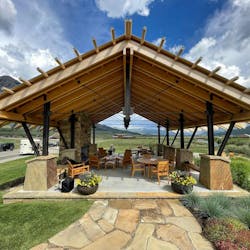
If the Dallas projects taught us to read institutional and architectural histories with patience, our Aperture Pavilion in Crested Butte, Colorado, demanded a different form of literacy: learning to read the land itself before committing anything to paper.
The site sits on the eastern bank of the Slate River at the base of Mount Crested Butte, a landscape defined by beautiful extremes: snow that buries fence posts by January, summer light so bright it feels aggressive against the skin, and the constant massive presence of the mountain anchoring every view. We conceived the pavilion as an open-air shelter generous enough to host family picnics, offer respite from afternoon thunderstorms, or simply provide a quiet place to sit with the peaks as the day softens toward evening.
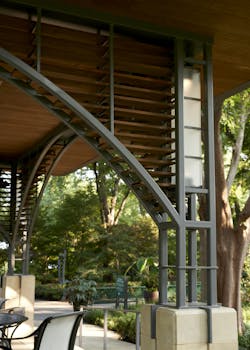
The structural vocabulary translates the region’s mining-town vernacular into a language of parts and pieces: Exposed steel elements with a deliberate laciness combine with timber roof framing in a way that acknowledges both the industrial heritage of the valley and the craft traditions of the pioneers that preceded it. The steel makes no apology for its modernity, and the timber refuses to perform frontier authenticity. Together, the materials establish an architectural dialogue about what this place has been, what it has lost, and what it might yet become.
The apertures that give the pavilion its name are each calibrated to a specific view: the river, the mountain, the aspen groves that ignite into gold every autumn. A visitor who ducks inside to escape a sudden snow flurry finds themselves confronting, almost paradoxically, a more concentrated experience of the landscape than the one available in the open meadow. The building’s fundamental work is to frame and intensify the world beyond its walls, never to compete with that world for attention.
The Slow Work
Our ongoing relationship with the Dallas Arboretum—a collaboration spanning multiple commissions and years—has permitted the kind of sustained design conversation that single-project engagements almost never allow. Each pavilion has built upon the lessons of the one before, and institutional knowledge on both sides has accumulated into something approaching genuine mutual understanding. This slow accretion of trust is the most undervalued resource in contemporary practice.
Fostering Connection + Culture
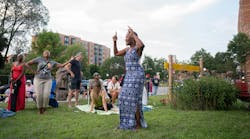
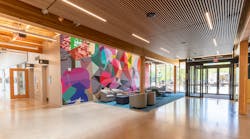
We remind ourselves often at the studio that the beauty of design resides not in the space itself but in what that space makes possible: the picnic unfolding beneath the steel canopy on an October afternoon, the wedding vows exchanged as the light turns golden, the stranger pausing to regard a mountain they have seen a thousand times before, now held inside a frame that renders it somehow unfamiliar and new. Our role as architects and designers is to create the conditions for encounters like these—and then, having done so, to step aside.
In an era seduced by the heroic gesture, this may register as modest ambition; but we have come to regard it as the only ambition capacious enough to be worth pursuing. The wager at the heart of this work is simple: that resilience ultimately depends less on the strength of our materials than on the weight of our care—to the histories we inherit, the landscapes we inhabit, and the communities who will continue gathering in these spaces long after our names have faded from memory.
About the Author
Nicholas McWhirter, AIA, NCARB
Nicholas McWhirter, AIA, NCARB, is design principal and studio head at SHM Architects in Dallas, TX. A registered architect in the States of Texas, Colorado, Georgia, and Montana, McWhirter leads a collaborative studio focused on the concept of total design. He joined SHM in 2015 after a ten-year post as a design and visualization leader at GFF Design in Dallas.
An AIA Dallas award winner, McWhirter is a graduate of Texas A&M University and holds a Bachelor of Environmental Design with a minor in Art & Architectural History. He also earned a Master of Architecture degree from The University of Texas at Arlington in 2005.