Evolution Yields Meaningful Design
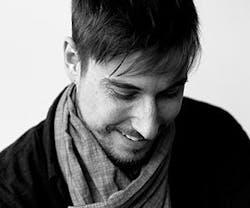
In the last year, one name in design has popped up over and over again, in the best way possible: Todd Bracher. It seemed that the industrial designer was attached to many of the eye-catching pieces dotted around NeoCon. But just as important as his designs, Bracher himself is the embodiment of what to expect from quality products; he’s down-to-earth, thoughtful and deliberate, and opinionated. It is with pride that i+s announces him as the Designer of the Year for 2016.
Growing up as a curious child, Bracher said he always wanted to be a scientist. “I thought [science] was fascinating, and I was always curious about everything. I was always asking a million questions as a kid.” Upon entering college, he wanted to use the medium of illustration to communicate about the world in a meaningful, concise way.
Instead, he was introduced to industrial design which became the lens through which he was able to explore the world. Upon graduating from Pratt in New York City, Bracher jumped on the chance to study in Copenhagen through the Fulbright scholarship. The trip overseas led to his receiving a master’s degree in industrial design, a job with Tom Dixon in London, and years spent traveling around Europe every week. “It was a completely crazy lifestyle I had for a long time, being everywhere at once,” he reflected.
However, the whirlwind experience of those years changed the way in which Bracher designed when he returned to New York. “When I look back, I think about these five countries: Denmark taught me an honesty in work and material in terms of product and how it relates to the user. [In Italy], I feel like it’s completely about poetry. How does this thing get you to fall in love with it? In France, there’s this extreme elegance—a visual beauty attached to it. In England, I felt it was about personality. With Dixon, we were designing him. And then back in America, it’s all about marketing and business, which is interesting. There’s nothing wrong with it, it’s just how it is. So I [put] all of those attributes into what it is that I do.”
The result is fully strategic design. Bracher and his studio—which bears his name—aims to create products which are the result of a thoughtful, scientific process. “I call myself an essentialist, which sounds kind of crazy, but in my mind, being a minimalist means you’re taking away and you’re reducing,” he explained. “What’s essential, to me, is an adding process. You start with zero and then add only what you need. And you keep adding only what you need until you have everything, and you stop.”
He points to natural evolution as an inspiration for this method of design. While unnecessary attributes are eventually removed, evolution started with nothing and continued to add just what was needed. “I’m not saying we should be doing less, but be thoughtful about it, and take the time to make positive evolutions forward, not just generate stuff,” he advised. “For example, you turn on the radio and you hear 50 new songs. Why don’t we just create a handful of new songs, but make sure they’re really good?”
This type of essentialism isn’t without critique, however. This month, Bracher will be participating in the Das Haus 2017 project as part of imm cologne. The project aims to show concepts of the future of home living through the furnishing of a space that is 2,100-plus square feet. “We have very few things in this house, and we’re getting a lot of criticism from the show organizers,” Bracher laughed. “They’re asking why we have eight pieces of furniture, not 2,000 like everyone else. But we don’t need 2,000 pieces of furniture. We don’t need all these things.”
What emerges from a design process which adds only what is needed are products such as the Vessel lighting system Bracher created for Humanscale, and Nest seating for HBF. The Vessel light is ingenious due to how clean it is—the result of approaching the project from a thoughtful, scientific perspective. “I said I need light to start [in one place], and I need it to arrive [in another],” he said. “I described this to a physicist, and he drew up what we needed to achieve that. He said something really beautiful: I asked him, ‘How do you know what this piece will look like?’ and he said, ‘Well, light is 100 percent predictable because it’s physics.’ So we were able to create without a doubt what it needed to be. To me, that’s the perfect type of design.
“I think that’s the future of design—it’s science-based,” Bracher continued. “What does it do to your body, what does it do to your eye, what does it do to the environment? It’s not about the shape or the color or the designer.”
As for approaching the near future of design during an uncertain political climate, Bracher said making positive steps doesn’t have to be a big undertaking. “Just do one thing. Make one contribution. If everybody made just one step, that’s a lot of steps.”
Photography courtesy of Todd Bracher Studio
About the Author
 Kadie Yale
Kadie Yale
Former Editor-in-Chief
Kadie Yale holds a BA in Industrial Design from San Francisco State University and a MA in Decorative Art History and Theory from Parsons the New School. In her role as editor-in-chief from 2015-2018, she led the interiors+sources team in creating relevant content that touches on sustainability, universal design, science, and the role of design in society.