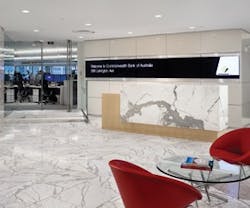
Banking, once a stoic business driven by adding machines and massive stacks of paper, is now, in many ways, an industry driven by cutting-edge technologies. A global monetary system means that financial institutions must be able to close deals, track markets and make trades within seconds, and without any downtime. Anything less means losing one’s competitive advantage, or worse.
That reality was at the front of Richard Kronick’s mind after being commissioned by Commonwealth Bank of Australia to renovate the firm’s New York headquarters, which includes the bank’s international trading floor. Kronick, AIA and principal of Gerner Kronick + Valcarcel (GKV) Architects, was tasked with redesigning the 22,000-square-foot space, as well as ensuring that the bank’s trading operations remained fully operational during the renovation. He in turn hired longtime associate Dennis Ormond, principal of Align Communications, to help install the complex new technology that powers CBA’s New York offices.
“The existing space was in terrible shape,” says Kronick. “They made the commitment to renovate it and we had to keep the facility, including technology, up and running 100 percent of the time. That was probably the hardest part of the job, and Dennis Ormond was instrumental in making sure that it happened. I brought Align into this project because I knew I could trust them with this very tricky situation.”
“It had to be complete, uninterrupted power,” says Ormond. “We installed new CISCO equipment, along with a complete new wiring scheme. We had to get new equipment and run it in tandem with the old room from the carrier services and market data services—Bloomberg and Reuters. We were moving the traders to a new trading floor, so it was an extreme challenge to make sure those platforms would stay live on the old system and then swing over to the new.”
The project began in September 2010 and was completed in two phases to avoid downtime. The solution for the design and technology teams involved numerous weekends and overtime hours to seamlessly transition from the old to new platforms. Phase one included the trading floor, reception area, elevator lobby, several offices and the technology room. Phase two included general office space.
“As Phase 1 was being constructed, the existing computer room had to be in Phase 2 so that it was up and running to provide the infrastructure through the first phase of construction,” says Kronick. “In Phase 1, the new computer room was being built, so the cut-over between the old and new rooms was done on a weekend. We were also moving people who were in the temporary existing space into the newly built space. We bought $25 tables at Staples, put them everywhere and shoved them in tight. Once we achieved Phase 1, we demolished the old computer room and the remaining part of the floor and took down the dividing wall.”
When it came to the redesign of the company’s general office space, Kronick wanted to showcase the people that make CBA’s technology work. “There are 32 traders, and we wanted them seen from the elevator lobby and reception area,” he says. “Twenty-five years ago, a bank would have wanted wood paneling and practical details because they wanted to be perceived as having traditional values. Now, people want to be seen as current and progressive. They want a clean, modern aesthetic. In the old days, you would bury the trading platforms behind walls. Now, if they’re behind a wall, it’s a transparent wall, so that it’s almost used as a sales tool to say ‘We are up front with all of this.’”
GKV redesigned CBA’s elevator lobby, reception area, boardroom, dining room, restrooms and trading floor, adding a hub area with open pantry and Nintendo Wii station (with 55-inch display) so that bank employees can hold meetings or enjoy a break and socialize. The lobby, hub, boardroom and dining area can connect into one large space via sliding walls.
The renovated CBA offices also boast a state-of-the-art boardroom with a 70-inch user-interactive smartboard display built into the wall for audio and video conferencing. The lobby, with its etched glass and silk-screened logos, features five 46-inch LCD screens that connect to create a single-image rack with a feed to software from the data center.
“There’s a wow factor to those screens,” says Ormond. “You walk into a nice, white space with a marble floor that flows into the reception desk and takes your eyes right up to that media wall. Everything is light and bright and quite impressive.”
The trading room features SBFI desks with two to four monitor screens, per each trader’s needs. The monitors are held in place with integrated trading desk arms, which were also designed by SBFI. “They’re easy on and easy off, and very adjustable,” says Ormond.
GKV and Align worked closely with furniture designers to ensure that cabling and power would mount easily into the furniture. Gone are the days of tripping over cords and surge protectors, as everything now wires directly and invisibly. “You have to be conscious of how to incorporate furniture design with the technology,” says Ormond. “There are extreme challenges when you’re wiring open floor plans. You have to core wire into the desks so you can get cable up to them, but in turn you have to design how the furniture is going to accept power and data. That’s not often thought about when you’re talking furniture and technology. It always looks good, but how do you make it work?”
Both Kronick and Ormond agree that the CBA project is a perfect example of how the relationship between design and technology has changed drastically over the years—from oversized, bulky computer monitors being replaced by slim flat-screens, to the considerations that come with properly disposing of and recycling the packaging from equipment and furniture. “You’re always thinking about which materials to use, how to save the customer money, and what’s best for cost effectiveness, power consumption and the environment,” says Ormond.
With computer systems running 24 hours a day, energy efficiency is key. New York City energy codes are very restrictive, says Kronick, and compliance was met via minimal-output light fixtures and LED lighting throughout the spaces.
“You get a lot of light for a little bit of wattage, and that’s a light fixture you’re going to see more and more, because it really works to help maintain our environment,” he says. “That was a major consideration. The windows harvest exterior natural light, and with the transparent spaces, the light from the exterior of the building penetrates all the way to the interior core. That gives you a bonus. It doesn’t cost anything to let the sunlight in.”
SOURCES:
back to top
|
desking & casegoods Touhy Walter P. Sauer | 2, 7 (718) 937-0600 ceilings
|
Decoustics flooring Haworth Infinity Stone and Tile | 5 Interface | 6 |
glass elements Dorma Automatics lighting Newmat | 8 Zumtobel |
seating tables surfacing & graphics Benjamin Moore Signs of Success |
CONTACT:
back to top
|
client project team |
technology consultant mep av consultants lighting consultants |
gkv project team align communications team edwards & zuck team photography |